
There is still no end in sight to Russia’s ongoing invasion of Ukraine, but in recent months perceptions of the war have undergone a dramatic and unmistakable transformation.
For years, most outside observers seemed to view Russian victory as more or less inevitable, with the only real question being how much land and sovereignty Ukraine would be forced to surrender in order to secure peace. Since the start of 2026, however, there has been a striking change in tone. More and more people now believe the tide has turned in Ukraine’s favor, with some even predicting a coming Ukrainian victory.
This shift in perceptions is not the result of any single event. Instead, it reflects growing international awareness that Ukraine has emerged from the crucible of Europe’s largest war since World War II as a major military power with the strength and technological capabilities to counter Putin’s invading army on the battlefield and bring the war home to Russia.
Stay updated
As the world watches the Russian invasion of Ukraine unfold, UkraineAlert delivers the best Atlantic Council expert insight and analysis on Ukraine twice a week directly to your inbox.
The international community has arguably been slow to recognize Ukraine’s evolution from military backwater to regional powerhouse. This process can be traced all the way back to the start of Russia’s invasion more than twelve years ago. In spring 2014, Crimea fell to Russia with only a few isolated pockets of resistance, leaving Putin with the impression that the whole of Ukraine was virtually defenseless. He was not far wrong. As Kremlin forces began seizing towns in eastern Ukraine, the Ukrainian army reportedly had just a few thousand combat-ready troops to call upon.
Ukraine was ultimately saved in 2014 by a grassroots movement of volunteers who formed makeshift battalions to fight off the Russian invasion. This spontaneous popular movement did not succeed in completely liberating the country, but it did stem the tide of Russia’s attack and buy precious time for the authorities in Kyiv to rebuild the army.
This was followed by years of comprehensive military reforms that expanded the Ukrainian army to a strength of several hundred thousand while implementing NATO standards. Ukraine’s revitalized post-2014 military formed the basis of the much bigger army that would take shape eight years later following the onset of Russia’s full-scale invasion.
Since 2022, the Ukrainian military has undergone a further transformation to become one of the most formidable and technologically advanced fighting forces on the planet. Faced with the reality of a national struggle for survival against a far larger and better equipped adversary, Ukraine has rapidly developed new tactics, empowered talented young commanders, and incorporated technological innovations at an often dizzying pace.
Four years on, the Ukrainian army is now a world leader in drone warfare. Ukrainian defense tech companies and their colleagues in the military have developed drones capable of dominating the battlefield, gaining the upper hand in the Battle of the Black Sea, and striking high-value targets located thousands of kilometers inside Russia. On multiple occasions, Ukrainian units have embarrassed their NATO colleagues during military exercises, exposing the gulf in tactical and technical awareness that has opened up since 2022.
Eurasia Center events

Ukraine’s recent reinvention as a military force to be reckoned with is now finally registering on the international radar. Kyiv’s fleet-footed diplomatic outreach to the Gulf states in spring 2026 certainly played a part in this process, with Ukrainian President Volodymyr Zelenskyy’s offer to help combat the threat of Iranian drones forcing many commentators to rethink outdated perceptions of Ukraine as a security burden.
Closer to home, NATO countries are lining up to learn from Ukrainian drone warfare instructors and are seeking to launch joint drone production initiatives with Ukrainian defense tech companies. Meanwhile, stunning images of recent Ukrainian drone strikes on Moscow and St. Petersburg have further underlined the changing military balance of power on Europe’s eastern frontier.
All of this is disastrous news for Russia. When Vladimir Putin launched the full-scale invasion in February 2022, he identified the “demilitarization” of Ukraine as one of two primary war aims. It is now clear that he has failed in spectacular fashion. Indeed, it is difficult to think of a single more self-defeating act of international aggression in modern history. Rather than demilitarizing Ukraine, Putin’s invasion has inadvertently created the heavily militarized enemy state of his worst nightmares.
This places the Kremlin dictator in an extremely difficult position. If he agrees to a compromise peace based on the current status of the war, this would mean accepting the reality of a permanently hostile and militarily powerful Ukraine on Russia’s doorstep. Alternatively, if he chooses to fight on, there is a good chance that Ukraine’s turbo-charged military upgrade will continue along the current trajectory, creating mounting security threats to Russia that could lead to the destabilization of the Putin regime.
For Europe, the rise of the Ukrainian military could not have come at a better time. Faced with an expansionist Russia and a United States administration signaling its intention to reduce its role in transatlantic security, Europeans are feeling more vulnerable than at any point for at least a generation. As nervous policymakers across Europe observe this unfavorable geopolitical landscape, they are increasingly inclined to view Ukraine’s military strength as an indispensable asset.
This makes it highly unlikely that European leaders will abandon Ukraine. On the contrary, they are now more motivated than ever to maintain support for the Ukrainian war effort, while also working to speed up the integration of the country into Europe’s wider security architecture. Ukraine is therefore poised to consolidate its status within the European community as a key security provider and bulwark against Russian aggression. This is exactly the outcome Putin most feared, and it will be all the more painful as he must know it would never have happened without the catalyst of his own criminal invasion.
Peter Dickinson is editor of the Atlantic Council’s UkraineAlert service.
Further reading


The views expressed in UkraineAlert are solely those of the authors and do not necessarily reflect the views of the Atlantic Council, its staff, or its supporters.

The Eurasia Center’s mission is to enhance transatlantic cooperation in promoting stability, democratic values, and prosperity in Eurasia, from Eastern Europe and Turkey in the West to the Caucasus, Russia, and Central Asia in the East.
Follow us on social media
and support our work
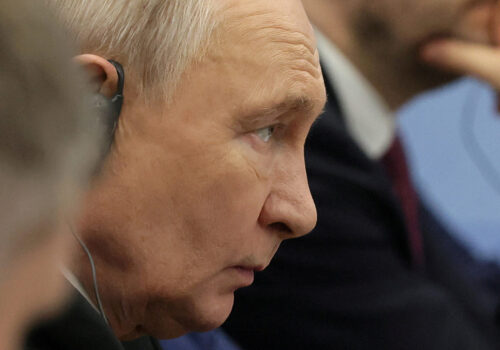
Image: Russia's President Vladimir Putin speaks at a meeting with graduates of higher education institutions of the Defence Ministry, Emergencies Ministry, Federal Security Service, Federal Guard Service, National Guard, Interior Ministry, Investigative Committee and Federal Penitentiary Service in Moscow, Russia, June 23, 2026. (Sputnik/Yuri Kochetkov/Pool via REUTERS)