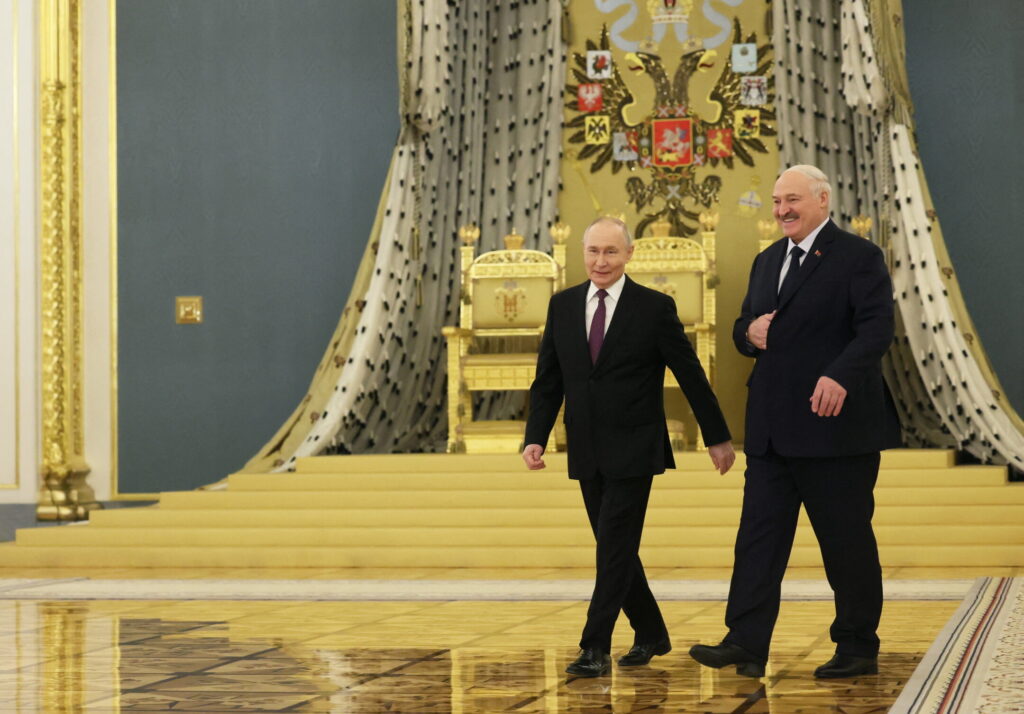
Ukrainian President Volodymyr Zelenskyy recently warned of “unusual activity” on his country’s northern border with Belarus. The Ukrainian leader’s comments came amid reports that Belarus is expanding military infrastructure in the border region. This is fueling speculation that Russia may be planning to open up a new front in the war against Ukraine, and could seek to pressure Belarus into joining the invasion.
Fears of a new Belarusian front are probably overblown, at least for the time being. However, there are clear indications that Russia is steadily expanding Belarusian involvement in the war.
In recent months, Ukraine has accused Moscow of using communications infrastructure located across the border in Belarus to enhance the strike capabilities of Russian drones inside Ukraine. Officials in Kyiv claim this infrastructure is often located close to civilian areas, making it far more challenging to detect and counter.
Meanwhile, the appearance of new military-related infrastructure including training grounds and logistics routes close to the Ukrainian border appears designed to create the conditions for potential future offensive operations. While there is currently no sign of any troop buildup in the border zone, Ukraine is treating these developments seriously and remains acutely aware that Belarus offers the shortest invasion route to Kyiv, a fact that shaped the initial stage of Russia’s invasion in 2022.
Stay updated
As the world watches the Russian invasion of Ukraine unfold, UkraineAlert delivers the best Atlantic Council expert insight and analysis on Ukraine twice a week directly to your inbox.
Speaking on May 4 during a meeting with exiled Belarusian opposition leader Sviatlana Tsikhanouskaya, Ukrainian Foreign Minister Andrii Sybiha warned of what he termed as the growing security threat posed by Russia’s use of Belarusian territory. “Moscow is increasingly dragging Belarus into its war against Ukraine, turning it into a platform for aggression, not only against our country, but against Europe as a whole,” Ukraine’s top diplomat commented.
While Ukraine is expressing alarm about recent activity in Belarus, Kyiv’s concerns are not limited to the latest developments across the border. Belarus increasingly functions as a support base for Russia that helps sustain the war effort in Ukraine. The Belarusian defense industry plays a crucial role supplying components, modernizing weapons systems, and contributing to joint production chains in areas such as electronics, robotics, and fire control. Over time, this is deepening military-industrial integration under Russian direction.
In this context, it is perhaps unhelpful to focus too narrowly on the question of whether Belarus is about to enter the war. Of greater significance at this stage is the steady expansion of the Belarusian role in Russian military aggression against Ukraine and the Kremlin’s hybrid war against Europe. This is in many ways more difficult to identify and harder to deter.
Eurasia Center events

Domestic constraints continue to shape Belarus’s involvement in Ukraine. Belarusian public support for direct participation in the war remains low. This limits Belarusian dictator Alyaksandr Lukashenka’s options. Any attempt to join the invasion of Ukraine could potentially destabilize the political situation inside Belarus and place the survival of the Lukashenka regime under threat. This is well understood in both Moscow and Minsk.
With direct Belarusian military involvement recognized as a high risk option, Lukashenka has so far limited himself to enabling Russia’s invasion through infrastructure and logistics support along with military-industrial integration. This locks Belarus into a hybrid role that stops short of co-belligerent status, while deepening the country’s indirect participation in Russian aggression. For the Kremlin, this approach makes good sense. After all, Belarus is more useful to Moscow in the role of stable support base than as an unstable ally on the battlefield.
For European policymakers, recent developments in Belarus create a different kind of challenge. The risk is not of sudden escalation, but rather of gradual normalization. As Belarus becomes more embedded in Russia’s war effort, incidents linked to its territory, whether drone activity, airspace violations, or other forms of pressure, are likely to become more frequent and harder to interpret. That ambiguity matters. It allows for escalation without clear triggers or any formal entry into the war.
A more proactive approach may be necessary. NATO and the European Union should consider stepping up their efforts to monitor military and dual-use infrastructure inside Belarus, while also expanding intelligence sharing on cross-border incidents and strengthening air defenses. At the same time, sustained engagement with the Belarusian democratic opposition is essential to signal that deeper integration with Russia is not inevitable.
Belarus may not currently be poised to join the invasion of Ukraine, but the country is being dragged deeper into Russia’s war effort. This poses obvious military problems for Ukraine and creates strategic threats that Europe cannot afford to ignore.
Hanna Liubakova is a journalist from Belarus and nonresident senior fellow at the Atlantic Council.
Further reading
The views expressed in UkraineAlert are solely those of the authors and do not necessarily reflect the views of the Atlantic Council, its staff, or its supporters.

The Eurasia Center’s mission is to enhance transatlantic cooperation in promoting stability, democratic values, and prosperity in Eurasia, from Eastern Europe and Turkey in the West to the Caucasus, Russia, and Central Asia in the East.
Follow us on social media
and support our work
Image: Russian President Vladimir Putin and Belarusian counterpart Alyaksandr Lukashenka arrive for a meeting of the Supreme State Council of the Union State of Russia and Belarus, in Moscow, Russia February 26, 2026. Maxim Shipenkov/Pool via REUTERS