Addressing stalled Russia-Ukraine peace talks in early April, US Vice President JD Vance accused both Moscow and Kyiv of “haggling over a few square kilometers of territory.” He then questioned whether this dispute was worth “losing hundreds of thousands of additional Russian and Ukrainian young men.”
Vance’s comments created the impression that the territory in question is of no particular importance, but this could not be further from the truth. At stake is the approximately 20 percent of eastern Ukraine’s Donetsk province that remains under Ukrainian control, which Russia insists must be handed over without a fight as part of any ceasefire agreement. So far, Kyiv has rejected Moscow’s demands, while also complaining of alleged US pressure to withdraw.
At around six thousand square kilometers, the Ukrainian-held portion of Donetsk province is much larger than the “few square kilometers” alluded to by Vance. This territory is also far more militarily important than Vance’s remarks would suggest; indeed, it is probably the most strategically significant land of the entire war.
Stay updated
As the world watches the Russian invasion of Ukraine unfold, UkraineAlert delivers the best Atlantic Council expert insight and analysis on Ukraine twice a week directly to your inbox.
The northern part of Donetsk province contains a heavily fortified area known as Ukraine’s “fortress belt.” This belt stretches for around fifty kilometers and connects the urban centers of Kramatorsk, Slovyansk, Kostyantynivka, and Druzhkivka. Ukrainian efforts to fortify the region have been ongoing for over a decade since the initial phase of Russia’s invasion in 2014.
Ukraine’s fortress belt takes advantage of the region’s favorable topography. It is located on relatively high ground that is ideal for defensive warfare, and incorporates a number of natural barriers including the Siverskyi Donets and Oskil rivers. The belt features an extensive range of trench and bunker networks, minefields, and anti-tank barriers built around multiple urban centers that serve as bastions and logistics hubs for the Ukrainian military.
Based on current battlefield dynamics, most military analysts believe it would take Putin’s army between one and two years to establish full control over the region. Moscow would need to concentrate the bulk of its invasion force for a large-scale offensive, with a series of major battles likely to result in hundreds of thousands of additional Russian casualties.
Eurasia Center events

If Ukraine agreed to retreat from the fortress belt voluntarily, the entire strategic outlook of the war would be transformed. A retreat would not only allow Putin’s troops to advance eighty kilometers deeper into Ukraine; it would also mean forfeiting the single biggest physical barrier to Russia’s invasion.
Following a withdrawal, the Ukrainian military would have to construct new fortifications on the borders of Donetsk province in far less suitable terrain. These defenses would require considerable amounts of time and money to prepare, but would inevitably be weaker than the existing fortress belt due to a lack of high ground and urban density. Meanwhile, Russia would enjoy an elevation advantage and be in a strong position to thrust deeper into central Ukraine.
Ukrainian President Volodymyr Zelenskyy is aware that any decision to withdraw from northern Donetsk would have potentially grave military consequences, and has referred to the area as a “springboard” for future Russian aggression. While advocates of a land-for-peace deal claim territorial concessions are necessary to end the war, Zelenskyy has stressed that any move to hand over the fortress belt would create the conditions for Putin to escalate his invasion.
Critics of the proposed Donetsk handover have also noted the potentially disastrous impact it would have on Ukrainian morale. The Ukrainian military has been defending the fortress belt region for more than twelve years, with thousands of lives lost to prevent Russia from advancing. Surrendering this land to the Kremlin would be a bitter blow that could divide and destabilize Ukrainian society.
Nor is there much confidence in Kyiv that Russia would be satisfied with Donetsk province alone. Ukrainians note that Putin has consistently framed his invasion in far grander terms as a mission to return “historically Russian lands” to Moscow’s control, a vision that almost certainly includes the whole of Ukraine and much else besides. Rewarding Putin with the remainder of the Donetsk region would only encourage these ambitions.
As Russia’s battlefield advances slow, the loss of Donetsk province is not inevitable. Ukrainian forces hold strong positions and are prepared to continue defending the region. Meanwhile, officials in Kyiv reject demands to retreat as both unjust and misguided. They argue that instead of calling on Ukraine to forfeit critical territory, Western leaders should concentrate on pressuring Putin to match Zelenskyy’s earlier acceptance of a proposal to freeze the war along the current front lines.
Marc Goedemans is a Young Global Professional at the Atlantic Council’s Eurasia Center.
Further reading
The views expressed in UkraineAlert are solely those of the authors and do not necessarily reflect the views of the Atlantic Council, its staff, or its supporters.

The Eurasia Center’s mission is to enhance transatlantic cooperation in promoting stability, democratic values, and prosperity in Eurasia, from Eastern Europe and Turkey in the West to the Caucasus, Russia, and Central Asia in the East.
Follow us on social media
and support our work
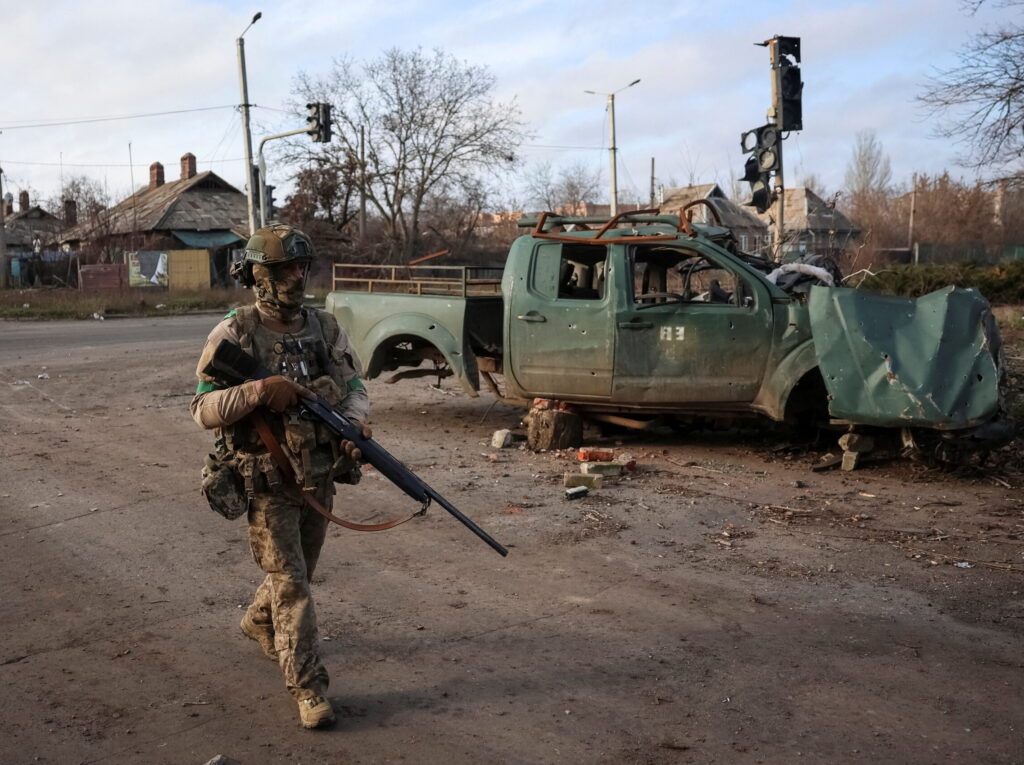
Image: A serviceman of the 49th Separate Assault Battalion Carpathian Sich of the Armed Forces of Ukraine walks on a street, amid Russia's attack on Ukraine, in the frontline town of Kostiantynivka in Donetsk region, Ukraine December 7, 2025. (REUTERS/Anatolii Stepanov)