
With little prospect of any imminent battlefield breakthroughs in the Russia-Ukraine War, the struggle for drone dominance is taking on ever greater importance. Over the past year, Ukraine appears to have regained the initiative in the drone war with an escalating campaign of strikes far behind the front lines that has succeeded in weakening the Russian war machine.
For much of the war, Ukraine’s drone strategy has been focused on short-range and long-range operations with less attention paid to intermediate targets. In practice, this has meant an emphasis on tactical strikes in the combat zone up to twenty kilometers from the front lines, along with headline-grabbing attacks on high-value targets at far greater distances of more than three hundred kilometers. Since the early months of 2025, however, there has been a mounting effort to expand attacks in the middle zone.
Ukraine’s mid-range strike campaign is designed to hit targets in the twenty to three hundred kilometer range including military warehouses, command points, transport hubs, missile complexes, radar systems, and air defenses. The main goal is to undermine the logistics of Putin’s invasion. This means disrupting the supply chains serving front line units of the Russian army, while depleting defenses and opening up the deep rear to attack.
Stay updated
As the world watches the Russian invasion of Ukraine unfold, UkraineAlert delivers the best Atlantic Council expert insight and analysis on Ukraine twice a week directly to your inbox.
Ukraine’s shift in targeting emphasis over the past year reflects the evolution of drone warfare strategy within the country’s military. Since 2024, Ukrainian drone strategists have recognised the need to concentrate strikes on the logistical networks that support Russia’s invasion. Crucially, they have also been able to identify the technical requirements to make this happen.
The appointment of Robert “Magyar” Brovdy as commander of Ukraine’s Unmanned Systems Forces in June 2025 has also proved instrumental in facilitating the recent growth in mid-range strikes. Brovdy has managed to overcome institutional divisions within the Ukrainian military and unite the efforts of different drone units, while also securing the resources for a comprehensive campaign of mid-range strikes.
None of this would have been possible without the necessary hardware. Since late 2024, Ukrainian drone producers have developed a number of models specifically designed for a middle strike campaign. As well as an ability to cover longer distances, these mid-range drones include features such as enhanced navigation, greater resistance to Russian electronic warfare, and the possibility of adjusting trajectory during flight.
Eurasia Center events

Analysis of video footage released by Ukrainian military units indicates that during the twelve-month period beginning in March 2025, Ukraine conducted at least 365 mid-range strikes, or one per day over the course of the year. Almost half of these strikes focused on Russian air defenses, missile complexes, and radar systems. This targeting strategy erodes Russia’s defensive capabilities, setting the stage for bolder air raids.
The methodical destruction of air defense complexes in occupied regions of Ukraine over the past year has been credited with helping to create corridors for long-range Ukrainian strikes against weapons manufacturing facilities and energy infrastructure inside Russia. In other words, mid-range drone strikes are an important element of Ukraine’s long-range bombing campaign.
Ukraine’s mid-range air offensive will not win the war. However, it is a good example of the progress being made by Ukraine as the country gains more experience of drone warfare and adapts accordingly. Ukrainian commanders are clearly receptive to new approaches, while the country’s innovative defense industry is capable of identifying and developing the necessary technical responses to the evolving needs of the battlefield. It is also worth underlining that although Ukraine’s military still relies on international partners for some weapons categories, Ukrainian drones are almost all domestically produced.
The US-Israeli war against Iran has recently shone an international media spotlight on Ukraine’s drone warfare expertise, with Gulf states eager to acquire Ukrainian interceptor drone technologies. Back in Ukraine itself, the world’s first full-scale drone war continues to evolve at a rapid pace with both adversaries innovating on an almost daily basis. While neither side has been able to achieve a decisive advantage, Ukraine’s mid-range strike campaign has allowed Kyiv to regain the upper hand. The challenge now for Ukraine will be to stay one step ahead as Russia responds.
Mykola Bielieskov is a research fellow at the National Institute for Strategic Studies and a senior analyst at Ukrainian NGO “Come Back Alive.” The views expressed in this article are the author’s personal position and do not reflect the opinions or views of NISS or Come Back Alive.
Further reading


The views expressed in UkraineAlert are solely those of the authors and do not necessarily reflect the views of the Atlantic Council, its staff, or its supporters.


The Eurasia Center’s mission is to enhance transatlantic cooperation in promoting stability, democratic values, and prosperity in Eurasia, from Eastern Europe and Turkey in the West to the Caucasus, Russia, and Central Asia in the East.
Follow us on social media
and support our work
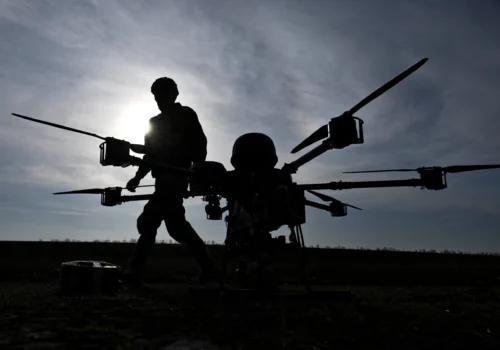
Image: A Ukrainian soldier gets ready to launch a UAS A1-CM Furia drone used for reconnaissance in the Zaporizhzhia direction, Ukraine, on February 22, 2026. (Photo by Dmytro Smolienko/Ukrinform)