
For the past two decades, the St. Petersburg International Economic Forum has served as a stage for Russian President Vladimir Putin to impress foreign guests and showcase his strength. Indeed, the glitzy annual event in Russia’s second city has become so closely associated with the Kremlin dictator that it is routinely referred to as “Putin’s Davos.”
This year’s forum was supposed to be an opportunity for Putin to reset the narrative following months of unfavorable headlines focusing on mounting Russian economic woes and a lack of progress in Ukraine. Multiple American influencers had been recruited to attend, while Chairman of the US Commission of Fine Arts, Rodney Mims Cook Jr., became the first US official in years to visit the forum. Though Cooks noted he was representing the United States as a minister of culture not as a politician.
Things did not go according to plan, however. As delegates prepared to attend the opening of the forum, long-range Ukrainian drones penetrated Russian air defenses and struck a series of targets across St. Petersburg including a major oil terminal and a naval base. Putin’s flagship forum duly began hours later with the city shrouded in smoke from burning energy infrastructure.
It is difficult to overstate quite how embarrassing this must have been for Putin personally. The Russian ruler prides himself on his carefully crafted strongman image, and for the past four years has been at pains to project confidence in the ultimate success of his invasion. And yet he was clearly unable to prevent Ukraine from sending drones over one thousand kilometers through Russian airspace to strike strategically important targets in Putin’s own hometown as he welcomed guests from around the world.
Stay updated
As the world watches the Russian invasion of Ukraine unfold, UkraineAlert delivers the best Atlantic Council expert insight and analysis on Ukraine twice a week directly to your inbox.
The early morning arrival of Ukraine’s “drone delegation” at Putin’s Davos has added to existing concerns in Russia over the country’s vulnerability to Ukrainian airstrikes. Following Wednesday’s attack, many members of Russia’s influential war blogger community accused the Kremlin authorities of failing to prepare properly and predicted further bombardments in the coming months.
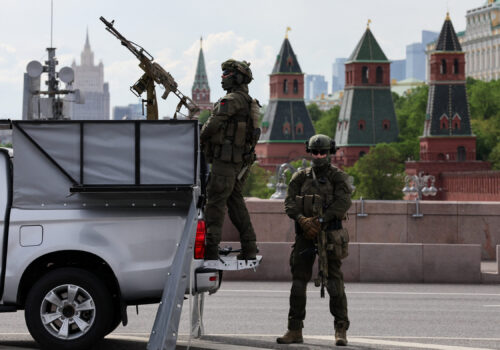
This was the second high-profile episode in a matter of weeks to cast serious doubt on the Kremlin’s ability to defend Russia’s major cities from aerial attack. In early May, Putin took the unprecedented step of dramatically downgrading the traditional Victory Day parade in Moscow, which went ahead without tanks and military hardware due to fears of possible Ukrainian drone strikes.
Putin’s Victory Day humiliation was not limited to the scaled down spectacle on Red Square. In the days before the holiday, he also sparked widespread ridicule by seek help from US President Donald Trump to secure a temporary ceasefire with Ukraine. This show of weakness was not lost on Ukrainian President Volodymyr Zelenskyy, who added to the Russian leader’s discomfort by issuing a spoof presidential decree granting Putin permission to hold his parade.
Eurasia Center events

It is easy to see why Putin is so worried about Ukrainian drones. Since the launch of Russia’s full-scale invasion more than four years ago, Ukraine has built a formidable domestic drone production industry and is now widely recognized as a world leader in drone warfare. In recent months, Ukrainian drones have carried out dozens of attacks deep inside Russia. Targets have included military and industrial facilities, with a particular emphasis on the oil and gas exports that fuel the Kremlin war machine.
Ukrainian long-range drone attacks inside Russia reached record levels during May 2026 according to data from the Russian Defense Ministry, ABC News reports. Meanwhile, following months of Ukrainian strikes on Russian refineries and oil industry hubs, Kremlin officials acknowledged for the first time this week that Russian oil production has fallen since the start of the year.
Russia’s apparent inability to defend itself against Ukraine’s escalating drone offensive is only one of multiple challenges Putin currently faces. His invading army is struggling to advance in Ukraine, and may have actually lost ground during May despite continuing to suffer catastrophic casualties. Behind the front lines, a Ukrainian campaign of mid-range drone strikes on logistics is disrupting Russian military supply networks and threatening to cut off the occupied Crimean peninsula.
These setbacks are leading to a change in mood across Russia, as elites close to the Kremlin and members of the Russian public begin to question whether the time has come to end the war. Russian officials are also warning Putin that the country’s economy is increasingly struggling with the burden of the invasion, amid ballooning military spending and anemic growth.
For now, at least, Putin appears to have little interest in peace and remains fully committed to his original goal of erasing Ukrainian statehood. Nevertheless, it is becoming increasingly difficult to escape the conclusion that Ukraine has turned the tide in the war and may now actually have the upper hand.
The sight of Ukrainian drones flying over Russian cities is the most striking symbol of this shift in the military initiative away from the Kremlin. By menacing Moscow and striking St. Petersburg, Ukraine has succeeded in shattering the myth of Putin’s invincibility, and has demonstrated to the watching world that the Russian dictator is now rapidly losing control of the war. After all, even the Kremlin’s most highly skilled propagandists could not hope to disguise the plumes of black smoke that quite literally overshadowed Putin’s Davos this week.
Peter Dickinson is editor of the Atlantic Council’s UkraineAlert service.
Further reading

The views expressed in UkraineAlert are solely those of the authors and do not necessarily reflect the views of the Atlantic Council, its staff, or its supporters.

The Eurasia Center’s mission is to enhance transatlantic cooperation in promoting stability, democratic values, and prosperity in Eurasia, from Eastern Europe and Turkey in the West to the Caucasus, Russia, and Central Asia in the East.
Follow us on social media
and support our work
Image: Heavy smoke billows after Ukrainian drones hit energy infrastructure, according to local authorities, in St Petersburg, Russia June 3, 2026. Picture taken with a mobile phone. (REUTERS/Stringer)