Russia lost ground in the war against Ukraine during April 2026 for the first time since summer 2024, according to battlefield analysis conducted by the Institute for the Study of War. This is the latest indication in recent months that the tide may be turning against Moscow as Putin’s faltering invasion approaches a fifth summer.
Ukraine’s recent battlefield gains have not come as a result of any innovative new weapons systems or a sudden surge in Western arms deliveries. Instead, they appear to have been enabled primarily by mounting command and communications problems within the Russian military.
Shortly after the first reports of new Ukrainian offensive operations began to emerge in early 2026, US company SpaceX decided to cut the Russian army’s illicit access to the satellite-based Starlink system. Within weeks, Ukrainian forces had advanced ten to twelve kilometers in two separate thrusts on the southern front of the war, recovering territory lost to Russia months earlier.
Communications failures appear to have contributed significantly to Russia’s problems. According to Ukrainian intelligence sources, Russian commanders on the southern front were forced to rely on inaccurate maps showing exaggerated gains, while clusters of Russian troops were deployed to forward positions without adequate communication tools or coordination, leaving them highly vulnerable to Ukrainian counterattacks.
Stay updated
As the world watches the Russian invasion of Ukraine unfold, UkraineAlert delivers the best Atlantic Council expert insight and analysis on Ukraine twice a week directly to your inbox.
Initial Russian attempts to compensate for the loss of Starlink access may have made things worse. In some instances, Russian military units sought to maintain connectivity by switching to large antennae mounted on the rooftops of high-rise buildings. These improvised solutions were visible from many kilometers away and quickly became targets. More recently, reports have begun to emerge of Russian forces receiving new domestically-produced satellite terminals in large quantities.
The Starlink shutdown is not the only communications issue confronting the Russian army in Ukraine. Front line troops are also struggling with the consequences of a Kremlin crackdown on the Telegram messaging app, which has been widely used by Russian military personnel since the start of the invasion and is regarded by many as a crucial communication tool.
The Putin regime began blocking Telegram in early 2026 as part of a more comprehensive campaign to limit internet access across Russia. While these restrictions are thought to be mainly directed at the Russian civilian population, soldiers serving in Ukraine and members of Russia’s vocal pro-war blogger community have also complained of significantly reduced connectivity.
Eurasia Center events

A clear pattern has emerged during the first four months of the 2026, with Ukrainian front line advances consistently accompanied by accounts of Russian informational degradation. In multiple different locations, there have been reports of individual Russian units unable to communicate effectively and Russian commanders incapable of verifying what they are being told. As a result of these breakdowns, Russian forces have repeatedly failed to prevent Ukraine from exploiting vulnerabilities.
Russia’s recent communications problems are unlikely to persist in their current form indefinitely. Steps are already being taken to restore effective comms capabilities through a range of alternatives including relay drones and satellite links. However, it may take a number of years for the Russian military to replicate the same level of efficiency previously provided by Starlink.
The battlefield trends of the past four months should now be taken into account by Ukraine’s international partners as they look to structure their ongoing support. At present, the debate over military assistance continues to be focused on issues such as which drones, how many missiles, and what air defense systems to provide. These questions matter, of course.
But the evidence from early 2026 suggests that capabilities which degrade Russian command and control may generate returns out of all proportion to their cost. This could include electronic warfare systems, cyber tools, communications denial, and shared intelligence feeds that help Kyiv identify when and where the Russian army’s situational awareness is weakest.
Ukraine has demonstrated in recent months that it is more than capable of exploiting communications gaps in Russia’s front line defenses. Kyiv’s allies should now seek to prioritize the tools that will identify and exacerbate these weak points. Ideally, this should be done in a timely fashion before Russia is able to implement solutions to reduce vulnerabilities and potentially regain the battlefield initiative.
Miro Sedlák is an associate research fellow at the Institute for Central Europe and a security and defense studies doctoral candidate at Slovakia’s Armed Forces Academy of General M.R. Štefánik.
Further reading

The views expressed in UkraineAlert are solely those of the authors and do not necessarily reflect the views of the Atlantic Council, its staff, or its supporters.


The Eurasia Center’s mission is to enhance transatlantic cooperation in promoting stability, democratic values, and prosperity in Eurasia, from Eastern Europe and Turkey in the West to the Caucasus, Russia, and Central Asia in the East.
Follow us on social media
and support our work
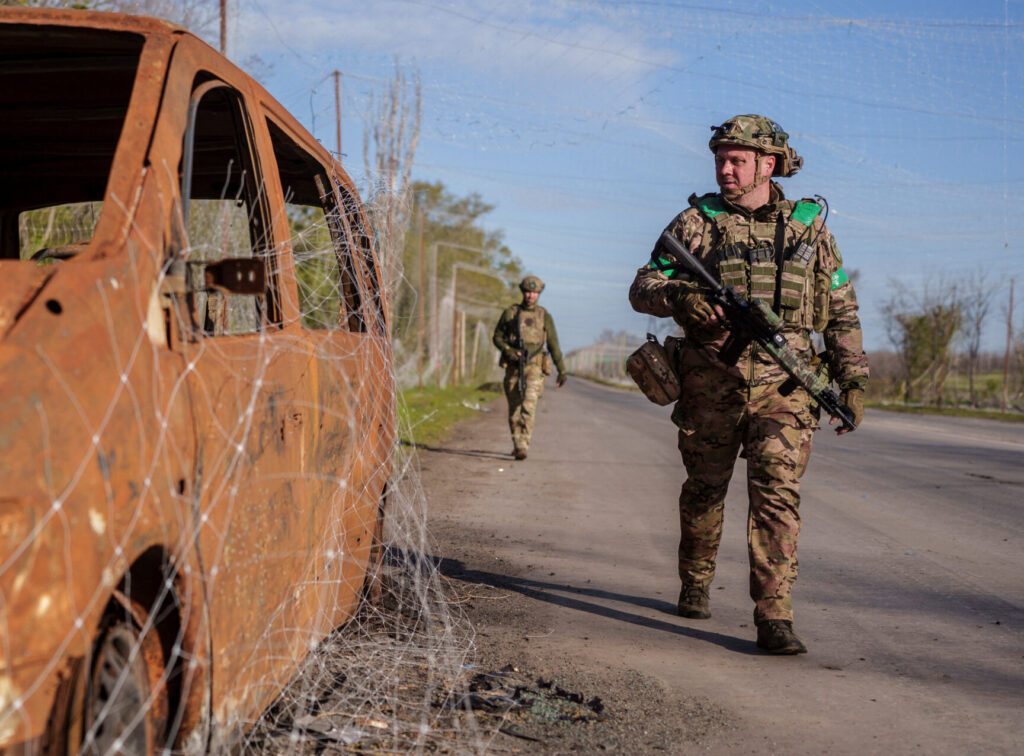
Image: Servicemen of the consolidated Brigade 'Khyzhak' of the Ukrainian Patrol Police Department walk along a street under an anti-drone net as they take part in a mission to protect streets from Russian drones near the frontline town of Druzhkivka, amid Russia's attack on Ukraine, in Donetsk region, Ukraine. April 28, 2026. (REUTERS/Serhii Korovainyi)