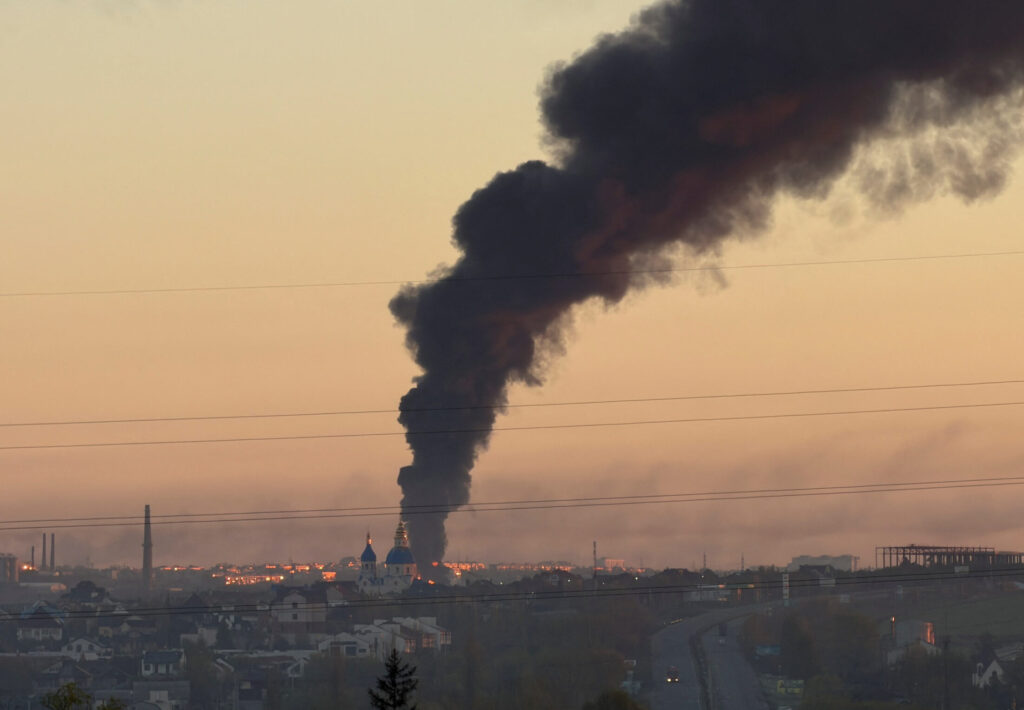
As Russia’s full-scale invasion of Ukraine approaches a fifth summer, the tide may be turning against the Kremlin. In recent months, Russian troops have advanced at their slowest pace since 2024, according to international analysis. At the same time, Russian losses remain exceptionally high, based on video evidence cited by Ukrainian officials.
Meanwhile, Ukrainian long-range strikes deep inside Russia have escalated dramatically, causing significant damage to defense industries and Moscow’s economically vital energy exports. Faced with this deteriorating situation, there are indications that the Kremlin may now increase attacks on Ukraine’s civilian population and the country’s critical infrastructure.
Russia’s current military priority remains completing the occupation of eastern Ukraine’s Donetsk province. In order to achieve this objective, Russian forces will have to overcome Ukraine’s formidable fortress belt of defenses in the region. Based on the experience of the past four years, this could take twelve months or longer and result in hundreds of thousands of additional Russian casualties.
Putin has reportedly set a deadline of September 2026 for the conquest of the approximately 20 percent of Donetsk province still in Ukrainian hands. Given the current battlefield dynamics, this looks wildly optimistic. It is no surprise, therefore, that Moscow continues to insist that Ukraine hand over this strategically important territory without a fight as part of any ceasefire deal.
Ukraine has consistently ruled out the idea of retreating from the Donetsk region. Kyiv’s confidence reflects the increasing effectiveness of the country’s drone-based defenses, along with the impact of an ongoing mid-range air offensive targeting Russian logistics hubs, air defenses, and ammunition depots far behind the front lines of the war.
Stay updated
As the world watches the Russian invasion of Ukraine unfold, UkraineAlert delivers the best Atlantic Council expert insight and analysis on Ukraine twice a week directly to your inbox.
With little hope of achieving decisive battlefield results during the coming summer season, Russia is expected to further escalate ongoing efforts to break Ukraine’s resistance by targeting the civilian population.
Russian attacks on Ukrainian civilians has been gaining momentum for some time, with civilian casualties surging by 31 percent in 2025, according to the UN Human Rights Monitoring Mission in Ukraine. The latest United Nations data points to a further recent intensification of Russian attacks, with the number of Ukrainian civilians killed or wounded in March 2026 up 29 percent year-on-year.
There are now concerns in Kyiv that Russia will likely expand its aerial campaign against Ukrainian cities and critical civilian infrastructure with a summer offensive targeting Ukraine’s energy network, water utilities, ports, and railways. In recent months, Russian strikes on Ukrainian trains and transport hubs have increased significantly.
Moscow’s goal is to disrupt daily life in wartime Ukraine, undermine the economy, mentally exhaust the Ukrainian public, and spark social unrest. Russia’s repeated attacks on electricity substations and grid stability also increase the pressure on Ukraine’s nuclear power plants, raising the risk of potential nuclear safety hazards. The Kremlin sees these attacks on the civilian population as a way of breaking the battlefield deadlock and pushing Kyiv to capitulate.
Eurasia Center events

The threat of escalating attacks on Ukraine’s civilian population is regarded as particularly severe due to surging global demand for Patriot air defense missiles as a result of the US-Israeli war against Iran. With more countries now competing for limited supplies of interceptor missiles, there are fears that Kyiv’s modest stocks could soon be exhausted.
While the Ukrainian military has made substantial progress in countering Russian drones, defending against ballistic missile attacks remains far more challenging. If Ukraine runs out of Patriot interceptors, the country’s cities and civilian infrastructure would be virtually defenseless against ballistic strikes.
This makes stronger European support for Ukraine’s air defenses absolutely critical. Some EU member states are already leading the way. In recent weeks, Germany announced a nearly $5 billion military support package for Ukraine, including several hundred missiles for Patriot air defense systems and 36 IRIS-T launchers.
Meanwhile, the Ukrainian military is increasingly acting as a security partner, offering its battlefield experience, drone expertise, and real-time combat data as strategic assets for Europe’s security architecture. In recent months, Kyiv has begun pushing for the deeper integration of Ukrainian and European air defense efforts. Ukrainian President Volodymyr Zelenskyy has gone further, calling on Europe to establish its own anti-ballistic missile system.
Efforts to protect Ukraine’s civilian population will be aided by the recent agreement to unblock a €90 billion EU loan for Kyiv. Zelenskyy has confirmed that the first tranches of this financial lifeline will be used to strengthen the country’s air defenses and protect infrastructure.
This is encouraging news for Ukrainians, but the civilian population remains highly vulnerable to attack. The effectiveness of Russia’s summer bombing campaign will depend on whether Ukraine and its Western partners are able to scale up the country’s air defenses in time, while also addressing potential supply shortages resulting from the ongoing war in the Middle East.
Maksym Beznosiuk is a strategic policy analyst whose work focuses on Russia, Ukraine, and international security. He is an associate fellow at GLOBSEC. William Dixon is a senior associate fellow of the Royal United Services Institute and an associate fellow at GLOBSEC. He specializes in cyber and international security issues.
Further reading

The views expressed in UkraineAlert are solely those of the authors and do not necessarily reflect the views of the Atlantic Council, its staff, or its supporters.


The Eurasia Center’s mission is to enhance transatlantic cooperation in promoting stability, democratic values, and prosperity in Eurasia, from Eastern Europe and Turkey in the West to the Caucasus, Russia, and Central Asia in the East.
Follow us on social media
and support our work
Image: Smoke rises in the city after a Russian drone and missile strike, amid Russia's attack on Ukraine, in Dnipro, Ukraine April 25, 2026. Picture taken using a mobile phone. (REUTERS/Serhii Chalyi)