
Ukrainians have taken to the streets in recent weeks to voice their concerns over the sudden removal of the country’s reformist defense minister. Rolling protests in Kyiv and cities across Ukraine have sparked the biggest political crisis since the start of the full-scale war and have highlighted the continued strength of the Ukrainian population’s democratic instincts.
The remarkable readiness of ordinary Ukrainians to defend their rights and hold their elected officials accountable in the midst of a national fight for survival is one of the most striking differences between modern Ukraine and Russia. It is also a key reason why Russian President Vladimir Putin is so determined to extinguish Ukrainian independence once and for all.
Nationwide protests began on July 15 in response to the dismissal of Ukraine’s innovative young defense minister Mykhailo Fedorov as part of a major government reshuffle. During his six months at the helm of the defense ministry, thirty-five-year-old Fedorov had helped Ukraine regain the battlefield initiative against Russia by enhancing the country’s drone warfare capabilities, while also taking steps to combat deeply entrenched corruption within the defense sector.
This brought Fedorov into increasingly open confrontation with the commander in chief of the Ukrainian army, sixty-year-old Oleksandr Syrskyi, who is widely seen as a key member of the country’s old guard shaped by Soviet-era thinking. Critics warned that Ukrainian President Volodymyr Zelenskyy’s decision to remove Fedorov could undermine the war effort, with many accusing him of choosing the past over the future.
The response to Fedorov’s dismissal was almost immediate. Within hours, thousands had gathered at makeshift protests in the heart of Kyiv and throughout Ukraine. The crowds included large student contingents along with military veterans, rights activists, and civic-minded citizens. These rallies were peaceful but determined, with participants stressing that they were undeterred by the ever-present threat of Russian bombardment and would continue protesting until they were heard.
Meanwhile, Ukrainian society as a whole was actively debating the removal of Fedorov online and throughout the country’s diverse media landscape. This included plenty of outspoken criticism from anti-corruption activists, the volunteer community, and members of the military, along with reported opposition from within Zelenskyy’s own political party. Many argued that although unity is vital in wartime, they could not remain silent while the fate of the nation was at stake.
Stay updated
As the world watches the Russian invasion of Ukraine unfold, UkraineAlert delivers the best Atlantic Council expert insight and analysis on Ukraine twice a week directly to your inbox.
The scale of the public backlash over the removal of Fedorov appears to have initially taken Zelenskyy by surprise. However, he soon grasped the severity of the situation and began signaling a desire to reach some form of compromise. Days after the protests broke out, Zelenskyy announced the appointment of popular young general Myhkailo Drapatyi as the new commander in chief of the Ukrainian army. This move was widely welcomed as a long-overdue generational shift in the country’s military leadership that reflected the demands of protesters.
Zelenskyy has also offered Fedorov a number of potential new positions in government that would allow him to remain part of the country’s leadership while focusing on the technological aspects of the war effort. For now, though, the former defense minister has rejected possible alternative roles and is insisting on a return to his previous post.
It is not yet clear how the political drama in Kyiv will play out, but the crisis has already served to underline the vibrancy of wartime Ukraine’s civil society. Despite the impossibility of holding elections in the current security environment, the country’s democratic political culture is clearly very much intact.
This powerful demonstration of Ukrainian grassroots democracy has drawn considerable praise from Western commentators, but has been greeted with far less enthusiasm in Moscow. Russia’s negative reaction is hardly surprising. For Putin and his Kremlin colleagues, the recent people power protests in Ukraine are an uncomfortable reminder of why they invaded the country in the first place.
Eurasia Center events
Putin’s fear of people power can be traced back to his Cold War experience as a young KGB officer in 1980s East Germany. During this period, he personally witnessed the rapid disintegration of the Soviet Union’s European empire as the captive populations of the Eastern Bloc rose up and turned away from Moscow. Within a few years, the USSR itself had ceased to exist.
The Soviet collapse was the formative event of Putin’s political career, leaving him with a lifelong hostility toward popular uprisings and pro-democracy movements of all kinds. This deep-seated distrust of grassroots democracy has long fueled Putin’s Ukraine obsession. It is no coincidence that the Russian dictator’s efforts to subvert Ukrainian statehood first began to dominate his reign in the aftermath of the 2004 Orange Revolution, a multi-million strong protest movement against a rigged election that marked post-Soviet Ukraine’s big democratic breakthrough.
Ever since the Orange Revolution, Putin has treated Ukraine’s fledgling democracy as an existential threat, viewing it as a potential catalyst for the next stage in a Russian retreat from empire that began in 1989 with the fall of the Berlin Wall. He has become fixated with the idea of destroying Ukraine, branding the country an artificial “anti-Russia” that could no longer be tolerated.
Initially, Putin attempted to subvert Ukrainian independence by undermining the country through a combination of political, economic, and cultural interference. Huge sums of money were invested in pro-Kremlin political parties, business ventures, media outlets, and religious initiatives, all with the aim of weakening Ukraine from within and discrediting the country’s efforts to join the community of European democracies.
When this approach backfired and provoked a second people power revolution, Putin opted to escalate further. In spring 2014, he ordered direct military intervention in Crimea and launched an undeclared war in eastern Ukraine. This set the stage for the full-scale invasion eight years later.
Today’s war is a continuation of the anti-Ukrainian policies that have been consistently advanced by Putin since the mid-2000s. For more than two decades, he has demonstrated his readiness to sacrifice Russia’s national interests and international standing in order to prioritize the subjugation of Ukraine. He has done so primarily because he believes the consolidation of a democratic, European Ukraine could prove fatal for his own authoritarian empire.
Despite frequent boasts of Putin’s popularity, the Russian dictator is well aware that his grip on power is far less secure than the propaganda machine suggests, hence his ruthless suppression of all possible domestic opposition. Having already seen one Kremlin empire overthrown in his lifetime by people power, Putin is utterly determined to prevent a repeat.
Ukrainian democracy is far from perfect, of course. For decades, it has been blighted by a lack of ideological principles that has often reduced elections to popularity contests, while oligarch interference and endemic corruption have remained major issues. Nevertheless, the Ukrainian population’s ability to influence the country’s political classes is undeniable and terrifies the Kremlin.
The recent wave of protests in Ukraine would be unthinkable in today’s Russia, but Putin remains fearful that Ukrainian courage could eventually prove contagious. This helps to explain why he has rejected a number of peace proposals that would end the invasion while securing Russia’s territorial gains.
While such terms may at first glance appear generous, any compromise peace deal would also oblige Putin to accept the geopolitical reality of an independent and democratic Ukraine on Russia’s border. This would be seen by many in Moscow as a defeat of historic proportions with potentially dire consequences for Russia itself. It is therefore futile to seek some kind of negotiated settlement with Putin. Instead, the only realistic option for Ukraine and the country’s allies is to pursue peace through strength.
Peter Dickinson is editor of the Atlantic Council’s UkraineAlert service.
Further reading


The views expressed in UkraineAlert are solely those of the authors and do not necessarily reflect the views of the Atlantic Council, its staff, or its supporters.
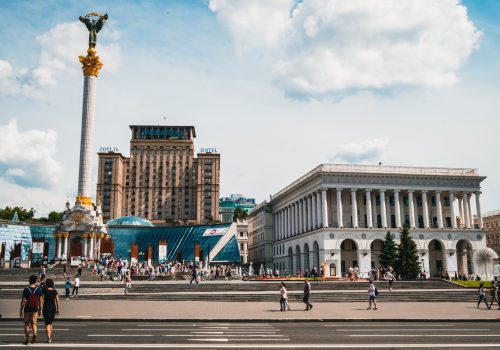

The Eurasia Center’s mission is to enhance transatlantic cooperation in promoting stability, democratic values, and prosperity in Eurasia, from Eastern Europe and Turkey in the West to the Caucasus, Russia, and Central Asia in the East.
Follow us on social media
and support our work
Image: People sing the national anthem during a protest demanding the reinstatement of Mykhailo Fedorov as defence minister and calling for the resignation of Commander in Chief of the Ukrainian Armed Forces Oleksandr Syrskyi, amid Russia's attack on Ukraine, in Kyiv, Ukraine. July 20, 2026. (REUTERS/Thomas Peter)