
Ukrainian Energy Minister Denys Shmyhal has warned that Moscow is likely to expand attacks on the country’s civilian population and critical infrastructure in the coming months as Russian President Vladimir Putin seeks to finally break Ukraine’s resistance.
“Russia’s goal now is to destroy our water supplies,” commented Shmyhal in an interview with Politico this week. “Last winter they targeted electricity and heating, but you could still survive if you had gas and water during electricity shutdowns. It is difficult to survive for more than three days without water.”
This grim forecast highlights Ukraine’s predicament as the country prepares for a fifth wartime winter amid mounting air defense shortages and escalating Russian bombardment. Russia is ramping up missile production as the Kremlin seeks to exploit Ukraine’s air defense deficit, leading to record numbers of cruise missile and ballistic missile strikes in recent months.
Ukraine is heavily dependent on the US-made Patriot air defense system to intercept Russian ballistic missiles. However, growing demand in the Middle East and limited American production mean the United States is currently unable to provide Ukraine with the quantity of interceptors needed to match Russia’s increased output. With plans to allow Ukraine to make Patriot missiles struggling to advance, this gap will not close soon.
Ukraine’s growing vulnerability to Russian ballistic bombardment is all too evident. During a recent large-scale attack on August 1, Ukrainian air defense crews only managed to intercept one of twenty-seven Russian ballistic missiles due to a lack of ammunition. “It is this shortage of ballistic missile interceptors that only encourages Russia to launch such attacks that take human lives,” commented Ukrainian President Volodymyr Zelenskyy.
The arithmetic of the air war is clearly trending in Russia’s favor. In July, Moscow launched twice as many ballistic missiles and cruise missiles as it fired during the previous month. This has been possible thanks to the Kremlin’s strategic focus on increased missile output, with production facilities located deep inside Russia and protected by some of the country’s densest air defense networks. While exact figures are not available, the expansion of Russia’s air strike campaign underlines Moscow’s ability to produce more missiles.
Stay updated
As the world watches the Russian invasion of Ukraine unfold, UkraineAlert delivers the best Atlantic Council expert insight and analysis on Ukraine twice a week directly to your inbox.
Russia’s emphasis on expanded missile volumes is part of Putin’s plan to bomb Ukraine into submission. Faced with a lack of progress and uncertain prospects on the battlefield, the Kremlin dictator is increasingly betting on the mass bombardment of Ukrainian cities and civilian infrastructure to render much of the country unlivable and force Kyiv to capitulate.
This Russian bombing campaign has ebbed and flowed throughout the full-scale invasion. It is now expected to intensify as winter draws closer. The coming cold season looks set to develop into a contest pitting Russia’s expanded missile production base against Ukraine’s increasingly overstretched air defenses and the country’s limited infrastructure repair capacity.
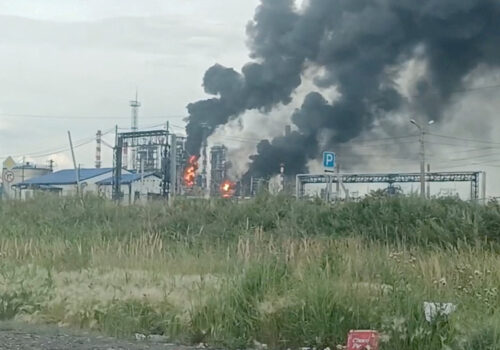
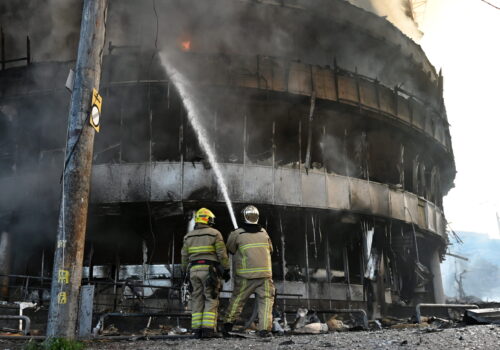
Russian targets in Ukraine now include energy production sites and elements of the country’s transport infrastructure. Since January 2026, Moscow has carried out more than 250 attacks on facilities belonging to Ukrainian energy giant Naftogaz as part of a sustained campaign to reduce domestic gas production. Ukraine’s railway transport network has also been targeted with a series of strikes on stations, maintenance facilities, and individual trains. In recent months, around 250 Ukrainian gas stations in front line regions have been hit.
Eurasia Center events

With the beginning of the winter season now just a few months away, Ukraine is calling on the country’s Western partners to urgently step up deliveries of air defense ammunition, including Patriot system interceptors. However, even increased supplies are unlikely to prove sufficient. In order to counter the Russian aerial threat effectively, Ukraine also requires greater long-range strike capabilities to target Russian missile production and launch sites.
This can be achieved by providing Ukraine with Western-made long-range weapons and targeting data. Additional funding to support the expanded production of domestically developed Ukrainian systems such as the Flamingo cruise missile is also vital. Meanwhile, Zelenskyy has recently highlighted the need to close the sanctions gap and target Russian companies involved in the production of ballistic missiles.
Until Kyiv has the strike capabilities to consistently reach Russian missile launch sites and production facilities, Ukraine and the country’s Western partners will remain on the losing side in the current air war. The Kremlin has spent the past four years building a missile production base designed to outpace Western responses and overwhelm Ukraine’s limited defenses. The coming winter will reveal whether this strategy can prove decisive.
Maksym Beznosiuk is a strategic policy analyst whose work focuses on Russia, Ukraine, and international security. He is an associate fellow at GLOBSEC. William Dixon is a senior associate fellow of the Royal United Services Institute and an associate fellow at GLOBSEC. He specializes in cyber and international security issues.
Further reading

The views expressed in UkraineAlert are solely those of the authors and do not necessarily reflect the views of the Atlantic Council, its staff, or its supporters.

The Eurasia Center’s mission is to enhance transatlantic cooperation in promoting stability, democratic values, and prosperity in Eurasia, from Eastern Europe and Turkey in the West to the Caucasus, Russia, and Central Asia in the East.
Follow us on social media
and support our work
Image: Municipal employees remove debris next to a crater that appeared after Russian missile strikes, amid Russia's attack on Ukraine, in Kyiv, Ukraine July 11, 2026. (REUTERS/Valentyn Ogirenko)