Content

Issue Brief

Sep 7, 2016

Water dispute escalating between Iran and Afghanistan

By Fatemeh Aman

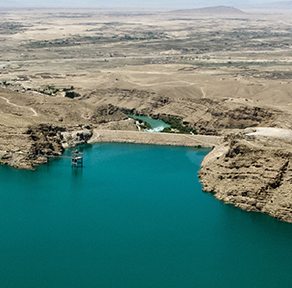
Iran and Afghanistan have no major territorial disputes, unlike Afghanistan and Pakistan or Pakistan and India. However, a festering disagreement over allocation of water from the Helmand River is threatening their relationship as each side suffers from droughts, climate change, and the lack of proper water management. In “Water Dispute Escalating Between Iran and Afghanistan,” […]

Issue Brief

Sep 6, 2016

Exploring US engagement in the Middle East: A crisis simulation

By Rex Brynen

With the current American election campaign and change in presidential administrations due in January 2017, the debate over appropriate levels of US engagement in an unstable Middle East assumes vital importance. Should a new administration be more proactive in seeking to address threats, resolve conflicts, support allies, and deter foes? Should the new US president […]

Middle East

Issue Brief

Jul 14, 2016

Bahrain’s inconvenient truths

By Bilal Y. Saab

Bahrain has been in the political doghouse in Washington ever since its government crushed Arab Spring-inspired popular protests in February 2011, leading to a political crisis between the government and the opposition that has deepened over the past few weeks. So, it was not surprising when the Bahraini government justified its latest crackdown against Al […]

The Gulf

Issue Brief

Jul 6, 2016

The Future of Brazilian Politics: Where We Place Our Bets

By Ricardo Sennes and Andrea Murta

In the midst of Brazil’s current political earthquake, projecting the future of power and politics in the country is an uncertain endeavor. But the Adrienne Arsht Latin America Center is taking that chance. The Center has engaged one of Brazil’s top thinkers, our nonresident senior Brazil fellow and economist Ricardo Sennes, to analyze what current […]

Brazil

Issue Brief

Jul 5, 2016

Updating NATO’s maritime strategy

By STEVEN HORRELL, MAGNUS NORDENMAN, WALTER B. SLOCOMBE

On the eve of the 2016 Warsaw Summit, NATO faces a new and challenging security environment dominated by a revanchist Russia increasingly willing to challenge the West and turbulence and violence across the Mediterranean’s southern rim. In this new security environment, the maritime domains around Europe are potential friction zones and where these challenges increasingly […]

Europe & Eurasia Maritime Security

Issue Brief

Jun 15, 2016

Brexit: What’s at stake for US security interests?

By WALTER B. SLOCOMBE

On June 23, 2016, a referendum will decide whether Britain will leave the European Union (EU) or remain a member. Britain’s departure from the EU would affect the rest of the world, because it would have implications for a broad spectrum of international concerns–very importantly, international security. For the United States, Britain remains among the […]

NATO Security & Defense

Issue Brief

Jun 3, 2016

A US strategy for building defense and deterrence in the Baltic states

By DAMON WILSON AND MAGNUS NORDENMAN

Since the start of the Ukraine crisis, the Baltic States have come into sharp focus as a key friction zone between a much more assertive Russia on the one hand, and the United States, NATO, and the broader transatlantic community on the other. NATO and the United States have made promising first steps to better […]

NATO Northern Europe

Issue Brief

Jun 3, 2016

Countering Russian aggression in Eastern Europe

By JONATHAN P. DUNNE

The past decade has witnessed a marked increase in Russian aggression and assertiveness. Many Eastern European nations, the Baltic States in particular, have recognized this disturbing and fundamental change in the European security environment and are responding both nationally and multilaterally. In “Countering Russian Aggression in Eastern Europe,” Jonathan P. Dunne, the Scowcroft Center’s US […]

Eastern Europe NATO

Issue Brief

May 26, 2016

Cyber, extended deterrence, and NATO

By Franklin D. Kramer, Robert J. Butler, and Catherine Lotrionte

Cyber is relevant in conflict as well as in lesser circumstances such as espionage and crime. This paper focuses on a conflict, both conventional and hybrid, with an adversary, such as Russia, that has advanced cyber capabilities (Tier V/VI as designated by the Defense Science Board) and includes a conflict with an improving, but less capable nation-state such as Iran.
Cybersecurity Europe & Eurasia

Issue Brief

May 11, 2016

Will Iran’s Human Rights Record Improve?

By Barbara Slavin

Read the Publication (PDF) In the aftermath of the Joint Comprehensive Plan of Action (JCPOA), a major question has been whether the landmark nuclear deal would have any impact on Iran’s other policies, including its record on human rights. While US President Barack Obama’s administration stressed that in negotiating the JCPOA its focus was on […]