So what’s the strategy for Iran?
In this episode, host Matthew Kroenig is joined by Alex Gray, a nonresident senior fellow at the Scowcroft Center, to discuss the ongoing war with Iran and how to understand Washington’s strategy for victory. Alex was chief of staff at the National Security Council during the first Trump administration and was in that role when US President Donald Trump oversaw the military operation that killed Iranian General Qasem Soleimani.
Listen to So What’s the Strategy wherever you get podcasts



About the podcast
Host Matthew Kroenig, vice president and senior director of the Atlantic Council’s Scowcroft Center for Strategy and Security, sits down with senior US and allied officials and leading experts to explore the strategies shaping today’s most pressing global security challenges. Inspired by General Brent Scowcroft, who famously asked his team “So what’s the strategy?” the series dives into how leaders think about power, policy, and the decisions shaping the future of international security. Watch and listen wherever you get your podcasts.
Transcript
Read the full episode transcript below
Expand to read
Alex Gray:
Strategically, what I would say is I think the president has a much grander vision of how that limited operation fits into American grand strategy. My sense is what the president’s looking at here more holistically is he’s tired and he’s tired of having his successors potentially forced into an endless whack-a-mole game with the Iranian regime.
Matthew Kroenig:
Welcome to, “So what’s the strategy?” I’m your host, Matthew Kroenig. In today’s episode, we’ll focus on the US military campaign in Iran. Does the Trump administration have a coherent strategy? To discuss this topic, we’re very fortunate to be joined by Alex Gray. Alex is a non-resident senior fellow at the Scowcroft Center at the Atlantic Council. He’s also the CEO of American Global Strategies. And in the first Trump administration, Alex served as chief of staff to the National Security Council staff where he oversaw the daily operations of the National Security Advisor’s office and provided critical guidance as the president sought to respond to major security crises. The security crises, of course, also included policy toward Iran and Alex was at the NSC at the time that the Trump administration conducted the military operation to take out Iranian general Qassem Soleimani. So Alex is an ideal guest to help us understand how the Trump administration is likely thinking through its current strategy toward Iran.
Matthew Kroenig:
Former National Security Advisor General Brent Scowcroft used to challenge his team with a simple question, “so what’s the strategy?” What do you want to do and how are you going to do it? That’s the focus of this show on So what’s the strategy? We talk with senior government officials and leading experts about the strategies for addressing the most important security challenges facing the United States and the world. Let’s get started.
Matthew Kroenig:
Alex, welcome to “So what’s the strategy?”
Alex Gray:
Thanks for having me, Matt.
Matthew Kroenig:
So we’re here today to talk about strategy for Iran with the US military ongoing military campaign. And unlike most of us, you spent time in the Oval Office with President Trump, including during some pretty tense moments with Iran. You were in office at the time of the Soleimani strikes. So I think you probably have insights into Trump’s strategy that maybe the rest of us don’t have. And it seems like the prevailing media narrative has been that Trump doesn’t have a strategy, that the administration’s messaging is inconsistent and the president’s not quite sure what he’s trying to achieve. Is that right? Or if not, what is the strategy for Iran?
Alex Gray:
Yeah, I definitely disagree with that presumption that I’ve heard quite a bit of in the media. I think we have to look at this in a couple of different dimensions. I mean, the first dimension is I think post Iraq war, there was this kind of unhelpful binary in the US foreign policy conversation that essentially said either you go in with an overwhelming ground force and you nation build and you topple regimes and you spend many years doing counterinsurgency or you do nothing. And there was the straw man that was kind of built into all of our foreign policy debates. And the president, I think being the least ideological commander in chief we’ve had in a very long time, the most pragmatic, just rejects fundamentally the idea that there is these two just totally artificial polar strawmen in the foreign policy toolkit. And so what he’s opted to do is this, what I would call a very surgical, bounded, limited duration operation with what I think are three specific operational objectives, right?
Take out the terrorist proxies, nuclear program, and the missile program. And strategically what I would say is I think the president has a much grander vision of how that limited operation fits into American grand strategy. My sense is what the president’s looking at here more holistically is he is tired and he’s tired of having his successors potentially forced into an endless whack-a-mole game with the Iranian regime. We are sixteen years on Matt from Hillary Clinton’s pivot to Asia speech. I think most of us acknowledge that ultimately the century will be defined by what happens in the Indo-Pacific. If we keep playing whack-a-mole with the Iranian regime for the next twenty years, that pivot will never operationalize. And I think the president has changed the paradigm here for use of force with the purpose of finally ending the whack-a-mole and being able to disengage from the region that he’s pretty eloquently said is not our key priority, but we can only do that if we can take out the head of the snake.
Matthew Kroenig:
Well, that was a clear and comprehensive way to start, and I want to dig into several items there. And so first on the objectives. So you said the objectives are degrading the nuclear program, the missile program, the terror proxy network. And if you do go back to the first speech the Saturday after the operation started, the president did mention all of those things. So I’m like you a little puzzled that people keep saying we don’t know what we’re trying to achieve, but what about regime change? Is governance of Iran and new government in Tehran part of the president’s goals or because he has talked about that, he’s talked about how the supreme leader’s son is not acceptable. How do you see domestic governance in Tehran fitting into the strategy?
Alex Gray:
Yeah, I mean this is where I think the president’s left himself a good deal of wiggle room and I think it’s a helpful strategic ambiguity. The p resident I think understands that the operational focus that you and I have laid out, navy drones, missiles, nukes proxies, that’s very important. But ultimately capability is less important than intent. And ultimately, as long as you have the clerical regime or a supreme leader and an inner coterie who are committed to reconstituting those capabilities, ultimately we play whack-a-mole again. So I think with the president, I like to say the president I think is personality agnostic. He’s somewhat regime agnostic as long as the people who follow Ayatollah Khamenei are people who are willing to play ball with the United States. I think it’s on a kind of grander scale. I think what the president’s looking for is something approximating the Delcy Rodriguez strategy in Venezuela where you find whether it’s someone that we would want to do business with, I’m sure it will not be, but if it’s someone who is able and willing to restrain themselves from the worst parts of the regime’s past behavior, I think the president’s left himself enough flexibility to accept whatever that outcome looks like.
Matthew Kroenig:
I think you’re right. He has mentioned the Venezuela model as a possible model for Iran and a different government with a different set of intent as you put it, I think would be seen as an improvement. What about, although the United States does have limited ability to dictate those outcomes, so what about a worst case scenario where it is essentially IRGC in charge or this supreme leader’s son manages to consolidate power and it is still hostile to the United States, but the capabilities would still be badly degraded. Is that still a success you think in the president’s mind, or is getting that policy change in Tehran also necessary?
Alex Gray:
Yeah, look, I think that foreign policy, as we both know, is never about the perfect. It’s about getting the best option with the resources we have with the other threats we have to balance against. And I think in a perfect world, you get a Venezuela option where you get someone who is willing to change behavior at least in the shortened medium term, and you have significantly degraded capabilities that take a long time to reconstitute. I think it’s also very possible, not ideal, but possible that you of course are going to see the degradation of the capabilities that’s already well in hand and maybe you have a leadership that’s less malleable and there’s a desire to reconstitute, but that reconstitution is certainly going to take time. And we bought ourselves additional breathing room to refocus on other things, to reorganize our defenses, to work with our Gulf allies to harden our capabilities in the region and their capabilities. So I mean, I think either of those outcomes is certainly a preferable instate from where we started. It’s just a question of I think how the president defines victory. And as I said, the president has done a really good job in my view, Matt, of defining, being very clear about what the operational prerequisites are here, but giving himself a little bit of breathing room on the broader strategic constitution of victory so he can be flexible with real world events. And I actually think that’s a very smart place for us to be.
Matthew Kroenig:
People point to his talk about regime change in the opening speech, but it seems to me that he was pretty clear that he wasn’t saying that’s a necessary goal for the United States, but that this is an opportunity for the Iranian people if they want to take it. I’m guessing you see that statement the same way.
Alex Gray:
Yeah, I think ultimately one of the lessons of Iraq and Afghanistan is you can’t want a Democratic transition more than the people themselves. And that really to me is twenty years of Iraq and Afghanistan has catalyzed the fact that you have to have a group of people on the ground in these countries who are willing to do very difficult, very painful, very dangerous things for their own freedom and to do it over a long period of time. And if the Iranian people are willing to do that, more power to them, ultimately that’s going to serve the interests of the United States. But again, I think the president has given him himself the flexibility that he’s not unfortunately like President Bush did, he’s not committed to a specific outcome that’s based on the actions of people over whom we have no control. The president, I think, has given himself that flexibility that we can pivot to what are the core interests of the United States in this scenario, and that’s what gives me confidence that I don’t think this is going to become a prolonged quagmire as some of the fevered media commentary has suggested.
Matthew Kroenig:
Another narrative I’ve heard is that the president is betraying his supporters, that his base voted for him because he promised not to get into wars and now he’s getting into wars. So why are you so confident that this isn’t going to be a quagmire, and is the president betraying his political base?
Alex Gray:
Well, on the first question, I don’t think it’s going to be a quagmire because quagmires, in my reading of history, Matt, quagmires happened when you leave overly open-ended objectives and you allow too much inflexibility in what you’re trying to accomplish on the ground, I think the president has been very clear that he has a couple of things that are not going to change nukes, missiles, proxies, maybe drones and the Iranian Navy. But otherwise, I think the president is willing to flex to the reality that we’re facing and to put it into a broader geopolitical and geo-economic context, that level of flexibility, the lack of what I would say is in previous wars like in Iraq, the lack of a willingness to adjust to the facts on the ground, I think that that gives me confidence. We’re not going to go down that quagmire route. In terms of the president’s commitment to the base and where his core voters are, I think what people fundamentally misunderstand, Donald Trump was never an isolationist.
MAGA America-first voters are not isolationists. They are not averse to the use of force. They are not adverse to the use of American military power to achieve strategic objectives. What they’re adverse to is open-ended conflicts that don’t seem to have a purpose, don’t have a core American interest at stake that are focused on ideology, that are focused on kind of Wilsonian universalist values, which this very much is not. Those are the things that his base detests. I would argue that this is perfectly in keeping with a reaganesque Jacksonian, Theodore Rooseveltian kind of tradition that MAGA, I think is the inheritor of all of those traditions in some sense, and I think this is perfectly consistent. As someone who supported the president since 2015, I would say this is perfectly consistent with how the vast majority of people who share my support for him, how we view this tradition of foreign policy that he’s leading.
Matthew Kroenig:
He has this peace through strength doctrine, and I think it’s often misunderstood. If it’s about peace, then how is he using force in Venezuela and Iran and elsewhere? But I think you’re right, it’s about he’s very comfortable with short, sharp, decisive uses of force, but he’s very skeptical of long drawn out military campaigns with no clear end inside. And so I’m pretty confident that this isn’t going to be a long drawn out quagmire. It’s about using force, achieving the goals and then getting out. And so do you see it the same, and what is your prediction, I guess, about how much longer we have? The president has said recently that we’re nearing the end, but then he’s also said three or four weeks. Any projections about timeline?
Alex Gray:
Yeah, I see it the same, and I don’t think the president, one thing I know from having worked for him, the president doesn’t do timelines. I mean, the president’s not going to have anyone dictate to him, advisors, media allies, no one’s going to tell him that this is over in a week or a month. He’s going to use his judgment on when we’ve accomplished the objectives that he has in his mind. And then I think he’s done a pretty good job of telling the American people what those are. I think General Caine has been really effective at messaging the operational successes that we’ve had. I think that the piece here that we’re not seeing in the public is the effort that I’m sure is being made to try and align those operational successes with changes in the regime’s behavior and trying to get a sense that whoever is following the former supreme leader, his son or anyone around him, figuring out if they are going to be responsive to the behavioral changes that we hope this operational success is going to have. That’s where I think I have no doubt there’s probably some conversations going on through intermediaries and otherwise, and I think that that is what we’re waiting for. I don’t know that there’s a significant amount of additional operational success that’s needed. It’s how much operational success is going to be needed to translate into that behavioral change. And if it looks like that’s not going to happen, I think you’ll quickly see the president say, we’ve done what we came here to do. It’s time to recalibrate what constitutes strategic success and move on.
Matthew Kroenig:
Really insightful and of course determining strategic success not only up to Washington. This is a operation alongside our partner Israel. And people have said that maybe there’s a difference in goals between the United States and Israel, that for Israel maybe regime collapse or regime change is an essential objective. Is there a gap between Jerusalem and Washington, and if so, how do you think the Trump administration’s going to manage this?
Alex Gray:
I have a feeling there probably are elements of the Netanyahu government where there may be a gap in objectives, but Prime Minister Netanyahu’s a very savvy strategic operator, and I think he understands better than anyone intuitively that he cannot allow a gap to grow between the United States and Israel. On the strategic question here, Israel has, they have incredible capacity, but they’re not going to be able to effectuate the type of sustained military operation without US support. And I think that Prime Minister Netanyahu is not going to allow the war aims to diverge in such a way that it would create further friction between the two sides. I think he understands where Israel’s capabilities start and stop, and that even if in a perfect world from an Israeli strategic standpoint, this campaign was pressed further, I think he gets that that would ultimately be counterproductive for Israel’s strategic interests if it meant drawing a wedge between the United States.
Matthew Kroenig:
That’s a good point. Israel’s foremost strategic objective is maintaining that relationship with Washington. So in your opening, you already got to the bigger geopolitical implications. So I do want to come back to that now because I’ve heard two things. One, that this is kind of a brilliant bank shot by taking out Iran. This is going to weaken China and allow the United States to prioritize and focus on China. But I’ve also heard the opposite that we’re wasting munitions, we’re wasting readiness on Iran. If Taiwan kicks off tomorrow, we’re not going to be ready. How do you see the action in Iran contributing to us bigger goals, including Indo-Pacific, which was highlighted as a priority in the national security strategy and in the National Defense strategy?
Alex Gray:
Well, let’s be clear, we don’t have enough munitions. I mean, that is 100 percent true, but that doesn’t necessarily mean that the solution to not having sufficient munitions, which is an underinvestment issue in a defense industrial base issue that goes back twenty years, that doesn’t necessarily mean that we have to shoot ourselves in the foot in other theaters because we’ve made a defense industrial base series of defense industrial based mistakes. I think it just further highlights the need for essentially a peacetime mobilization to ensure that we do have those capabilities. Look, the reality is president is I think, very correct in the sense that we will never get out of the Middle East without making some sort of, you said bank shot. I would say kind of a moonshot. We will never get out of the Middle East without taking an extraordinary effort to change the paradigm.
We know how this ends, Matt. I mean, we will continue to constantly go in kind of an Operation Northern Watch style, just endless policing action in the Middle East, unless we try and fundamentally change some of the facts on the ground. I don’t think that requires an invasion. I don’t think that requires some sort of democracy agenda. I think it requires pretty much what this operation is, which is a more ambitious series of kinetic actions than we’ve done thus far, but still firmly grounded by kind of a relatively limited set of objectives, but objectives that have realized will finally free us up to be able to get away from this endless policing action. And that’s really what the last twenty-five-plus years have been is an extended Middle Eastern, north African policing action that goes on regardless of who’s in the White House, regardless of what presidents run on.
And unless we kind of flip the script, it’s just going to keep going on in perpetuity and we’ll never be able to prioritize the Indo-Pacific, which everyone seems to agree is the predominant theater for our future. And so I think, Matt, where we’re at right now is the president has this unique opportunity. The president made some comments essentially reminding Xi Jinping in my interpretation that he’s going to have a lot of leverage going into their meeting in April in Beijing that Xi Jinping is not the only one who has access in leverage to strategic resources. The United States is changing the energy calculus for the Chinese, and I think the president is very much reminding him that two can play this geo-economic supply chain game.
Matthew Kroenig:
Well, that’s well put. And it struck me that a lot of the coverage hasn’t seen the forest for the trees. A lot of focus on which administration officials said what, when. But zooming out to the bigger picture, I mean, Iran has been one of the greatest threats to US national security since the revolution in 1979. Most of the bad activities in the Middle East can be traced back to Iran one way or another. They are working more closely with China and other adversaries. And so it does seem to me like removing that piece from the chess board or significantly weakening it for years to come is overall a brilliant strategic move. And whether the administration’s talking points are always aligned or not, I think is missing the point.
Alex Gray:
I really think this may be the best chance that we have had in a long time to effectuate this rebalance or pivot that’s been talked about for over fifteen years now. The president, as we all commented on at the time, the president put the Middle East relatively far down his list of priorities in his national security strategy both times frankly, but most recently last year. That doesn’t mean the Middle East isn’t important, and obviously it’s significant because he just committed to a significant military operation there. But from a larger strategic standpoint, the president was making a key point in the NSS. He was saying that the American interest over the medium and long term is not a long standing presence in the Middle East. It’s the hemisphere, the homeland, and the Indo-Pacific. And the president, I think, has come to the conclusion that the only way to make that a reality, take it out of rhetoric, take it out of strategy documents, how do you operationalize that?
You do it by taking away the distraction of the Iranian theocracy. As you said, that since 1979 has been at the center of most of the chaos and most of the destabilization in the Middle East that continuously drags us in. I’ve told people when I was National Security Council Chief of Staff, I sat there one day and we had just done a major Indo-Pacific focused action, and the next day I said, you know what? I’m going to go and check how much of the intelligence, the paper, the inputs that go to the National Security Advisor on this random day after we’ve just done something significant on the Indo-Pacific. How much of the incoming today is focused on the Middle East? It was over 70 percent of everything that went to the Senior National Security Leadership at the White House on that random day. It was on the Middle East, and that is a reflection of the way the Iranians have played games with us in the region for so long and have continuously dragged us into this slow burning. I would argue this is the quagmire, this endless policing action with Iran. That is the quagmire. The president is setting us up to potentially be able to cut the cord and finally do the rebalance.
Matthew Kroenig:
Well, Alex, it’s been a terrific discussion and we’ll have to have you back on soon and see where we end up on this. But I think you’ve given our listeners a lot of insight into how Trump is likely thinking about his strategy right now at this important moment, biggest US military campaign in decades. And so thank you very much for joining us on. So what’s the strategy?
Alex Gray:
Thanks so much, Matt.
Matthew Kroenig:
Well, that was an interesting discussion, and I think Alex and I are largely on the same page that the Trump administration does have a clearer strategy than they’re getting credit for. They’ve been clear and consistent throughout that the objective is about degrading Iran’s military capabilities, and they are making a lot of progress there. I suspect it’ll take another couple of weeks or so for the United States to completely degrade Iran’s ballistic missile manufacturing capability and drone manufacturing capability. But at that point, I could imagine the president declaring victory. I don’t think this is going to become a quagmire when it comes to Iran’s governance. I think the Trump administration would prefer a more cooperative regime internationally that respects the human rights of its own people. But I think that’s largely in the hands of the Iranian people, and that’s how the Trump administration sees it, not something that they can easily dictate from Washington. This concludes our episode. Thank you all for listening. Be sure to subscribe to, so what’s the strategy wherever you get your podcast, and we look forward to seeing you all again soon.
Related content

Explore the program
The Scowcroft Center for Strategy and Security works to develop sustainable, nonpartisan strategies to address the most important security challenges facing the United States and the world.
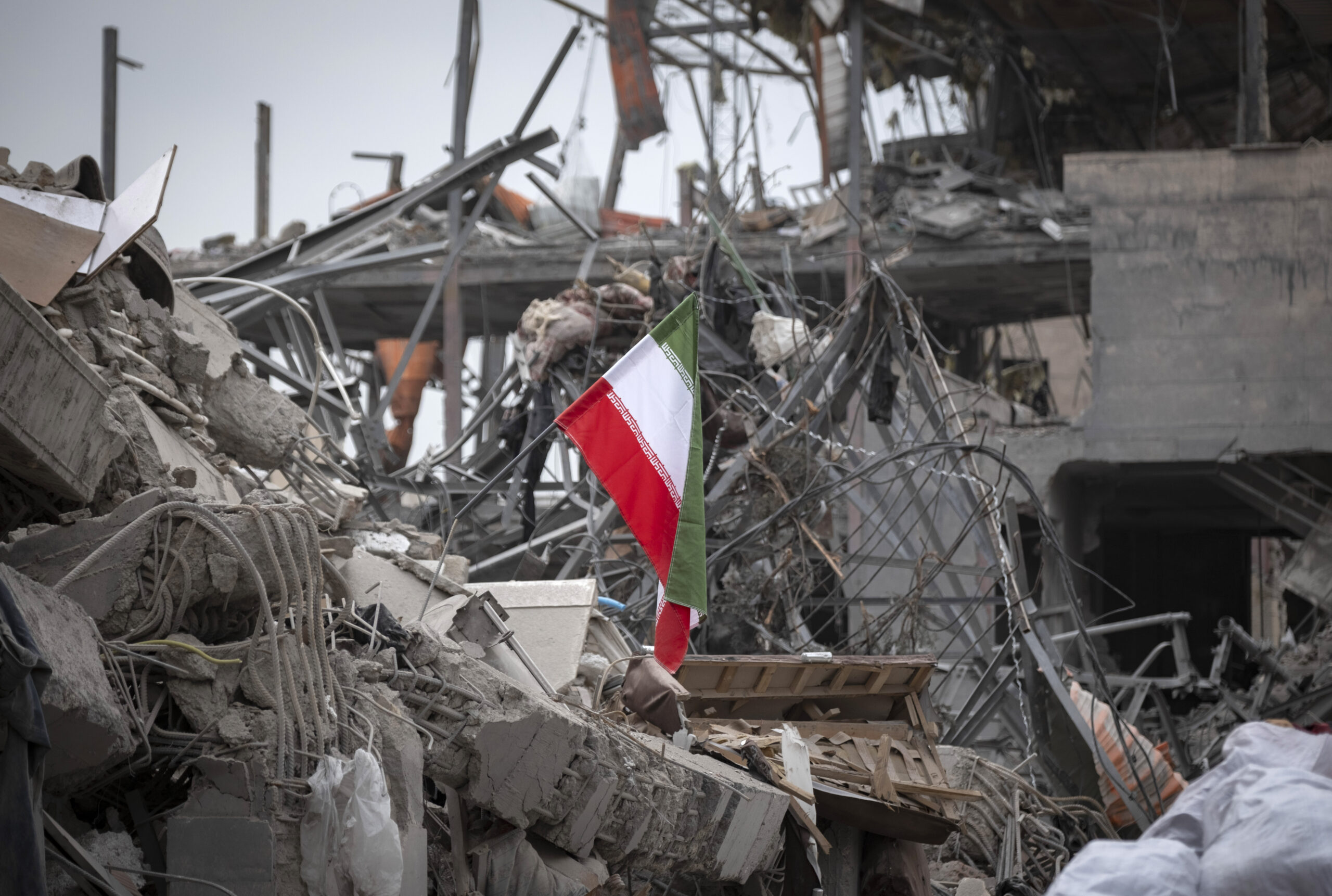
Image: A national flag is placed on the ruins of a building that is destroyed during the U.S.-Israeli military campaign that strikes a residential area on March 9, 2026, in Tehran, Iran, on March 12, 2026. (Photo by Morteza Nikoubazl/NurPhoto)NO USE FRANCE