
Will the Iran war redraw the global energy map?
In this episode, Josh and Jessie get into the supply shock caused by the Iran war and the closure of the Strait of Hormuz, from Asia’s energy crunch to US dependencies. Senior Director of the Atlantic Council Global Energy Center, Landon Derentz, joins us to discuss the scale and duration of this energy crisis and what that means for the global energy landscape.
Listen to The Guide to the Global Economy wherever you get podcasts



About the podcast
Guide to the Global Economy is your go-to podcast for navigating the increasingly busy intersection of global economics, finance, national security, and geopolitics. Through interviews with leading experts and behind-the-scenes insights from the Atlantic Council’s GeoEconomics Center, we break down the storylines that matter most for the global economy—from major news everyone’s talking about to developments few have noticed. These days, if you don’t get economics, you don’t get Washington. From tariffs to crypto to sanctions and beyond, our team is here to guide you. Watch and listen wherever you get your podcasts.
Related content


Explore the program
At the intersection of economics, finance, and foreign policy, the GeoEconomics Center is a translation hub with the goal of helping shape a better global economic future.
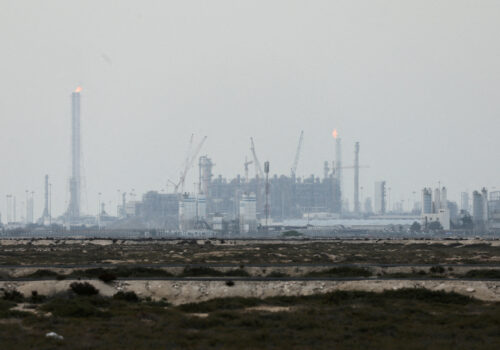
Image: Photo taken from a Kyodo News helicopter shows a crude oil tanker from the Middle East arriving in Tokyo Bay on April 3, 2026, after passing through the Strait of Hormuz on Feb. 26, two days before the U.S. and Israeli militaries started strikes on Iran. No Japan-bound tanker has been confirmed to have passed the strait since. (Kyodo) ==Kyodo NO USE JAPAN