
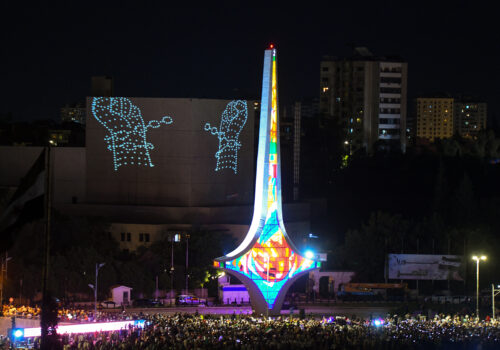
RIYADH—It has been one year since Bashar al-Assad’s fall, and Syrians are celebrating the end to his and his father’s brutal dictatorships, which had spanned more than half a century. On December 8, crowds filled Umayyad Square to cheer the anniversary and listen to Assad’s improbable successor, Ahmed al-Sharaa, a forty-three-year-old former al-Qaeda fighter and rebel commander.
In Washington, the House of Representatives marked the moment by voting through the National Defense Authorization Act (NDAA), which includes the repeal of sanctions on Syria under the 2019 Caesar Act. President Donald Trump signed the bill into law on Thursday, potentially unlocking billions of dollars of investments—much of it from Saudi Arabia—that could contribute significantly to Syria’s economic revival. That follows al-Sharaa’s historic visit to the White House in November as the first Syrian leader ever in the Oval Office, where Trump promised support.
But this past Saturday, a member of Syrian security forces—an individual set to be fired for suspected links to the Islamic State of Iraq and al-Sham (ISIS)—killed two US soldiers and a US civilian interpreter in an ambush. It was an unsettling reminder that dangers for al-Sharaa and his international supporters lurk underneath all of Syria’s progress.
Still, few Americans are paying much attention to those events, with so much else dominating the news, including the possibility that a Venezuelan dictator might soon fall in their own hemisphere. In Saudi Arabia, however, officials are embracing al-Sharaa’s rise—and shrugging off his terrorist past—as nothing less than a historic opportunity to ensure that Syria doesn’t again fall prey to the Iranian adventurism and regional chaos that has long stymied progress in the Middle East.
During my recent visit to Riyadh, a Saudi official, who spoke with me on the condition of anonymity, compared the US lifting of Syrian sanctions to “giving a suffocating person an oxygen mask.” “We need to give Syrians a trickle of hope, and speed is of the essence,” the official explained, given the urgent need to head off any new feelings of despair and discord in the country. And the need is urgent. Damascus, for instance, gets only around three hours of electricity each day, and there is not enough housing for the many displaced and returning Syrians. More than a million Syrian children are without schools, and millions more Syrians need health care in a country where many hospitals have been destroyed by targeted bombings.
Why the Saudis are invested
For Saudi Crown Prince Mohammed bin Salman, Syria until recently had been a missing piece in a larger regional design. What Riyadh wants is to construct an integrated Arab economic and security space that stretches from the Gulf to the Mediterranean. Central to this goal is a secure and prosperous Syria that denies Iranian and extremist influence.
Syria, which was once the cradle of Arab culture and civilization, has in recent decades contributed to Middle East instability, including by providing Iran a platform and a corridor for its proxy wars in Lebanon, Israel, and Yemen. So, it’s understandable why Riyadh is now interested in helping ensure a secure, moderate, modernizing, and Saudi-anchored “new Syria” that replaces the sanctioned, fragmented, failed state that Syria had become.
Riyadh already has announced more than six billion dollars in Syrian investments this year, from housing and health care to energy and infrastructure. Gulf money has helped clear Syria’s arrears to the World Bank, paving the way for International Monetary Fund and World Bank teams to return to the country for the first time in more than a decade.
The Saudi official told me that embracing Syria also has an emotional dimension for Saudis. Many of their country’s most prominent families have their roots and take their names from Syria, which has provided so much of Arab literature, poetry, and the arts. Even al-Sharaa himself was born in Riyadh in 1982 into a middle-class Sunni Syrian family, his father an oil engineer and his mother a geography teacher.
Al-Sharaa’s life story tracks the region’s upheavals. His family returned to Damascus when he was seven years old, and there his neighbors remember him as a polite young man who worked in his father’s grocery store. Al-Sharaa has said that the second Palestinian intifada against Israel, which began in 2000, radicalized him, and he then traveled to Baghdad in 2003 to join the al-Qaeda terrorist group after the US invasion of Iraq. US forces captured him and imprisoned him between 2006 and 2011. Al-Sharaa’s release coincided with the Syrian revolution against Assad, during which al-Sharaa created the al-Qaeda-backed Al-Nusra Front in 2012, using the nom de guerre Abu Mohammed al-Julani.
The US State Department listed him as a Specially Designated Global Terrorist in May 2013, and al-Julani thereafter remade himself as the nationalist rebel commander of the jihadist group Hayat Tahrir al-Sham in the city of Idlib. In November 2024, his forces caught the world and Syria’s government by surprise, racing through Aleppo, Hama, Homs, and finally Damascus, forcing Assad to flee to Russia.
Western governments that had long treated al-Sharaa as a terrorist have come to embrace him in the past year as Syria’s best hope. He is the beneficiary of Turkish sponsorship, American optimism, and Saudi ambition. “We’ve all decided to give him the benefit of the doubt because there really is no other alternative,” the Saudi official told me.
Why the Israelis are worried
Israel sees the situation differently, putting it at odds with Washington. Trump views al-Sharaa as a potential partner in containing what’s left of Iranian influence, combating new terrorist threats, and reintegrating Syria into the world after more than a decade of civil war. Israel worries about the dangers of a premature normalization with al-Sharaa, a former jihadist commander who is now in charge of a fragile, heavily armed state on its northern border. As evidence for this concern, Israeli officials point to recent video of Syrian soldiers chanting that Gaza is a “rallying cry” and vowing “from your blood, rivers will flow.”
Israeli jets and missiles have struck post-Assad Syria over the past year more than six hundred times, targeting remnants of Iranian forces, Hezbollah infrastructure, and what Israelis see as new threats emerging under al-Sharaa’s rule. Israeli troops have also moved deeper into a demilitarized buffer zone along the Golan Heights, citing Israel’s national security needs. Saudi Arabia isn’t waiting for the United States and Israel to resolve their differences. Riyadh sees this as a now-or-never moment for a country at the center of its regional aspirations. Bin Salman appears to have convinced Trump that Syria risks sliding back into extremism, instability, and insurgency unless the Arab world, Turkey, and the United States move quickly to help the young Syrian leader stabilize the country.
What to make of al-Sharaa
For Syria itself, the stakes are of a historic nature. At the Doha Forum earlier this month, al-Sharaa told CNN’s Christiane Amanpour about his goal of building a “sustainable, safe, and secure future for the Syrian people.” He spoke about reaching out to Alawite, Druze, and other minority communities, noting that all parts of Syrian society were victims of the Assad regime, and all were part of the revolution that ousted it. Al-Sharaa also emphasized the importance of establishing the rule of law in Syria, which he said is “the way to guarantee everybody’s rights and the rights of all minorities.” Finally, he promised a four-year transition, a new constitution, and elections.
Al-Sharaa is saying all the right things. Given that he has transformed himself so often and so thoroughly already, it would be understandable to treat his words with skepticism. At the same time, al-Sharaa’s adaptability could serve him in rising to this historic moment and, most urgently, in implementing a domestic agenda that fulfills the new Syria he describes. Success would not only transform his country. Many Saudis believe that a Syria in line with this vision would contribute to Lebanon’s rebirth and to a more secure and prosperous Jordan, as well.
Yet one year after Assad’s fall, the existential challenges facing the new government are many. Much of Syria still lies in ruins, more than 70 percent of Syrians still need humanitarian aid, and outbreaks of sectarian violence persist. Intent on playing spoiler to al-Sharaa’s vision for Syria are various militant and terrorist groups, including ISIS, which has plotted to assassinate the Syrian president.
From Saudi Arabia, the stakes could not be clearer. Syria can either become the first success story of a new Middle East economic and security order, or it could be the setting for its next failure.
Frederick Kempe is president and chief executive officer of the Atlantic Council. You can follow him on X @FredKempe.
This edition is part of Frederick Kempe’s Inflection Points newsletter, a column of dispatches from a world in transition. To receive this newsletter throughout the week, sign up here.
Further reading
Thu, Sep 4, 2025
Dispatches from Damascus: The state of Syria’s postwar transition nine months after Assad’s fall
New Atlanticist By
On a recent trip to the Syrian capital, Atlantic Council experts took note of how far the country has come since the Assad regime’s fall and what still needs to happen to secure peace and prosperity.
Sun, Dec 7, 2025
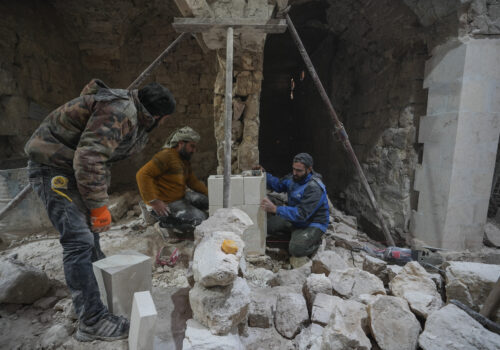
Syria’s civil society must take center stage in reconstruction
MENASource By
One year since Bashar al-Assad’s fall, Syria stands to have the most potential to showcase how local ownership can accelerate reconstruction.
Mon, Dec 8, 2025
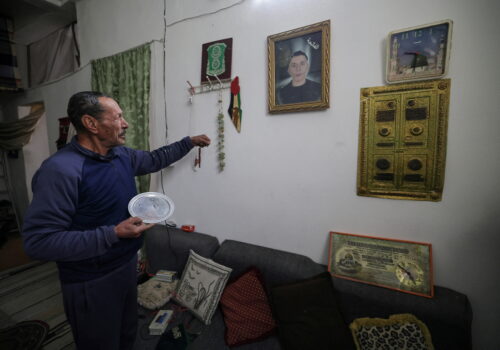
States shouldn’t waste the chance to establish a Syria Victims Fund
MENASource By Kate Springs, Celeste Kmiotek
A centralized fund would better support victims of international law violations in Syria, who face unique challenges.
Image: US President Donald Trump watches as Saudi Crown Prince Mohammed bin Salman shakes hands with Syria's interim president Ahmed al-Sharaa in Riyadh, Saudi Arabia, on Wednesday May 14, 2025. Donald Trump has said that lifting sanctions on Syria gives them a chance of greatness. The sanctions were really crippling, very powerful, he added. He said the US will drop all of the sanctions on Syria, which I think will be a good thing. He said that he is looking to normalise relations with Syria. (Bandar AL-JALOUD / Saudi Royal Palace/ EYEPRESS)