The recent softening of the US dollar on global markets has prompted another round of declinist commentary: The world is losing faith in Washington’s global leadership, America’s era is ending, and the greenback is irretrievably slipping!
That misses the real story behind the dollar’s slide to its lowest value in almost four years—and a more than 10 percent decline since US President Donald Trump’s inauguration. As The Economist argues this week: The world isn’t selling America, it’s hedging it.
If global investors were abandoning the United States, then you would see capital flight, surging Treasury yields, and a scramble for alternative safe havens. Perhaps the clearest indication of that has been the price of gold increasing by more than 25 percent so far this year.
Writes The Economist, with a nod to gold buyers: “Trading floors are abuzz with talk of the ‘debasement trade,’ a broad term for bets on the deterioration of American financial exceptionalism. If the debasement traders are right, then the sell-off in the greenback has barely begun.”
Yet even as the dollar has declined, US stocks have remained strong. The S&P 500, for example, has risen by 15 percent in the past year, briefly hitting an all-time high earlier this week. The yield on the United States’ ten-year Treasury bonds is lower than when Trump began his second term, which is a sign of enduring demand. The dollar could further decline if Trump’s just-announced nominee for Federal Reserve chair—Kevin Warsh—cuts interest rates as the president desires, but there’s no guarantee that Warsh will do so. “It’s still early and there’s no need for alarmism, as any other competitor is light-years behind the dollar,” says Josh Lipsky, the Atlantic Council’s chair of international economics. “But these trends didn’t appear overnight.”
The Atlantic Council’s GeoEconomics Center, which Lipsky leads, has been tracking these shifts for the past three years with its Dollar Dominance Monitor. The data show that the “hedge America” trade, while accelerating in recent months, is not new. In fact, the first demand signal predates Trump and has its roots in the search for alternative payment systems to work around sanctions. Interest in de-dollarization picked up, for example, after the Group of Seven (G7) sanctions response to Russia’s invasion of Ukraine. “What’s new in the past year is that the movement is growing beyond payments and now into currency trading and even the bond market,” says Lipsky.
Robin Brooks of the Brookings Institution points to “policy chaos” as a driver of the dollar’s fall, most recently including Trump’s threat to “buy” Greenland, which he backed off of in Davos last week. “In a nutshell,” writes Keith Johnson in Foreign Policy, “in much the same way that countries are hedging their geopolitical exposure to the United States—such as the EU and India inking a historic trade and defense deal as part of a quest for new partners in an uncertain world—foreigners are hedging their bets against too much exposure to the dollar.”
Last July, I issued “an Independence Day warning about the US dollar” in this space, writing, “For decades, the world chose the dollar without thinking about it all that much, and that was not only because of unrivaled American economic strength. Most of the world’s major economic players also trusted the United States’ financial leadership—its rule of law, its institutions, its predictability.”
That trust is what’s eroding. Part of the problem in recent days has been that Trump has crowed that the dollar’s fall is “great,” making US products cheaper on global markets. These comments stirred rumors about a US scheme to weaken the greenback, which Treasury Secretary Scott Bessent dispelled by reinforcing the country’s strong dollar policy.
The Economist warns that “‘hedge America’ may eventually turn into full-blown ‘sell America.’ If Mr. Trump keeps undermining the credibility of America’s financial system, that moment could come sooner.” Though I still side with those who argue that it’s never been smart to bet against the US economy, it’s concerning that a growing number of traders and allies are deciding that it’s prudent to hedge.
Frederick Kempe is president and chief executive officer of the Atlantic Council. You can follow him on X @FredKempe.
This edition is part of Frederick Kempe’s Inflection Points newsletter, a column of dispatches from a world in transition. To receive this newsletter throughout the week, sign up here.
Further reading
Fri, Jan 30, 2026
Trump finally got the Fed chair he always wanted (or so he thinks)
Dispatches By Josh Lipsky
The president announced Kevin Warsh as his nominee for Federal Reserve chair Friday morning.
Mon, Sep 29, 2025
How to dismantle a reserve currency
Issue Brief By Daniel McDowell
For the economic tumult that the dollar has faced over the last eighty years, its political foundations have remained steadfast—until now. As the political order on which the dollar system rests grows creaky, dollar preeminence is also looking wobbly.
Tue, May 20, 2025
Why the US cannot afford to lose dollar dominance
Atlantic Council Strategy Paper Series By Martin Mühleisen, Valbona Zeneli
Since World War II, US geopolitical influence has been compounded by the role of the dollar as the world’s dominant currency. As global economic power becomes more diffuse and strategic competitors “dedollarize,” policymakers must determine how to maintain the dollar’s role at the center of global trade and financial networks.
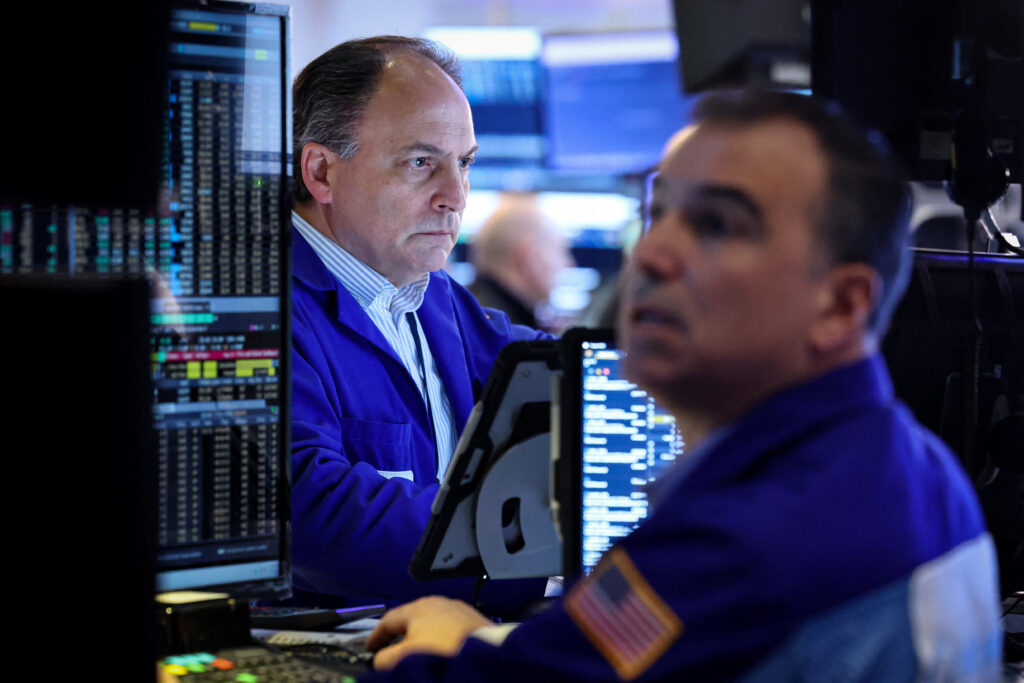
Image: Traders work on the floor at the New York Stock Exchange (NYSE) in New York City, on January 21, 2026. (REUTERS/Brendan McDermid)