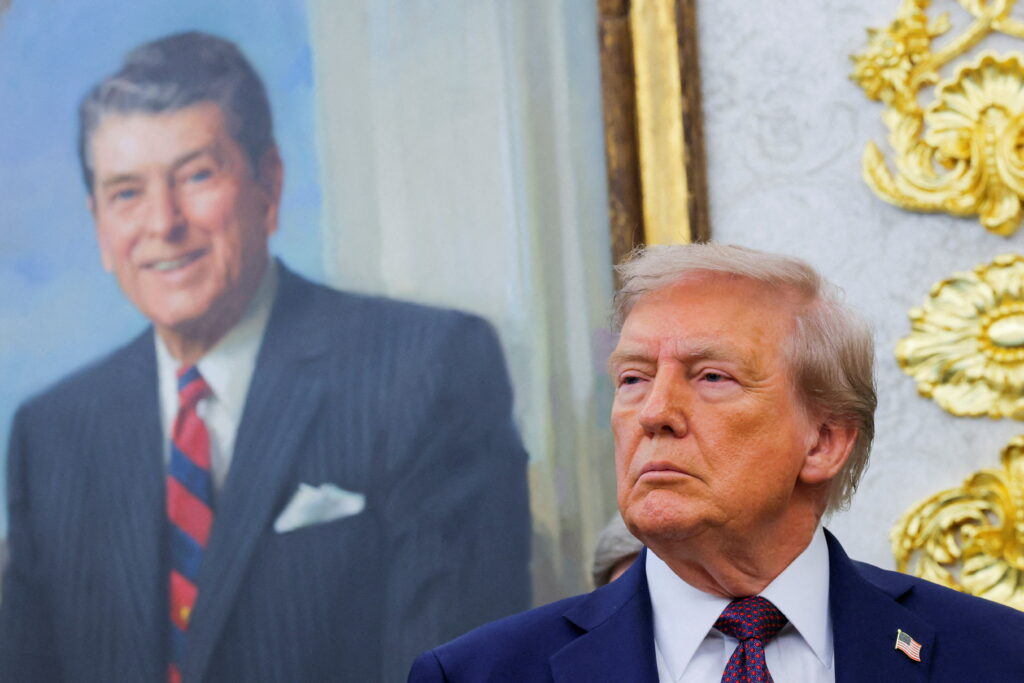
Following the US military operation that captured Venezuelan dictator Nicolás Maduro and flew him to New York to face narcoterrorism charges, Secretary of State Marco Rubio said this about Donald Trump: “This is a president of action . . . If he says he’s serious about something, he means it.”
As 2026 opens, the most significant question facing the United States and its global partners is not what Trump has accomplished thus far, up to and including the Maduro ouster. The year ahead will be about something more consequential: What sticks? What actions get lasting traction, and what historic legacy will this peripatetic man of action leave behind?
Today’s action is not always tomorrow’s legacy
The first year of Trump’s second term was tumultuous by his own design. It stretched presidential authority, challenged constitutional norms, unsettled many allies, drove global market volatility, and dominated news cycles with a relentlessness that none of the other forty-four US presidents ventured.
Trump’s first year back dramatically altered the weather, but 2026 will indicate whether Trumpism marks a climactic shift that permanently changes the nature of US leadership both domestically and abroad. What’s at stake isn’t just whether the United States, working alongside partners and allies, will build on its global leadership of the past eighty years. It’s what sort of America will celebrate the 250th anniversary of its independence.
Trump likes to show important visitors around the White House, comparing himself to the greats in the portraits that decorate its walls and wondering where he will rank among them. Where he may pay too little attention, write professors Sam Abrams and Jeremi Suri in a must-read Wall Street Journal op-ed, is to the fact that “Presidents are assessed by their legacy: institutions they create, coalitions they form and governing assumptions they stamp on America. By that standard, Mr. Trump’s second term remains unsettled at best.”
Here’s a sampling of what Trump’s leadership has brought the world in the past year: NATO allies agreed to a record increase in defense spending. Iranian despots suffered direct US attacks on three nuclear sites. Gaza has a peace plan (albeit a fragile one) endorsed by the United Nations Security Council. US tariff rates reached their highest level in a century. A new US National Security Strategy warned Europe of “civilizational erasure.” And the United States removed a Venezuelan dictator, while Russian despot Vladimir Putin continued his murderous war on Ukraine with relative impunity.
A scan of recent news, however, reveals Trump’s unfinished business: Trump has said the United States will “run” Venezuela, but details regarding what that means are few. Shortly before the new year, Ukrainian President Volodymyr Zelenskyy paid Trump a visit at Mar-a-Lago to ensure US peace efforts don’t reward Putin’s criminal revanchism. Around the same time, Chinese President Xi Jinping mobilized his naval, air, and missile forces around Taiwan, in a live-fire drill showing off Beijing’s growing ability to encircle the free and democratic island after the announcement of an eleven-billion-dollar US arms package to Taipei. And Iranian students joined expanding anti-regime protests, with Trump promising to protect them if shot upon (“We’re locked and loaded and ready to go”).
Trump is “the most ubiquitous president ever,” historian Douglas Brinkley recently noted. “He plays to win the day, every day.” Yet history remembers presidencies not by that measure, but rather by what outlasts them. If Trumpism proves more personal than institutional, then its effects may fade over time. If Trumpism embeds itself in how the United States defines its interests, exercises its leverage, and understands its obligations, then allies and adversaries alike will further correct course to adjust for a permanently altered America.
So will Trumpism endure or fade? There are signs pointing in both directions. Here’s what I’ll be watching over the next twelve months to sort the noise from the signal.
Venezuela and the Western Hemisphere
No US commander-in-chief has paid more attention to the daily choreography of leadership and the political theater of the presidency than Trump has. So it is fitting that he would launch the second year of his second term with his most audacious foreign policy decision yet—something The Washington Post editorial board called “one of the boldest moves a president has made in years”—though one executed as a domestic judicial matter based on a criminal indictment.
Before the 2003 Iraq War, then-US Secretary of State Colin Powell popularized the “Pottery Barn rule” that “if you break it, you own it”—a warning about the long-term costs and obligations of military intervention. Trump’s convictions against democracy promotion and nation-building suggest he’ll want to stabilize Venezuela and deliver on US interests without doing either of those things.
How he does that will do much to define US foreign policy in 2026. Can he deliver in Venezuela in a manner that advances the country’s freedom and stability without signaling to China and Russia an endorsement of “spheres of influence” that would encourage their own regional ambitions?
The early hours show how complicated the Venezuela effort will be. Trump appears to be relying on Delcy Rodríguez, Maduro’s vice president who became the country’s de facto leader on Saturday, rather than turning to the opposition, which is widely recognized to have won Venezuela’s 2024 election before it was stolen by the Maduro regime. For her part, however, Rodríguez shot back, “Never again will we be slaves, never again will we be a colony of any empire. We’re ready to defend Venezuela.”
And what other actions might the Trump administration take to deliver on the vision set out in its National Security Strategy to restore preeminence in the Western Hemisphere through a “Trump corollary” to the Monroe Doctrine? Its stated aims, among others, are to prevent and discourage mass migration, ensure governments cooperate with the United States against transnational criminal activity, maintain a hemisphere “that remains free of hostile foreign incursion of ownership of key assets,” and protect “continued access to key strategic locations.”
Alliances, Ukraine, and Taiwan
Trump has strengthened and weakened US alliances simultaneously. He’s prompted allies to spend more on defense and accept more of their own security burdens, but he’s also left them hedging against US unpredictability. Meanwhile, Russia and China have emerged from 2025 more confident that they can achieve their geopolitical goals: in the case of Moscow, to expand its sphere of influence by reversing its setbacks after the Cold War, starting with Ukraine; and in the case of Beijing, to gain greater control over its own region with an emphasis on Taiwan and a bid to assume the mantle of global leadership.
Trump could take steps in 2026 that reinforce US alliances, or he could give autocratic adversaries even more reason to test US resolve. Through his interactions with Russian and Chinese leaders—Trump talks with Putin frequently and at length, and he is scheduled to meet with Xi at least twice in 2026—he could inadvertently encourage them to press for whatever gains are possible during his remaining three years in office, introducing a period of increased geopolitical volatility.
Trump inherited a global situation where a group of aggressors—China, Russia, Iran, and North Korea—have been working more closely together than any group of autocratic countries since Nazi Germany, Fascist Italy, and Imperial Japan ahead of World War II. Trump’s advisers blame previous presidents for allowing the unnatural bond between China and Russia to deepen, and they still seem to hope that they can draw Moscow away from Beijing. Thus far, however, Trump has emboldened both Putin and Xi. Their countries’ military and intelligence coordination has deepened, allowing Russia’s war on Ukraine to continue.
Global trade, markets, and economics
In 2025, Trump transformed tariffs from a last resort to a preferred economic weapon with multiple aims: gaining trade leverage, raising federal revenues, incentivizing domestic manufacturing, and punishing miscellaneous misbehavior. Economic nationalism crossed from taboo to mainstream, and protectionism became modern mercantilism.
In a recent Wall Street Journal op-ed, titled “Prepare for More Tariffs in 2026,” the Atlantic Council’s Josh Lipsky argued that Trump is more likely to continue his current approach than to amend it, even if Supreme Court decisions expected early this year temporarily set him back. “The second year of the second Trump administration is likely to look much like the first in trade policy,” Lipsky wrote, laying out several reasons why.
Perhaps, but global markets and American voters will also have a say, and they are likely to push back. I’m less sanguine than others are that the inflationary aspects of Trump’s tariff approach and the market response will continue to be muted. In particular, look for signs of eroding US dollar dominance. (You can access our own Atlantic Council tracker on that matter here.)
No one quite knows when global investors and sovereigns will tire of financing US debt, which now stands at more than $38 trillion, or nearly 125 percent of US gross domestic product, with roughly $6 billion added every day. Even at current financing levels, the United States is paying more in interest on its debt than it spends on defense. Something must give—but how and when?
It’s true that the US stock market held up fine in 2025, with the S&P 500 up an impressive 16 percent. Still, that outcome far undershot the 32 percent gain for the MSCI All-Country World ex-US index, the widest such margin since the global financial crisis in 2009. The S&P 500 also trailed both the DAX (Germany) and the FTSE 100 (United Kingdom), in addition to many emerging market indices. In a front-page report in The Financial Times, journalist Emily Herbert wrote that this rare year of Wall Street underperformance came due to “worries about high valuations, a Chinese artificial intelligence breakthrough and Donald Trump’s radical economic policies.”
It’s true that even a Democratic president in 2029 is unlikely to roll back Trump’s tariffs dramatically, given that both parties currently lack a free-trade consensus. But it’s also unlikely that the trade system going into the future will be so driven by one individual and his preferences.
Watch to see whether Trump can continue to press US economic advantage in the coming year without greater economic or political blowback than he has experienced thus far. Will rising investments in artificial intelligence continue to buoy markets? Or will slowing growth, consumer concerns about affordability, and global worries about US debt levels weigh the economy down? Expect 2026 to be a year of continued economic and market volatility—but not necessarily the lasting, wholesale change of the international trading system some are forecasting, as other actors advance trade deals.
The president and his Republican Party
Perhaps the most important “What sticks?” question of 2026 is whether Trump will move toward more strategic consistency or instead double down on the improvisational approach that he believes served him so well in 2025.
His unpredictability, which his son Don Jr. praised in Doha late last year, wins him leverage at key moments, and he certainly caught Maduro off guard over the weekend. But there’s no indication that he has built a governing system or a sustainable national security strategy around that unpredictability. Durable legacies require repetition, delegation, and follow-through by a cadre of intellectual and ideological acolytes.
“Successful political movements outlive their founders,” Abrams and Suri wrote in the Wall Street Journal. “New Deal liberalism outlasted Roosevelt. Postwar conservatism survived Reagan. Trumpism appears to be dependent on Mr. Trump’s personal authority, media dominance and capacity for conflict.” The president, who is confronting actuarial tables as he turns eighty this year, could face a starkly different Congress a year from now. That means the next several months could present a major test of both Trump and Trumpism.
Watch in 2026 to see whether any Republican leaders translate Trump’s instincts into a more lasting doctrine—on alliances, on relations with autocratic adversaries, and on trade. Potential Republican presidential candidates such as Vice President JD Vance, Secretary of State Marco Rubio, and Senator Ted Cruz of Texas will have to gauge whether Trumpism is a winning ideology for the future.
One recent cautionary sign for Trump acolytes was the decision by more than a dozen employees of the Heritage Foundation think tank to jump ship to the previously little-noticed Advancing American Freedom (AAF), which former US Vice President Mike Pence set up in 2021. “The debate over the direction of the post-Trump right is underway,” the Wall Street Journal editorial board wrote, with Pence explaining that what attracted the individuals to AAF was finding “a consistent, reliable home for Reagan conservatism.”
In the year ahead, I will be seeking to sort spectacle from substance regarding the actions and reactions of US adversaries and allies, global markets, and Trump himself. The president changed the political and geopolitical weather in 2025—dramatically but not irreversibly. Not every shock becomes a structure, and not every provocation determines an enduring policy change. When it comes to what sticks, the stakes are both global and generational.
Frederick Kempe is president and chief executive officer of the Atlantic Council. You can follow him on X @FredKempe.
This edition is part of Frederick Kempe’s Inflection Points newsletter, a column of dispatches from a world in transition. To receive this newsletter throughout the week, sign up here.
Further reading
Mon, Dec 22, 2025
The Atlantic Council’s greatest hits of 2025
Dispatches By
These articles, reports, initiatives, and convenings represent the Atlantic Council at its most relevant and preeminent.
Tue, Dec 9, 2025
Dispatch from Doha: A tale of two Trumps (constrained vs. unleashed)
Inflection Points By Frederick Kempe
The Trump administration's recently released National Security Strategy is a stark departure from its predecessor during Trump's first term.

Sat, Jan 3, 2026
Experts react: The US just captured Maduro. What’s next for Venezuela and the region?
Dispatches By
What does the future hold for Venezuela following the US raid that removed Nicolás Maduro from power? Atlantic Council experts share their insights.
Image: U.S. President Donald Trump, in front of a painting of former U.S. President Ronald Reagan, attends an event to announce that the Space Force Command will move from Colorado to Alabama, in the Oval Office at the White House in Washington, D.C., U.S., September 2, 2025. REUTERS/Brian Snyder