
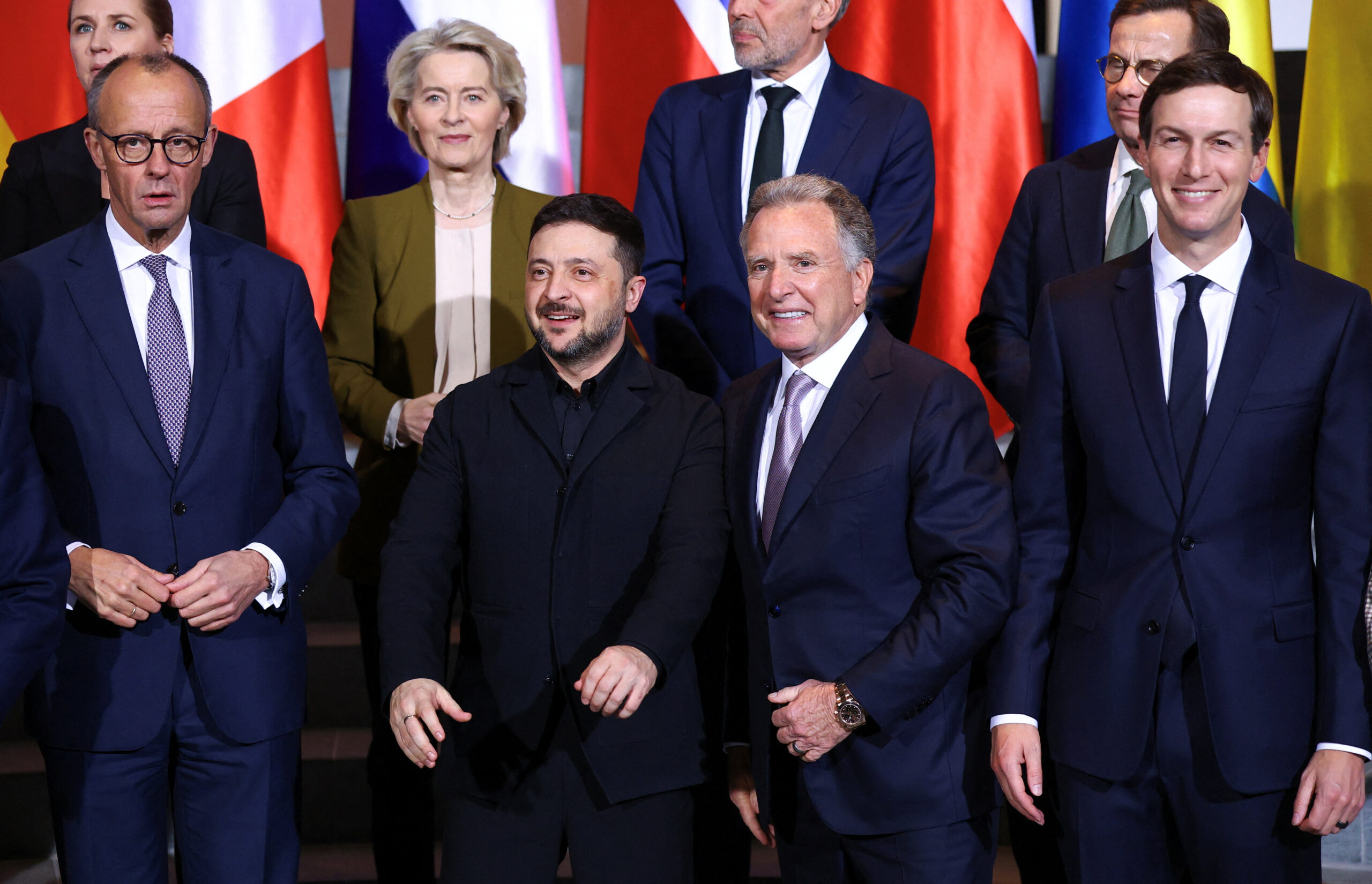
WASHINGTON—The likelihood of a cease-fire by Christmas is low, but the Trump administration’s latest effort to achieve a negotiated end to the Kremlin’s aggression in Ukraine continues in hope. Today, US envoy Steve Witkoff and Jared Kushner, US President Donald Trump’s son-in-law, wrapped up two days of meetings with Ukrainian President Volodymyr Zelenskyy and other European leaders in Berlin.
While the exact details of the current White House plan are not publicly available, reporting suggests that the key points include a renewed US proposal for Ukraine to cede the strategic regions in western Donbas that Russia has been unable to conquer and create a demilitarized zone there. Kyiv rejected this initiative when initially presented in mid-November, and it was widely criticized in the United States, including by Republicans in Congress, as dangerously favorable to the Kremlin. Kyiv still considers this proposal—an effort to meet Moscow’s demand that Ukraine give up all of the Donbas—extremely risky. If Russian troops were to move into this highly fortified “demilitarized zone,” then it would be much easier for them to move west and take far more Ukrainian territory.
In order to persuade the Ukrainians to accept this, Washington is willing to give Ukraine, according to Axios’s Barak Ravid, “a guarantee based on NATO’s Article 5 that would be approved by Congress and be legally binding.” The exact details of this guarantee are not public. But talks regarding the guarantees have been underway since Zelenskyy and seven other European leaders met in August with Trump, following his Alaska summit with Russian President Vladimir Putin. For months, Team Trump has been reluctant to provide Ukraine concrete guarantees, preferring to reach agreement on the terms of a cease-fire first, and only then to turn to the issue of guarantees—a position Kyiv thought unsatisfactory. This is understandable given the fact that Ukraine gave up its nuclear arsenal under the Budapest Memorandum in 1994 in exchange for “security assurances” from Russia, the United States, the United Kingdom, France, and China that they would not permit any infringements on Ukraine’s territorial integrity—assurances that proved worthless.
If Washington is now willing to provide Ukraine strong guarantees, either alone or, better yet, with at least some of its European allies, then that might be enough for Zelenskyy to consider a withdrawal from western Donbas. In connection to that, the Ukrainian president said publicly late last week that he was willing to consider a public referendum on handing over western Donbas. This step would likely meet his constitutional requirement not to make, without public approval, any change to Ukraine’s borders.
In his December 12 report, Ravid quotes an unidentified senior US official as saying, “We want to give the Ukrainians a security guarantee that will not be a blank check on the one hand but will be strong enough on the other hand. We are willing to send it to Congress to vote on it.” This is certainly a gesture to Zelenskyy, but it does not make clear if the administration is talking about a (legally binding) treaty—Zelenskyy’s position—or something less.
There is also little public information on the critical elements of those guarantees. How would this work? Zelenskyy worries that Russia might secretly place troops in the demilitarized zone. This past Friday, senior Putin adviser Yuri Ushakov said that while “it’s entirely possible that there won’t be any troops [in the Donbas], either Russian or Ukrainian” in a postwar scenario, “there will be the Russian national guard” and “police.” Russia’s national guard is a paramilitary force, and it would not be difficult to conceal a build-up of troops in the zone as national guardsmen. In 2014, Russian troops without any markings seized Crimea. Would the security guarantees under discussion respond to a significant build-up of the Russian national guard in this zone? More broadly, what Russian violation of the demilitarized zone or offensive action beyond it would oblige a strong US response?
It is worth noting that this proposal poses an unnecessary risk to the United States. To persuade Ukraine to give up strong defensive positions, the guarantees must offer strong US action if Russia breaks the cease-fire and moves troops into this area. That would immediately put any US forces—even from the air—in unnecessary danger because Russian troops would be operating from an advantageous position both for defensive or offensive operations. The United States would have to be prepared for this contingency.
Trump’s envoys are claiming serious progress in the talks, but there are still no clear indications that the Kremlin is willing to accept conditions that would lead to a sustainable peace. Indeed, Ushakov said on Friday that while Moscow had not seen the latest draft following talks between the United States and Ukraine, “when we see them, we may not like a lot of things, that’s how I sense it.”
Trump’s stated aim is still a peace that lasts. And despite nearly a month of talks since the launch of this latest Trump initiative, there is no indication that Putin has given up his objective to achieve effective political control of Ukraine, which would require Russia to take far more Ukrainian territory. Even Trump seemed to acknowledge this when criticizing Zelenskyy on December 7 for not responding favorably to the latest US proposal. While he felt that Russia would accept that proposal, Trump stated that “Russia . . . I guess, would rather have the whole country when you think of it.”
Andrei Kelin, Russia’s ambassador in London, made this clear in a December 10 interview when he said that what was on the table was not a “deal” so much as Ukrainian “surrender.” As US envoys push Ukraine to accept even previously rejected Russian conditions, and as the United States and its European allies spar about the terms of the plans to end the war, Moscow watches, with no incentive to make concessions to achieve a durable peace.