
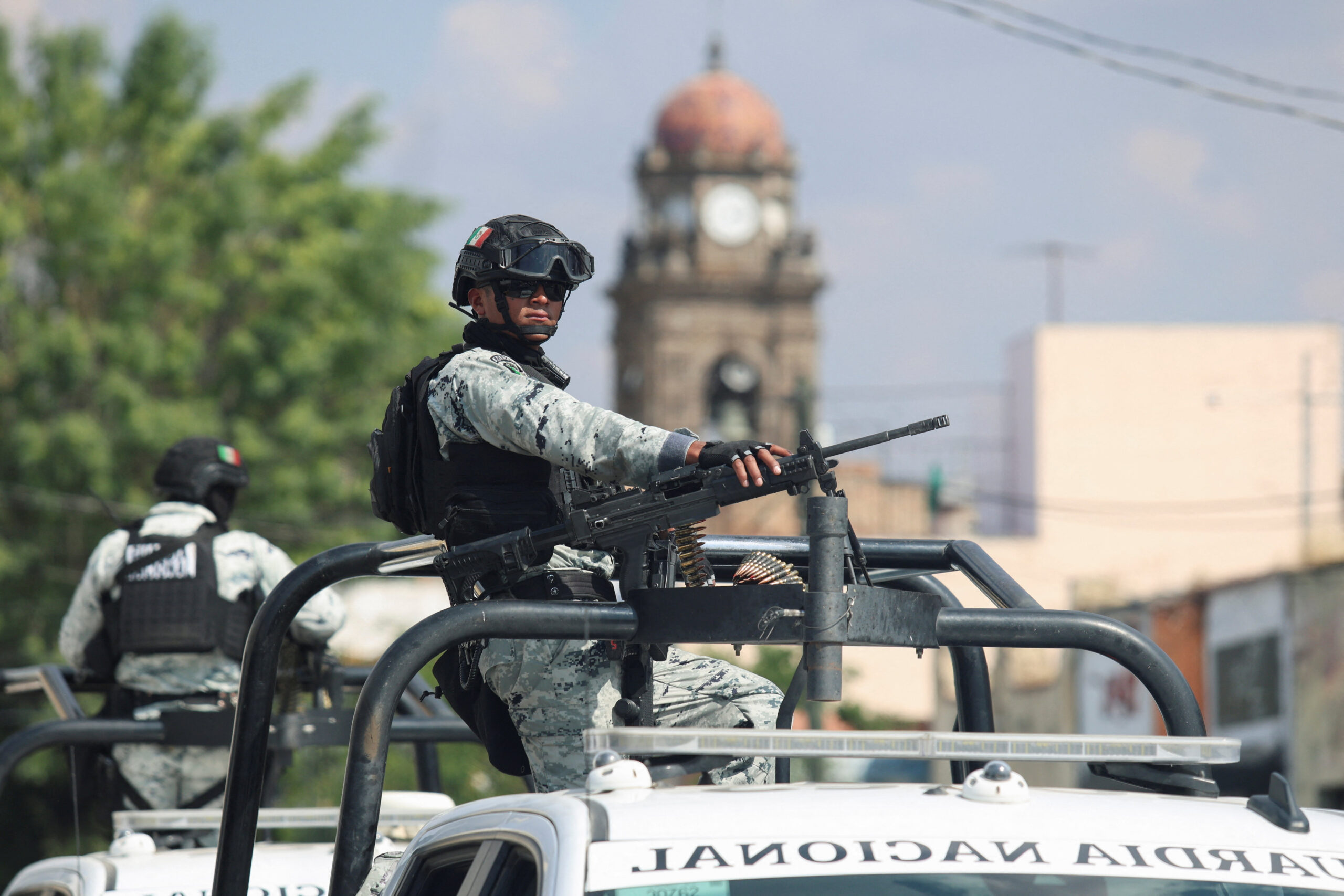
WASHINGTON—On February 23, Mexican security forces conducted an operation with US intelligence support against the Jalisco New Generation Cartel (CJNG), killing its leader, Nemesio Oseguera Cervantes, also known as “El Mencho.” The operation decapitated one of Mexico’s most powerful cartels. It also came about a year after the United States designated certain drug cartels, including CJNG, as Foreign Terrorist Organizations (FTOs)—one element of a wider renewed US focus on the Western Hemisphere.
But narco-terrorist groups are different from many of the organizations that the United States hunted during the global war on terrorism. Policy responses that transpose traditional counterterrorism frameworks directly onto narco-terrorism are unlikely to succeed, as they neglect the market pressures that influence cartel behavior. This is evidenced by failures in Mexico’s “kingpin” strategy, which began in 2006 and targeted cartel leaders.
To effectively combat narco-terrorism in Mexico, the United States should move beyond the fleeting appeal of decapitation strikes. Rather, it should combine offensive strikes with enhanced supply disruption while bolstering domestic efforts to reduce substance use disorder in the United States.
Differences among ‘terrorists’
For many years, drug cartels were perceived as primarily a law enforcement imperative, not a military one. It was widely believed that while the cartels certainly employ tactics of terror, such as public executions and mass killings, they lack the ideological ambition that defines terrorism. The Islamic State of Iraq and al-Sham (ISIS), for instance, sought to establish a global caliphate governed by extremist interpretations of Sharia law. Cartels in Mexico have shown no such political ambitions. Instead, they rely on the continued international legitimacy of the Mexican state to sustain the trade flows they exploit to conceal and transport contraband. A Mexico openly ruled by a criminal leader would invite isolation, sanctions, and border closures, undermining the very commercial and logistical networks on which cartels depend.
That’s not to say that the United States’ FTO designations of several Mexican cartels were baseless. Cartels challenge state sovereignty by creating zones of lawlessness in which they conduct their illegal activities. Moreover, Mexican cartels have built infrastructure and distributed humanitarian aid to galvanize popular support, illustrating attempts to present themselves as legitimate providers of social services at the expense of the Mexican government. The rise of narcocultura, the glorification of cartel leaders and crimes, further erodes state sovereignty. Following the killing of El Mencho, for example, news outlets have even made lists of the top ten songs that reference the CJNG leader, illustrating the pervasive impact of cartels on popular culture. The conjunction of these factors grants cartels a politico-ideological dimension, thus placing them squarely within the confines of terrorist organizations.
Still, the profit-seeking logic that drives their behavior makes cartels distinct and demands a new strategy to counter them. While more ideological terrorist organizations are no strangers to crime, groups such as ISIS have relied on illicit activity to finance their ambitions, whereas cartels originate in—and exist to expand—illegal markets themselves. While this distinction may appear technical, it is in fact consequential. Past US strategies targeting drug cartels in Mexico have fallen short precisely because they failed to account for this nuance.
‘Kingpin’ isn’t checkmate
Starting in 2006, to curtail violence in Mexico, the United States supported the “kingpin strategy,” wherein the Mexican government targeted cartel leadership. The assumption, derived from traditional counterterrorism, was that eliminating a group’s figurehead would weaken, if not dissolve, the group. While this might make sense for an ideologically driven organization, it fails to account for the economic realities of the drug trade.
In Mexico, once cartel leaders were decapitated, the cartel would be weakened but other actors would subsume their operations, or brutal infighting between factions occurred. Ultimately, violence in Mexico rose because of the “kingpin strategy.” CJNG itself, now one of the most consequential cartels in Mexico, emerged during this period as a splinter of the decapitated Milenio Cartel. More recently, the arrest of top Sinaloa Cartel leaders last year fomented a brutal internal war as drug flows remain unabated. Scholars attribute these dynamics to the persistence of illicit markets; as long as demand exists, actors will move to supply it.
Consequently, while the strike against El Mencho was a success, expanded US intelligence-sharing to enable decapitation strikes cannot serve as the end-all, be-all US strategy. Doing so risks perpetuating cartel fragmentation and violence, repeatedly generating splinter groups that the United States would be forced to designate as FTOs in an unsustainable and self-defeating cycle. To successfully combat narco-terrorism, facilitating Mexican offensive strikes must be paired with measures geared toward constraining the narcotics market.
What else is required
The United States should continue existing efforts to disrupt narco-terrorist supply chains. Cartels rely on precursor chemicals and pill presses from China to produce fentanyl products. In November, Washington escalated its demand that China halt the exports of fentanyl precursors. Next, the United States should apply sustained pressure to compel compliance. The success of intelligence-sharing with Mexico in the El Mencho operation should spur deeper cooperation focused on identifying and interdicting suspicious shipments. Diplomatically, the United States should continue pressing the Mexican government to address the rampant corruption within its ranks.
In addition, strengthening the US border with nonintrusive inspection technology geared at commercial cargo would help hinder cartel routes. Expanding the use of canines at the border and within the US postal system represents another promising avenue. Given that 86 percent of those charged with fentanyl trafficking offenses in 2021 were US citizens, the United States must also prioritize robust domestic law enforcement and judicial responses.
Furthermore, Mexican cartels would not have a sustainable business model without US drug demand. The United States should continue efforts to address substance use disorder, and it should frame de-addiction as a national security matter, in addition to a public health priority. Since 2000, more than one million people have died of a drug overdose in the United States, while many others likely face a similar fate without help. Pivoting away from purely carceral approaches to drugs toward de-addiction treatment, strengthening cooperation among federal, state, territorial, and tribal authorities, and investing in social and community resources are among the steps the United States can continue to take to save lives and undercut cartel networks.