The United States’ extraction of Venezuelan leader Nicolás Maduro from his bunker on January 3 triggered an explosion of activity across Venezuelan social media. Across Instagram, TikTok, and WhatsApp status updates, millions of Venezuelans shared jubilant reactions to images of the former dictator in custody. Venezuelan diaspora communities from Buenos Aires to Madrid posted celebratory videos, while domestic users circumvented internet restrictions to express relief and hope.
The regime’s communication apparatus—typically one of its most formidable weapons—collapsed during the crucial first fifteen hours following the operation. Targeted strikes on antennas disrupted the radio communications of the security forces, while an electricity outage impacted the area around the Fuerte Tiuna Army Base. However, internet and phone communications continued to function normally. State TV and radio stations were broadcasting prerecorded programming rather than providing critical news coverage. Chavismo took refuge on Telegram channels and groups.
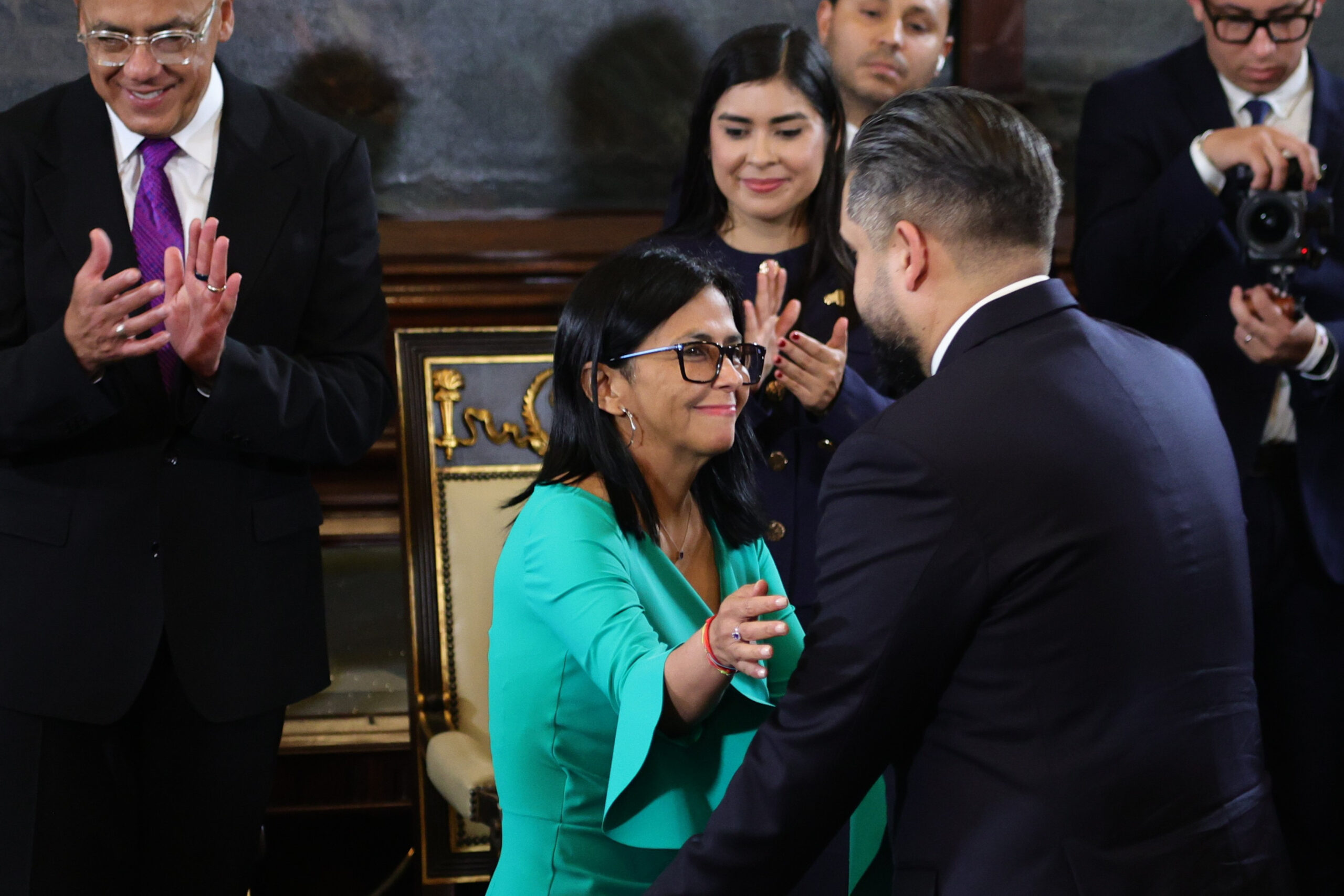
When government communications finally resumed, conflicting statements revealed chaos within the regime. Late on January 3, former Vice President Delcy Rodríguez proclaimed Maduro “the only president of Venezuela” and demanded his release while simultaneously assuming the role of acting president. In contrast, US President Donald Trump claimed that she was cooperating with his administration and was willing to fulfill all his requests regarding the US takeover of the Venezuelan oil industry. This dissonance highlighted the regime’s turmoil, torn between defiant rhetoric for domestic audiences and pliant negotiations with Washington.
The regime’s double game
Hours after Maduro’s removal, María Corina Machado, the leader of Venezuela’s democratic opposition movement, whose candidate won 67 percent of the vote according to tallies from the stolen 2024 election, declared on social media “Venezuelans, the HOUR OF FREEDOM has arrived!” However, despite her overwhelming popular legitimacy and moral authority, she operates under the constraints of surveillance and repression. The opposition’s mobilization capacity remains uncertain, as the Maduro regime’s systematic repression has crushed the country’s civil society.
For her part, Rodríguez confronts an unprecedented challenge for a Venezuelan leader: She must satisfy Washington’s demands while maintaining sufficient Chavista coalition support to prevent an internal fracture or a military coup. The Trump administration demands sufficient cooperation to enable US oil company operations, likely including transparent property contracts and regulatory stability—precisely the institutional environment that Chavismo systematically dismantled. Rodríguez making such an agreement with Trump would alienate the regime’s hardliners, who would view her accommodation as a betrayal. Thus, Rodríguez may be unable to guarantee the stability required for the business operations Trump wants to run in Venezuela.
Her public contradictions reflect this impossible position. In her first televised addresses as interim president, she demanded Maduro’s immediate release to demonstrate loyalty to domestic audiences. Less than twenty-four hours later, however, she declared it a priority to move toward a “balanced and respectful” economic cooperation between the United States and Venezuela.
This double game cannot persist indefinitely. Rodríguez must choose between accommodating Trump’s demands or preserving Chavista unity. Trump’s threat that if Rodríguez “doesn’t do what’s right, she is going to pay a very big price, probably bigger than Maduro” makes clear that there will be consequences of noncompliance. Purging the hardliners may be Rodríguez’s best option.
Navigating the geopolitical minefield
Perhaps Rodríguez’s most complex challenge is managing Venezuela’s deep entanglements with China, Russia, Iran, and Cuba while simultaneously partnering with the Trump administration. This is especially the case after the Trump administration demanded that Venezuela immediately cut ties and cease intelligence cooperation with Russia, China, Iran, and Cuba. These relationships represent more than diplomatic alignments—they constitute binding financial obligations, operational dependencies, and strategic commitments that cannot simply be abandoned without triggering massive economic and security consequences.
China presents the most significant financial exposure. Venezuela owes Beijing around twenty billion dollars in loans. These debts are secured through oil-for-loan arrangements that require repayment through crude deliveries, with China currently absorbing more than half of Venezuela’s oil exports (approximately 746,000 barrels per day in November 2025).
Beyond petroleum, Chinese state enterprises control critical Venezuelan infrastructure. Huawei built and maintains control over Venezuela’s national fiber-optic backbone. China Electronics Import & Export Corporation built and operates the VEN911 surveillance system. ZTE Corporation designed the Homeland Card system and operationalized the Patria System database used for social control. These companies don’t simply provide services—they embed operational control within Venezuela’s digital infrastructure, creating dependencies that cannot be severed without system collapse. Expelling Chinese technology companies would require the complete reconstruction of Venezuela’s telecommunications and surveillance systems.
Russia’s Strategic Partnership Treaty with Venezuela, signed in May 2025, commits Caracas to comprehensive cooperation with Moscow across the hydrocarbons, military technology, and strategic sectors. Russia is Venezuela’s primary supplier of naphtha and diluents—essential additives for processing Venezuela’s heavy crude. These Russian commitments create immediate conflicts with a potential US partnership, as the Trump administration’s demands make clear. The energy deal announced by the Trump administration on January 7 indicates that US diluent will be sent to Venezuela, meaning that Russia will have to withdraw from that market.
Iran provides Venezuela’s most operationally sensitive international cooperation—drone technology production at El Libertador Air Base, where Iranian personnel set up operations. On December 30, 2025, the US Treasury imposed sanctions on Empresa Aeronautica Nacional SA, the Venezuelan company operating in a joint venture with Iranian companies at drone manufacturing facilities in Venezuela. This military-technical cooperation directly threatens US interests and almost certainly constitutes a nonnegotiable red line for Washington.
Cutting ties with Cuba would resent the deepest ideological and operational challenge for the regime. Cuban intelligence advisors remain embedded throughout Venezuelan security services despite the neutralization of Maduro’s personal protection unit. These advisors provide counterintelligence expertise, interrogation training, and repression coordination—exactly the capabilities Rodríguez needs to maintain internal control against potential coup attempts. Cuba’s own survival depends on Venezuelan oil shipments, with Havana receiving subsidized petroleum. Severing Cuban intelligence cooperation would affect operational expertise within the security forces, potentially triggering a military fracture. Yet Washington has demanded the immediate severance of Venezuela’s ties to Cuban intelligence. Moreover, on January 3, US Secretary of State Marco Rubio issued a warning to the Cuban leadership: “If I lived in Havana and was part of the government, I’d be at least a little concerned.” He also emphasized that Cuba would no longer receive oil from Venezuela.
Democracy deferred
Each day of ambiguity increases pressure from all directions, making Rodríguez’s balancing act increasingly untenable. There are three competing scenarios: First, Rodríguez could successfully navigate between Washington and Chavismo. Second, hardliners could resist accommodation with the United States, triggering Trump’s threatened “second wave” operation. Third, a rebellion could replace Chavista leadership, opening the door to a transition.
Amid this uncertain picture, Venezuelan civil society, having demonstrated extraordinary resilience through the October 2023 primary elections and the July 2024 presidential campaign despite systematic repression, now confronts a different challenge. It must fight to remain relevant amid a power transition dominated by US economic interests and Chavista factional negotiations. In the days following Maduro’s capture, a clear priority has emerged for Venezuelan civil society: the total liberation of all the regime’s political prisoners, who currently number nearly one thousand. Only then will Venezuela’s transition to democracy truly begin.