
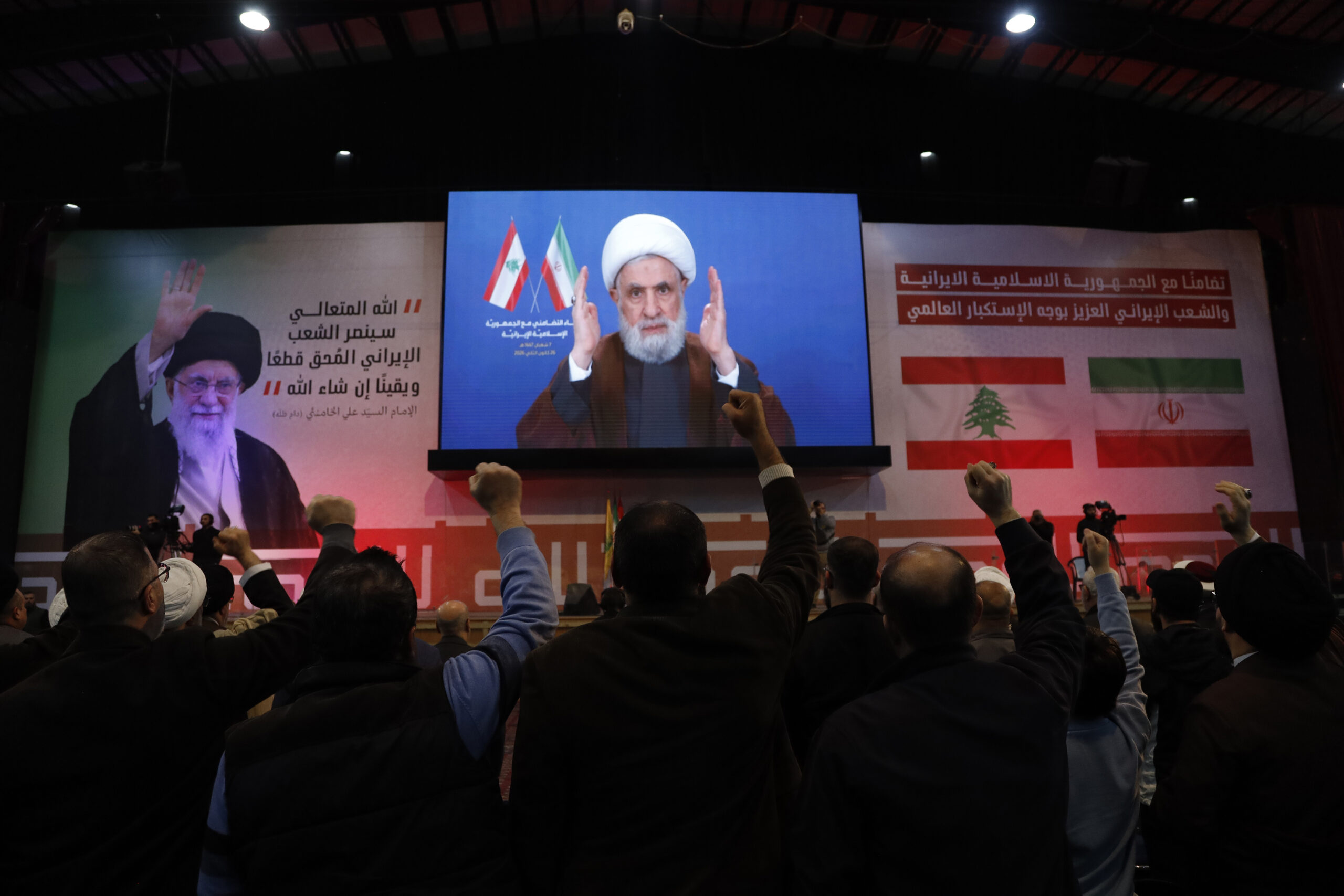
BEIRUT—Following the inconclusive end of the month-long Hezbollah-Israel conflict in 2006, Hezbollah fighters began referring to the “last war with Israel,” a climactic future confrontation in which there would be no restrictions on the use of force and from which only one winner would emerge. When Hezbollah launched its conflict with Israel on October 8, 2023, there was an initial fear in Lebanon that this was the beginning of the long-awaited “final war.” After nearly a month of border clashes, then Hezbollah leader Sayyed Hassan Nasrallah made it clear in his first speech that the “support front” for Hamas in Gaza was but one battle “on the road to Jerusalem” and not a final confrontation.
However, the ongoing US-Israeli attacks on Iran and the assassination of Iranian Supreme Leader Ali Khamenei have changed the calculus. Hezbollah is now embarking on what fighters and others close to the organization describe as the “last war,” and the group is fully committed to a long and painful confrontation with Israel. “There won’t be another one after this. Either we win or they win,” a veteran Hezbollah source told me.
Hezbollah entered the war in the early hours of March 2 by firing several rockets from an area north of the Litani River, targeting an Israeli military base near Haifa. Curiously, there is a growing conviction that the decision to join battle was not made by Hezbollah’s political leadership. Instead, it may have been coordinated directly between the Quds Force of Iran’s Islamic Revolutionary Guard Corps and the Islamic Resistance, Hezbollah’s armed element. This was confirmed to me by several people close to and inside Hezbollah.
According to a diplomatic source, as soon as reports of the initial rocket fire spread, a senior Lebanese official contacted Hezbollah’s political leaders and asked if they were responsible. The response was a hesitant “maybe.” The official urged Hezbollah to issue a statement denying responsibility. Hezbollah agreed, wrote a statement, and sent it to the official for approval. But by the time the official returned the statement, Hezbollah informed him that it was too late and that the Islamic Resistance had released its own statement confirming responsibility for the cross-border attack. The anecdote indicates that Hezbollah’s political leadership may have been unaware in advance of the rocket attack into Israel.
The decision to strike
Although Khamenei’s assassination in the opening hours of the war on Iran was a shock for Hezbollah, there was no indication that it was planning an imminent retaliation. Even Hezbollah leader Sheikh Naim Qassem’s statement mourning the loss of Khamenei contained no threats of revenge, only pledges to follow the supreme leader’s path.
Emerging differences between the Islamic Resistance and Qassem, who was elected secretary-general in October 2024 following the death of Nasrallah, have been growing more apparent for some time. Before the latest US-Israeli operation in Iran, Qassem seemed to want to steer Hezbollah in a more Lebanon-centric direction. He had, for example, focused attention on restructuring Hezbollah, centralizing the decision-making process, and tightening security. He had also taken steps to reduce the size of the Islamic Resistance, sideline officials who were close to Nasrallah, and promote figures with more of a political than religious, security, or military background. In part, these efforts were an attempt to streamline an organization that has grown too large and unwieldy, and thus vulnerable to penetration by Israeli intelligence. Another reason was to strengthen Hezbollah’s domestic position at a time of unprecedented pressure due to the battering it received in the 2023–24 conflict and the Lebanese government’s decision this past August to have Hezbollah disarmed.
My Hezbollah source emphasized that Qassem is a pragmatist who seems to adhere more closely to the line of Imam Hassan than his younger brother Imam Hussein, both of whom are historical figures revered by Shias. The description requires a brief history lesson to understand its import. Imam Hassan was the second caliph after the assassination of his father, Ali. He struck an agreement with his enemy Muawiya, the governor of Syria, in which he relinquished the title of caliph to Muawiya in exchange for a treaty intended to preserve the peace. Shia tradition interprets Imam Hassan’s decision as a strategic and moral choice to avoid unnecessary bloodshed. The agreement outlived Imam Hassan and Muawiya but was breached by the latter’s son, Yazid, spurring Imam Hussein to launch his doomed uprising that culminated in his death and that of his companions at the Battle of Karbala in 680 AD.
Comparing Qassem to Imam Hassan suggested that the Hezbollah leader might have preferred to avoid entanglement in a war with Israel that would prove highly destructive for Lebanon. Hezbollah’s Shia support base in Lebanon would likely bear the brunt of any major conflict, and it could prove existential for the organization as a viable political, let alone military, entity.
Much of this is now moot; Hezbollah has entered the conflict and will have to let the chips fall where they may. The reaction of the Lebanese government to the launching of rockets into Israel came quickly. The cabinet held an emergency meeting within hours and banned all Hezbollah’s military and security activities. Implementing this decision is another matter, and any serious moves in that direction may not occur until the current conflict is over. Nevertheless, the unprecedented step underlined the government’s sense of frustration and anger that Lebanon has been dragged into a fresh conflict not of its choosing.
“An existential battle”
In his first comments on entering the war, Qassem, setting aside any presumed private misgivings, played down the linkage to the war on Iran and the assassination of Khamenei. Instead, he said Hezbollah’s actions were the result of its patience being exhausted after fifteen months of Israeli occupation in parts of south Lebanon, and as Israeli forces continue near-daily air strikes against his organization’s cadres and facilities. Qassem added that war was “an existential battle” and that “surrender is not an option.”
Sources within and close to Hezbollah tell me that the organization has committed as many as thirty thousand fighters to the battle, some of them drawn from the elite Radwan unit currently deployed in south Lebanon. They are well trained, motivated, and eager to fight. Many fighters had grown frustrated at Hezbollah’s policy of “strategic patience” by turning the other cheek to Israel’s repeated attacks. The existential nature of this conflict for the Iranian regime and possibly for Hezbollah has helped galvanize ideological and religious sentiment to drive the fighters onwards. A letter addressed to the fighters this past week from the leadership of the Islamic Resistance was filled with references to “Karbala” and “jihad” to inspire the cadres. The letter urged the fighters to battle “the tyrants of this age—the killers of prophets and saints, the ‘Great Satan’ America and the cancerous tumor ‘Israel,’” and to fight their enemy “like the self-sacrificing fighters of Karbala.”
So far, Hezbollah’s operations are following a similar pattern to the 2023–24 conflict: confronting Israeli troops on the ground in southern Lebanon, and firing rockets, precision-guided missiles, and suicide drones across the border at targets in Israel. In the previous confrontation in 2023–24, Hezbollah fought with one hand tied behind its back because the Iranians refused to allow the organisation to employ its full arsenal of precision-guided missiles in sufficient numbers to have an effect, a source of great bitterness among the cadres at the time. However, in this battle, there are believed to be no restrictions on the weaponry and tactics that can be used. On March 9, Hezbollah said that it had fired a barrage of precision-guided missiles at a satellite communications station belonging to the Israeli army’s Cyber Defense and Communications Division in the Ella Valley, ninety-five miles south of the border. Two of the missiles struck the site and caused significant damage, judging from footage on social media, in what was Hezbollah’s deepest ever attack into Israel.
At this stage, it is unlikely that Hezbollah is considering cross-border raids into Israel, a tactic for which the Radwan Brigade had trained but is today far harder to achieve given the Israeli troop presence inside Lebanese territory.
Hezbollah’s strategy, likely in coordination with Iran, appears to be to inflict as much pain on Israel for as long as possible in the hope that a settlement is reached between the warring parties that essentially leaves the regime in Tehran in place. Where that result would leave Hezbollah remains to be seen.
The response from Israel
This past week, Israel issued large-scale evacuation warnings for dozens of towns and villages in south Lebanon, both north and south of the Litani River, as well as for the southern suburbs of Beirut. The latter evacuation order on March 5 caused panic and massive traffic jams across Beirut as tens of thousands of residents attempted to flee ahead of a series of Israeli air strikes. Initial Israeli ground operations suggest an intention to deepen an existing buffer zone the army maintains adjacent to the Blue Line, the United Nations term for Lebanon’s southern border.
Whether the Israelis push further into Lebanon, possibly as far as the Litani River, remains to be seen. Such a step would require a significant military effort and risk an increase in casualties. The area is too large for Israel to occupy for any length of time, which suggests that it may prefer to employ airpower and artillery to destroy populated areas rather than deploy ground forces in large numbers. After all, in the previous conflict in the so-called Sixty-Six-Day War in October and November 2024, the Israeli military was modest in its territorial reach. Mainly special forces units ventured no further than five miles into Lebanese territory, moving on foot, with tanks playing fire-support roles. These operations concentrated on dynamiting villages immediately adjacent to the Blue Line. The geography of south Lebanon, with its steep hills and wooded valleys, is not advantageous for armored columns, as the Israelis have learned to their cost in the past. This lesson could now weigh against a more ambitious push into Lebanon.
It is far too soon to predict with any certainty when and how this war will end. Its fate is intertwined with the convolutions of the ongoing conflict with Iran. But even if the Iran war draws to some form of closure, the Hezbollah-Israel front may well continue until Israel is satisfied that Hezbollah can no longer exist as a military force.