
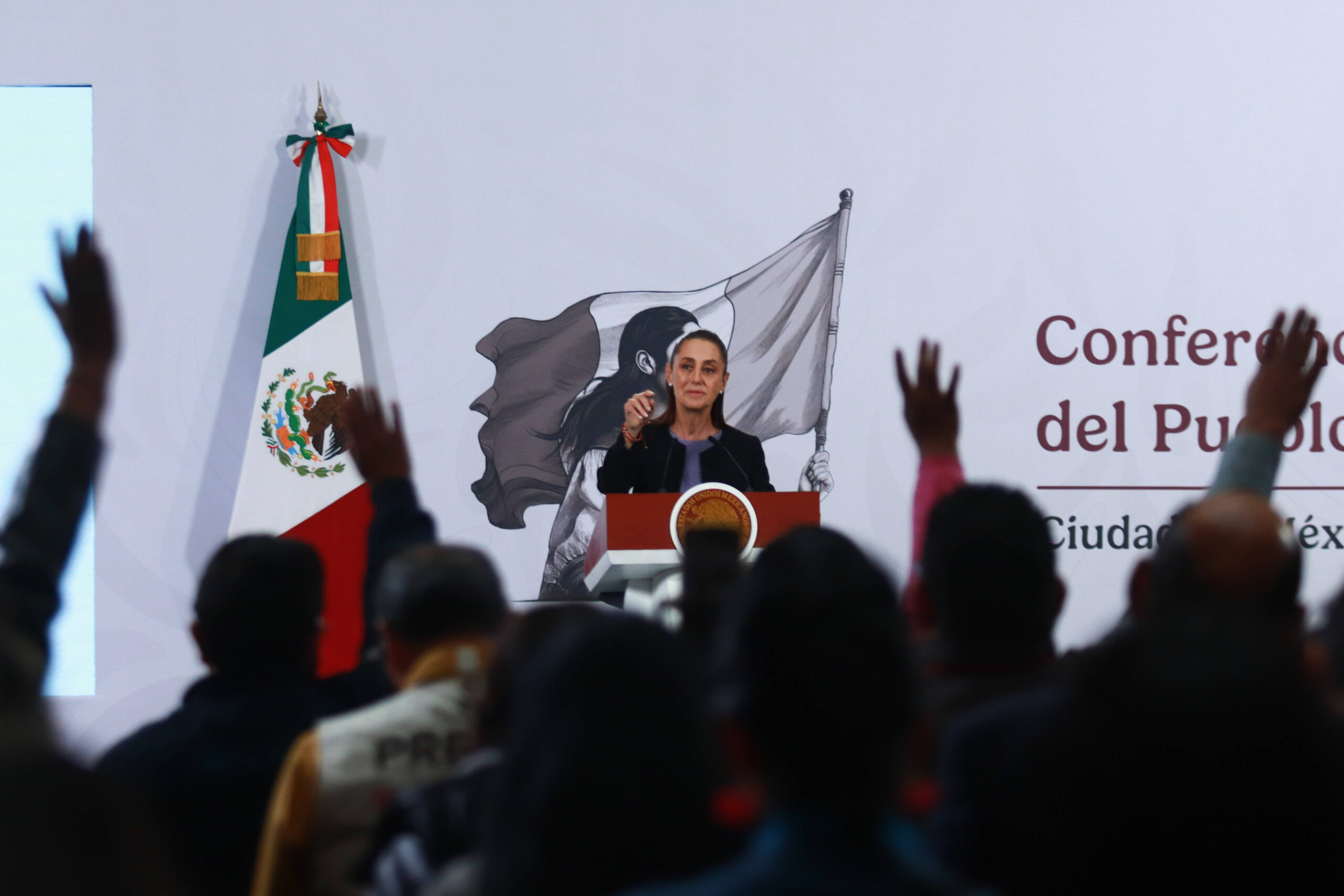
MEXICO CITY—The pressure is mounting in Mexico’s capital as the country faces a summer deadline that will captivate world attention. For locals in Mexico City, that means the impending June 11 deadline—just four months away—when the World Cup kicks off with an opening match at the iconic Estadio Azteca. This is why crews are working around the clock for a much-needed remodeling of the Mexico City International Airport and why other repairs are being done across the city.
But pressure is mounting, too, on Mexican business and policy leaders, who are also working full-time ahead of the July 1 deadline for the mandatory review of the United States–Mexico–Canada Agreement (USMCA), the trilateral trade pact US President Donald Trump struck in his first term. These officials and private-sector leaders are devising options for addressing US concerns about the agreement, as well as putting forward their own suggested fixes. The lead-up to that deadline, which falls during the World Cup’s round of thirty-two, is unlikely to capture the world’s attention as much as the major quadrennial sporting event, but it will nonetheless have far-reaching consequences for the economies of countries in North America and beyond. By July 1, the three parties must decide either to extend the trade deal or trigger annual reviews that could lead to its termination.
So, what is the reaction to reports that Trump is considering withdrawing from the agreement? During my visit to Mexico City this week, I sensed concern about the implications of termination but minimal anxiety that this may be the road ahead. Both countries continue to have fluid, regular dialogue around the USMCA. And similar comments have been made previously. There’s also a recognition that the US president is quite adept at making statements that elicit media attention as part of his broader negotiating tactics. Most of all, recent musings are a clear signal from Trump that—like any other deal—nothing is off the table.
The USMCA review is a potential game-changer in the commercial world.
Rewind to December, when both Trump and US Trade Representative Jamieson Greer each noted in different circumstances that the USMCA review could yield a number of possible outcomes. This past December 3, Trump said in reference to the USMCA, “We’ll either let it expire, or we’ll maybe work out another deal with Mexico and Canada.” A week later, Greer said at the Atlantic Council that the agreement’s future is far from certain, noting: “So, you know, could it be exited? Yeah, it could be exited. Could it be revised? Yes. Could it be renegotiated? Yes. I mean, that is the purpose of that clause. And all of those things are on the table.” The US trade representative added that “it makes sense to talk about things separately with Canada and Mexico.”
Mexican officials I have spoken with are focused less on the scenarios around agreement termination and instead prioritizing how to address issues such as the Section 232 steel and aluminum tariffs, which were increased to 50 percent this past June with the removal of previous exemptions. Their attention is also on increasing the competitiveness of the auto industry and ensuring overall predictable enforcement of the USMCA. At the same time, US concerns range from curtailing the rise of Chinese investment in Mexico (including ensuring that rules of origin are not bypassed and that Mexico is not a back door into the US market) to energy access and auto rules of origin.
Another lingering question is how to resolve broader USMCA questions in a context in which Trump and Mexican President Claudia Sheinbaum have established a good working relationship, but the same cannot be said for Trump and the leader of the United States’ northern neighbor. Relationships matter, and Trump’s relationship with Canadian Prime Minister Mark Carney is fraught. And for Mexico, the United States is the more important USMCA partner. In 2024, for example, more than 80 percent of Mexico’s goods exports went to the United States, and more than 40 percent of imports to Mexico came from its neighbor to the north. The same year, just 3 percent of Mexico’s exports went to Canada. So Greer’s discussion at the Atlantic Council of the possibility of bilateral deals is welcome news for many in Mexico. It’s a path forward to avoid Mexico getting embroiled in the more challenging US-Canada disputes.
The USMCA review is a potential game-changer in the commercial world. It’s a unique mechanism to make an agreement work better without having to go completely back to the drawing board. But it also creates uncertainty as the review deadline approaches. Trump will likely continue to question the utility of the USMCA throughout the spring as negotiators seek to get the best deal. Ultimately, however, with Mexico accounting for 15 percent of US exports, and with the US economy—as it usually does—figuring prominently in midterm elections this year, expect the White House to negotiate the best adjustments to the agreement to benefit US interests, but also to do so with the notion that economic certainty will be increasingly important in this election year.