
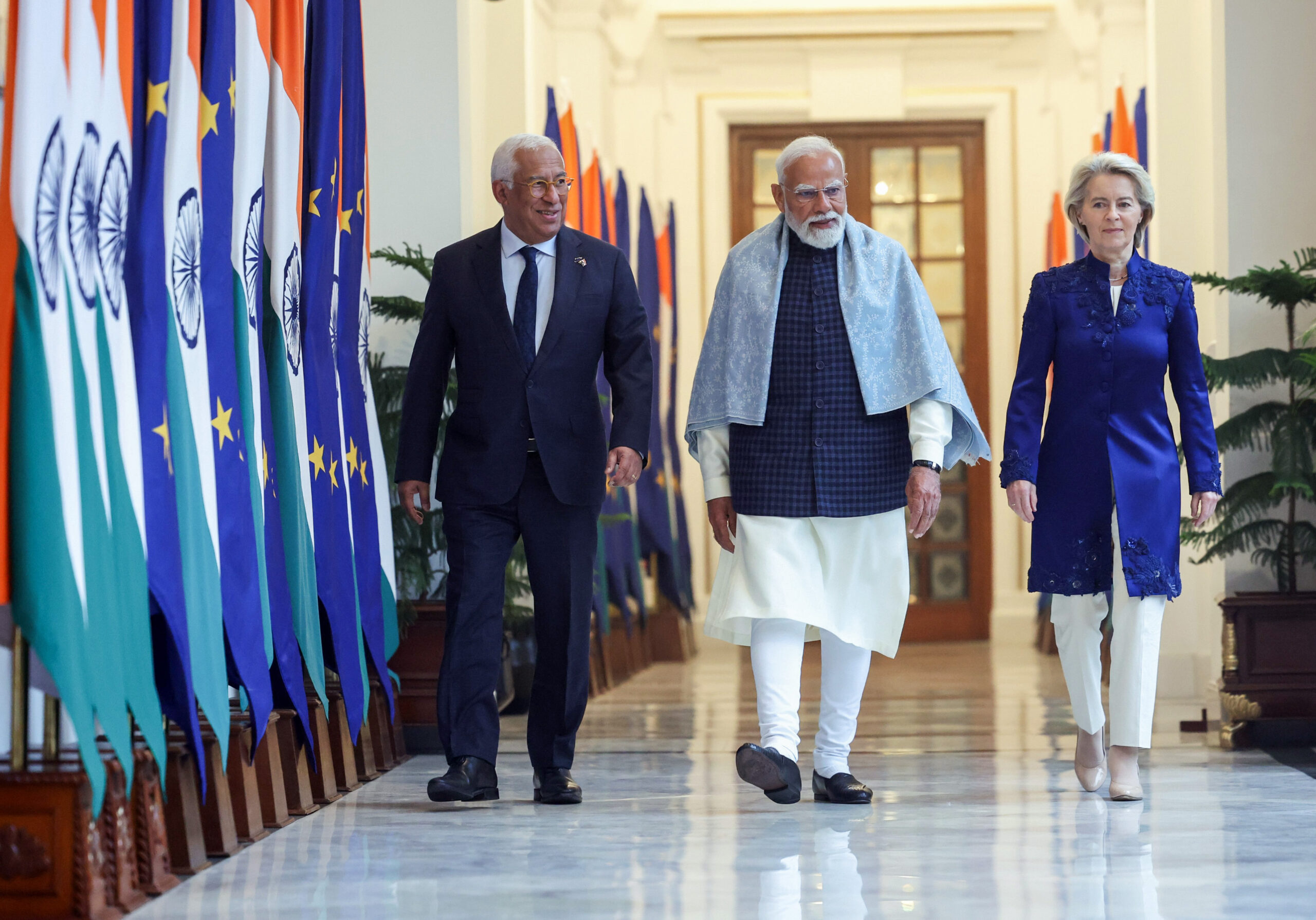
WASHINGTON—References to the “mother of all deals” are a clear case of political hyperbole, but there should be no doubt that the India–European Union (EU) free trade agreement (FTA) warrants attention. When two of the biggest economies in the world agree to eliminate a significant proportion of their trade barriers, particularly at a time when almost any trade deal captures news headlines, governments and stakeholders around the world should take notice.
The EU and India have been at this negotiation for roughly two decades, although with several long pauses. This negotiating duration is the clearest indicator of how complex and difficult it was to conclude this agreement. The United States and the EU have their own failed experiment in the form of the Transatlantic Trade and Investment Partnership (TTIP), which collapsed after several years of negotiations during the Obama administration.
But observers also shouldn’t rush to conclusions about the deal redirecting global trade, speeding up economic integration, or jump-starting economic growth. In the end, the India–EU FTA may have only a modest impact using all these yardsticks.
More to follow
First things first: The results are incomplete and will require follow-up action. Many of the early press reports breezily skip through this reality. As forecast by both sides in the closing months of negotiations, there will be unfinished business to attend to soon after the signing ink is dry. It’s always the most sensitive issues that take the longest, and India and the EU have conveniently set some of these aside in the rush to conclude an agreement in time for the bilateral summit and European Commission President Ursula von der Leyen’s visit on India’s Republic Day.
For example, there are likely to be follow-up negotiations on agriculture, intellectual property rights, and the EU’s Carbon Border Adjustment Mechanism, among other issues. That said, the fact that there is unfinished business should not diminish the accomplishment of reaching agreement on preferential tariff schedules and a large number of detailed rules chapters, such as Technical Barriers to Trade.
Additionally, each trading partner must jump through domestic approval hoops. In the case of the EU, that involves obtaining a “qualified majority” (essentially, a double majority of member states and the represented population) through the Council of the European Union and separate approval from the European Parliament.
Acknowledging the limits
The India–EU FTA will not significantly alter existing supply chains, although it can make the India–EU ones more resilient. Nor is it likely to result in trade diversion from other major trading partners. Although the FTA will include a number of new disciplines for persistent and difficult non-tariff barriers, the headline numbers from the announcement will be tariff reductions on both sides. In fact, EU tariffs are already low in general, and the benefits to India in those sectors where EU tariffs are high may be offset by the EU’s action earlier this month to eliminate preferential treatment for India under its Generalized System of Preferences (GSP) program. For example, the GSP program kept India competitive with the likes of Bangladesh in the EU market for textiles and apparel. Now, the FTA may simply replace a low GSP tariff with a new bilateral FTA tariff.
For the EU, its benefits from tariff reductions are likely to emerge slowly, and transition periods for tariff reductions suggest that there will not be immediate substantial increases in exports. That said, an FTA provides a degree of certainty, stability, and predictability in market access that is absent with no trade agreement in place. Existing supply chains between the EU and India can be reinforced in the short term and even grow over the longer term.
The view from Washington
While the agreement may be interpreted as a response to the Trump administration’s tariffs and tariff threats, there is no reason it should undermine the US trade relationships with either the EU or India. Indian and EU trade negotiators have been pushed to their limits by the agendas of political leaders and responded impressively, even in orchestrating work-arounds in areas, such as geographical indications and sustainability commitments, that have long been part of the immutable template for EU FTAs with other countries.
No doubt, journalists and many other commentators will pronounce cause and effect between the Trump administration’s tariffs and the India-EU FTA, but the history of the negotiation suggests otherwise. The current push to the finish line actually began during the Biden administration. While the Trump administration’s predictable unpredictability on tariffs has been important context for the accelerated timetable, the EU and India have long understood the economic and strategic value of striking a substantial trade deal between the two of them.
The EU–India deal could even light a fire under efforts to conclude a US–India trade deal and help to move negotiations forward on a comprehensive bilateral trade agreement, as US President Donald Trump and Indian Prime Minister Narendra Modi discussed last year.