
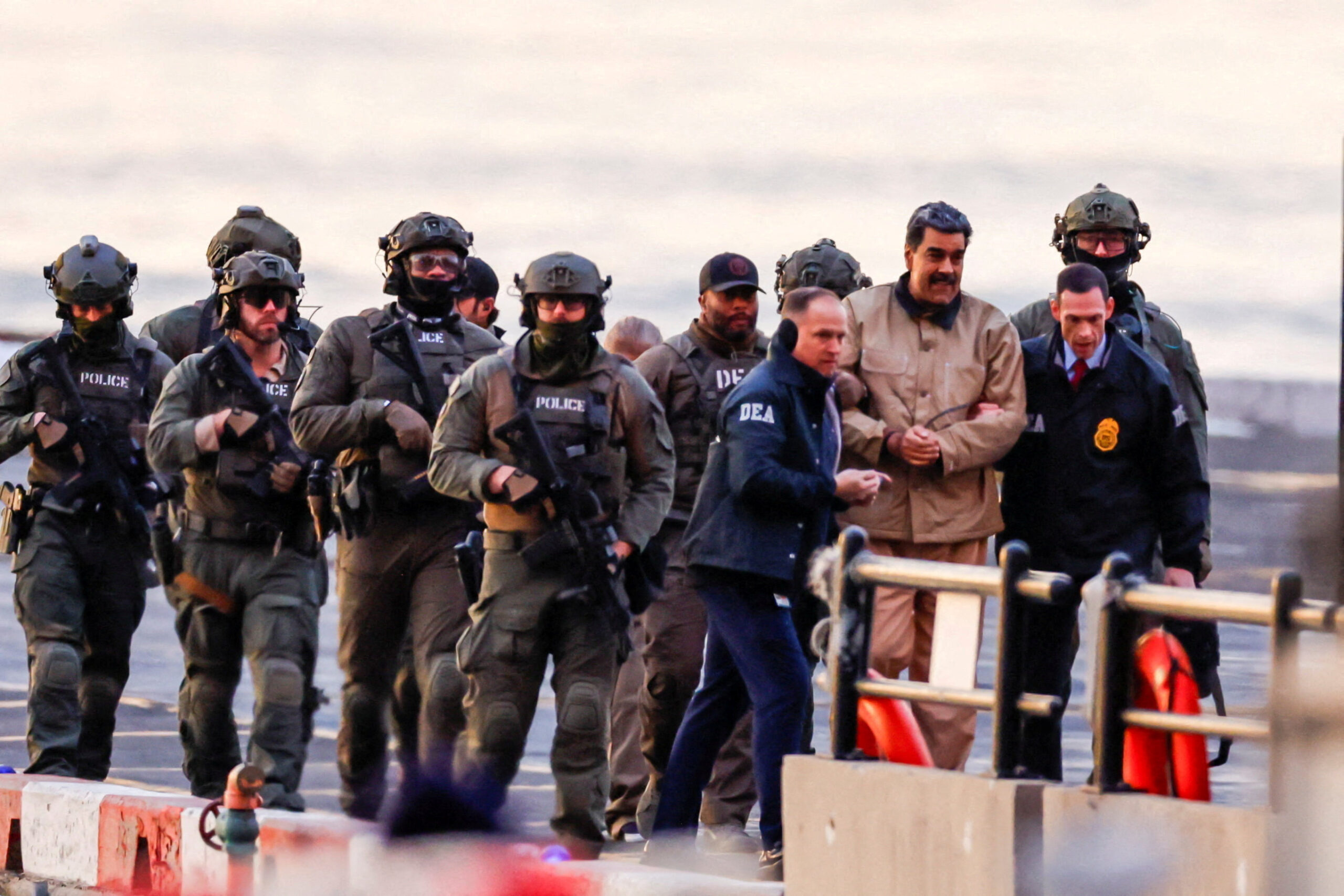
WASHINGTON—The daring US operation that captured Venezuelan dictator Nicolás Maduro and transported him to the United States to stand trial for his crimes signals a dramatic shift in US foreign policy, with implications far beyond Venezuela. The Trump administration’s decision to depose the Maduro regime is the embodiment of its recent National Security Strategy (NSS), which prioritized the defense of the US homeland and the Western Hemisphere.
While most National Security Strategies are quickly forgotten, both of Trump’s strategies have served as reliable guides to his approach to foreign affairs. His 2017 NSS announced a US focus on great-power competition, principally with China, and heralded an important shift of the United States’ attention after decades of Middle Eastern preoccupation. The president’s 2025 NSS, released in December, set about prioritizing US security interests globally and identified protection of US territory and the Western Hemisphere as the central tasks of US foreign policy. Importantly, the NSS also carved out a “Trump Corollary” to the Monroe Doctrine, citing malign activity by “extra-hemispheric powers” as a serious threat to US national security.
As such, the recent Venezuela operation should be understood as of a piece with the president’s earlier focus on acquiring Greenland, his calls for resuming US control over the Panama Canal, and his interest in stemming the flow of narcotics trafficking and illegal migration in the hemisphere. In each instance, extra-hemispheric influence has played a significant role in galvanizing Washington’s concern: Chinese outfits own key facilities along the canal. Russia and China conduct military activity near Greenland and in the High North. And Beijing, Moscow, and Tehran hold long-standing influence in Caracas. With the Maduro capture, Washington is sending a powerful signal that it is taking the NSS seriously, and that it is prepared to act swiftly to enforce the Trump Corollary.
The Trump administration’s decision to depose the Maduro regime is the embodiment of its recent National Security Strategy.
Beijing’s ambitions in the Western Hemisphere have long been a concern for Washington, but recent trends are particularly alarming. In late December, reports emerged that China’s People’s Liberation Army was conducting war games simulating combat in the Western Hemisphere. This news came shortly after Beijing published an official strategy for Latin America that takes an increasingly belligerent tone in asserting its regional interests there. China actively supports the destabilizing Cuban regime, including by maintaining a surveillance post on the island just ninety miles from US territory. With Beijing increasing its efforts to extend coercive economic diplomacy across the hemisphere and its public interest in West African naval access fronting the Atlantic Ocean, the Trump Corollary seems poised to clash with China’s strategic posture.
The sheer number of potential flashpoints between the United States and great-power rivals such as China under the rubric of the Trump Corollary demonstrates an important point about the administration’s strategy: While the new NSS is primarily a document about narrowing and prioritizing US objectives globally, with a lesser focus on Europe and the Middle East, it is wholly committed to an expansive vision of US interests in the Western Hemisphere. This is likely to lead to near-term adjustments to US policy, with the goal of better operationalizing the Trump Corollary to address the hemispheric challenges facing the United States.
Here are three areas to watch in the coming months.
First, under the rubric of “hemispheric defense” that guided US security strategy in the hemisphere for decades, the Trump administration should expand the geographic definition of the hemisphere for the purpose of applying the Monroe Doctrine and the Trump Corollary. By stating unambiguously that the hemisphere is broadly defined as the Aleutian Islands to Greenland and the North American Arctic to Antarctica—with Central and South America and the Caribbean in between and the Pacific and Atlantic approaches to the hemisphere included—the administration could effectively place the region in lockdown, preventing encroachment by China, Russia, and Iran.
Second, to operationalize hemispheric defense going forward, the administration should expand the rotational and permanent deployment of US land, naval, Coast Guard, and air assets in the hemisphere. As the Trump administration works to reposition US forces from legacy bases in Europe and the Middle East, it could simultaneously expand or reopen US facilities in Puerto Rico and the US Virgin Islands. It could also seek to establish or expand rotational or permanent access agreements with US partners such as El Salvador, Ecuador, the Dutch Caribbean islands of Aruba and Curaçao, Guyana, Trinidad and Tobago, and others.
Beyond these countries, Washington could seek a more expansive agreement with Costa Rica, which lacks a permanent military and currently allows the US military access on a case-by-case basis. A new agreement with Costa Rica could look like the comprehensive defense arrangements the United States enjoys with Pacific Island partners such as the Marshall Islands, Palau, and Micronesia. Similarly, as the administration explores its options for a broader political solution to the president’s desire to acquire Greenland, the United States could request expanded access to the island under the 1951 defense agreement and begin prepositioning anti-submarine warfare and Arctic training assets there to counter Chinese and Russian malign activity in the High North.
Third, the administration can begin leveraging such force posture changes to actively deter malign activity and advance US interests in the hemisphere. Greater US forward presence in the region would, among other outcomes, help deter Chinese and Russian collaboration with the Cuban regime, which has spread chaos and destabilization across Latin America for decades. Expanding the US presence in Costa Rica and the Dutch Caribbean would help ensure access to the Panama Canal while the administration seeks broader solutions to Chinese influence. A stronger US Coast Guard and naval presence in the Caribbean would help combat narcotics trafficking and illegal migration that pose a direct threat to the US homeland. Further north, increasing US assets in Greenland would contribute to Arctic security.