
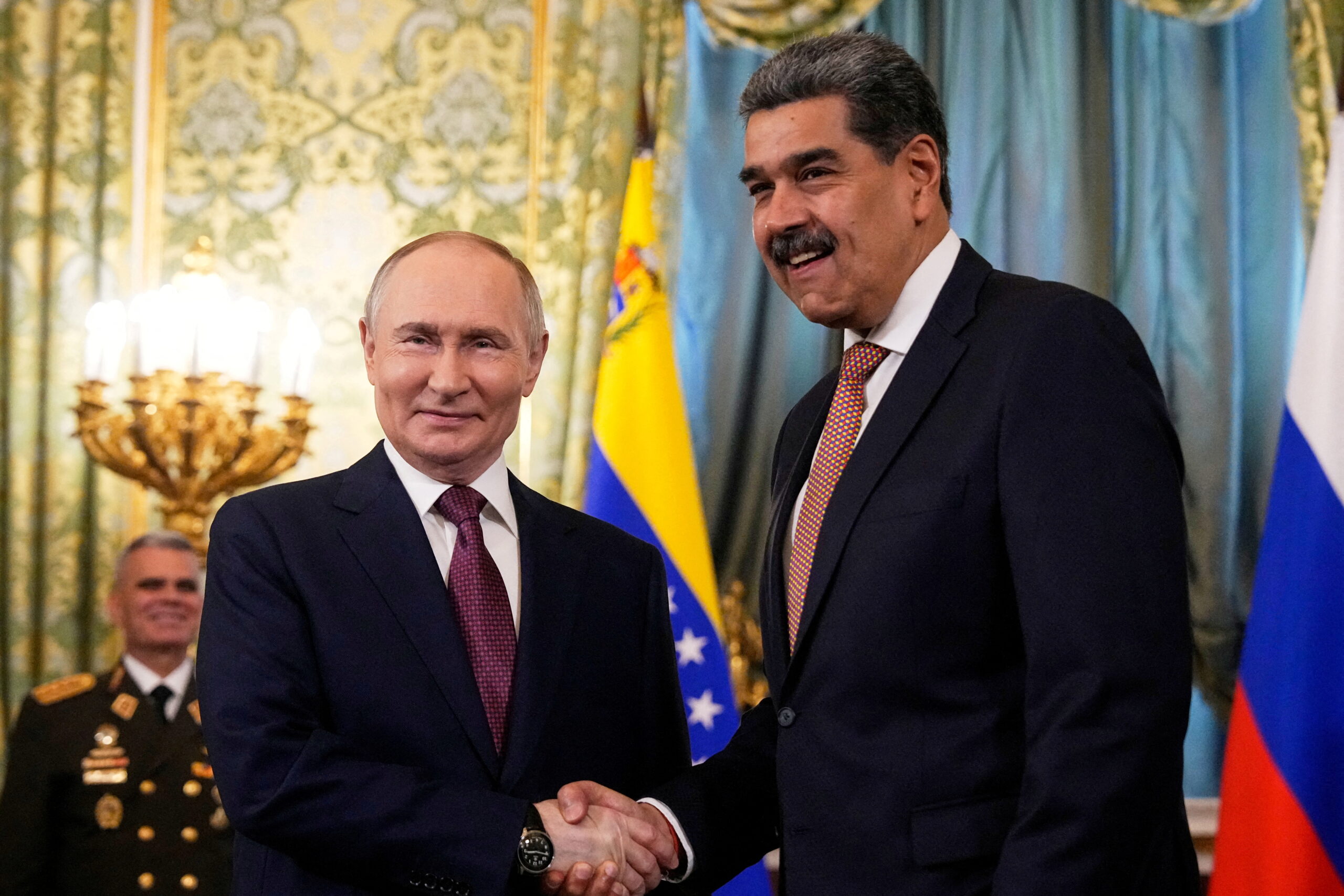
WASHINGTON—The Trump administration’s bold operation on January 3 meant the end of the Maduro dictatorship, but it was also another blow to Moscow’s political prestige. It is the second time since President Donald Trump returned to the White House that he demonstrated the United States could act against a Kremlin ally with impunity. When the United States delivered a massive blow to Iran’s nuclear program this past June, Putin could offer little effective support. The Russian president was reduced to bluster, just as he is now.
As US pressure on Venezuela began to build in the fall, Venezuelan strongman Nicolás Maduro was hoping for tangible support from Moscow. According to The Washington Post, he wrote to Putin in October asking for drones, missiles, and radars. His request was not met.
Putin himself has not commented yet on the US operation in Venezuela, but Russian Foreign Minister Sergey Lavrov phoned acting Venezuelan President Delcy Rodríguez on Saturday to express “strong solidarity” with the government, and the Russian foreign ministry publicly demanded that the United States release Maduro. That’s it.
Limits on Russian capabilities explain much of this muted response. Russia may be a nuclear superpower, but its conventional military has limited ability to project power and, as its problem-plagued war on Ukraine has demonstrated, is characterized by clear weaknesses when fighting near home. Indeed, Putin’s aggression in Ukraine is his overwhelming priority, and it has stretched, if not exhausted, his military and greatly weakened Russia’s economy. Simply put, the Russian president does not have the resources for further foreign adventures, a fact noted by some of the Russian voenkory, or war bloggers on Telegram. That was evident even before Trump’s second term as Moscow watched in late 2024 as its half-century alliance with the Assad regime in Syria collapsed when Islamic rebels took control.
But these material limits are not the only factors driving Kremlin policy. There is also the question of Putin’s approach to managing Trump’s efforts to achieve a durable peace ending Russian aggression in Ukraine. Trump has said multiple times that in order to establish this peace, he would put major pressure on the side unwilling to make peace. Kyiv has said yes to numerous US proposals to end the fighting, and Moscow has rejected every one. But by skillful diplomacy with Trump and some of his subordinates, Moscow has avoided new US sanctions (with one large exception) and the transfer of more potent US weapons to Ukraine. This must be foremost on Putin’s mind, and he does not want to waste any capital with the US president on Venezuela. Trump himself gave Putin reason for caution when asked about the Russian president during his press conference on the Maduro snatch. Trump replied by expressing his displeasure with Putin for the ongoing killings in Ukraine.
While Putin will avoid doing anything to provoke Trump over Venezuela, the operation will likely weaken Russia’s war effort. Putin’s struggling economy rests on the income coming from its oil and gas sales—already under pressure thanks to Ukraine’s US-aided drone and missile strikes on its hydrocarbon installations. Trump has said he intends to put Venezuelan oil—still under tough sanctions—back on the market. While this may take some time, it will help him reach his goal of driving down oil prices for US (and therefore global) consumers. This will be another big hit to the Russian economy.