
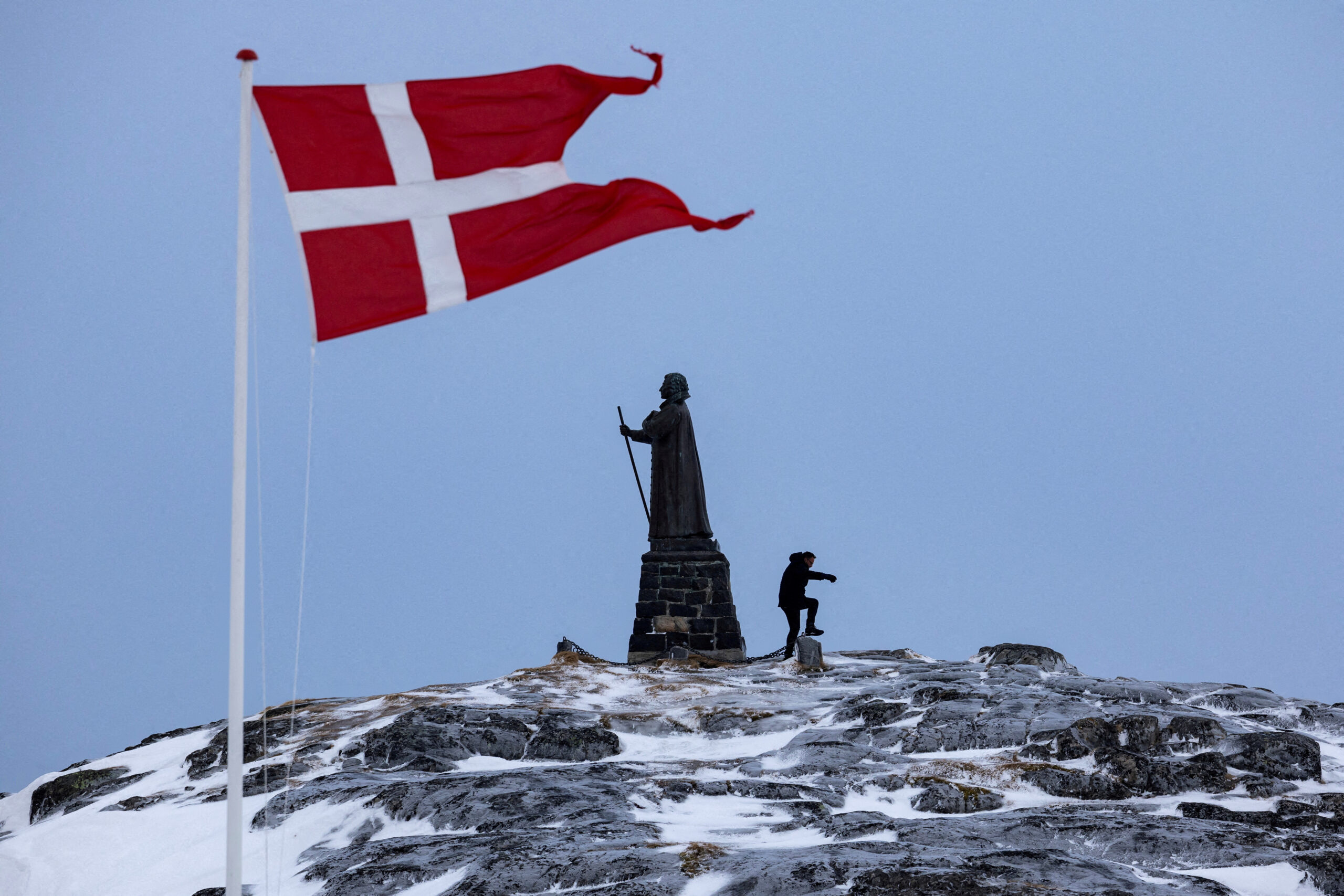
STOCKHOLM—After a bumpy start with the new Trump administration in 2025, NATO enters 2026 facing what could become the worst crisis of its existence. “We need Greenland from the standpoint of national security,” US President Donald Trump said on Sunday, ignoring the warnings of Danish Prime Minister Mette Frederiksen that the United States should stop threatening the Kingdom of Denmark or it might lead to the end of NATO.
Following the US intervention in Venezuela and the capture of Venezuelan leader Nicolás Maduro on Saturday, the wife of Trump’s close adviser Stephen Miller, Katie Miller, a Republican podcaster, posted on social media a map of Greenland covered by the American flag and accompanied by one word in capital letters: “SOON.” Sparking harsh reactions in Europe, the remarkable post was followed by Stephen Miller himself, who stated that Greenland should be part of the United States and that no one would militarily challenge a US takeover.
For NATO, this means the worst possible start to the year. The possibility that the United States, the leading member of the Alliance, would use its might to annex part of another ally’s territory is almost beyond imagination and a nightmare for NATO Secretary General Mark Rutte. As expressed in the first paragraph of the North Atlantic Treaty, the Alliance rests on the principles of the United Nations Charter that international disputes are settled by peaceful means, and that the parties refrain in their international relations from the threat or use of force inconsistent with the charter.
Should the darkest hour come and the United States uses military force to annex Greenland, the essence of Article 5 and collective defense within NATO would lose its meaning.
Denmark is a founding member of the Alliance, and it has been a loyal ally since 1949. In Afghanistan, Denmark fought alongside the United States in the tougher mission areas and suffered the most casualties in relation to its population of all NATO allies, apart from the United States.
There is nothing new about Greenland’s importance to US national security. An autonomous part of the Kingdom of Denmark, Greenland has hosted a US military base since the 1950s for exactly that reason. A 1951 treaty between the United States and the Kingdom of Denmark allows for increased US presence on Greenland if requested. But that is not what Trump is looking for, as the harsh dialogue between Copenhagen and Washington over the past year has revealed. The Trump administration argues that Greenland is part of the Western Hemisphere, and as such it should belong to the United States, which Greenland clearly opposes. This extraordinary US stance, in flagrant disrespect of international law, has caused the Danish defense intelligence service to flag the United States as a concern to Danish national security.
More broadly, the Trump administration’s stance risks dissolving the transatlantic community and putting an end to the most successful military alliance in history.
Trump has nurtured the idea of US ownership of Greenland for a long time. In his first term, he suggested a US purchase of the island on several occasions. When reelected, Trump renewed his interest, stating that “the United States of America feels that the ownership and control of Greenland is an absolute necessity.” This time, he did not rule out the use of military force to get it. A few months later, when Rutte visited the White House, Trump suggested that NATO could help him get Greenland, a request that Rutte declined.
Trump has defended his stance, saying there are “Chinese and Russian ships everywhere” near Greenland and that Denmark cannot protect it. Former National Security Advisor Mike Waltz has emphasized the need for the United States to access Greenland’s vast natural resources. But since Denmark has signaled that the United States is welcome to increase US troop numbers on Greenland should it so wish, and Greenland has announced that it is open for business if US companies are interested, neither of these arguments make sense.
Perhaps importantly, there is a parallel interest in Greenland stemming from the tech giants with close connections to the Trump administration. As reported by Reuters and The Guardian, a circle of US tech entrepreneurs and venture capital figures is promoting Greenland as a potential site for so-called “freedom cities” and large-scale extraction and infrastructure projects. These ideas are framed through libertarian concepts of minimal corporate regulation and ambitions spanning artificial intelligence, space launches, and micronuclear energy. Several of these actors are among Trump’s largest campaign donors and investors, including investors linked to mining operations in Greenland, fossil fuels, and cryptocurrency ventures. Collectively, this cohort reportedly contributed more than $240 million to his 2024 campaign and potentially stand to benefit from a US takeover of the island.
As the United States starts implementing the “Trump corollary” to the Monroe Doctrine, first by intervening in Venezuela and then quickly threatening Cuba, Colombia, Mexico, and Greenland, Europe is witnessing its strongest ally voluntarily retreat from global leadership to excel in regional dominance. “This is OUR hemisphere”, the State Department declared in an X posting on Monday to underline the launch of its new strategy, presumably sending a message to Russia and China. However, from a NATO perspective, where does this leave allies such as Canada and Denmark? Are they targets of this message as well?
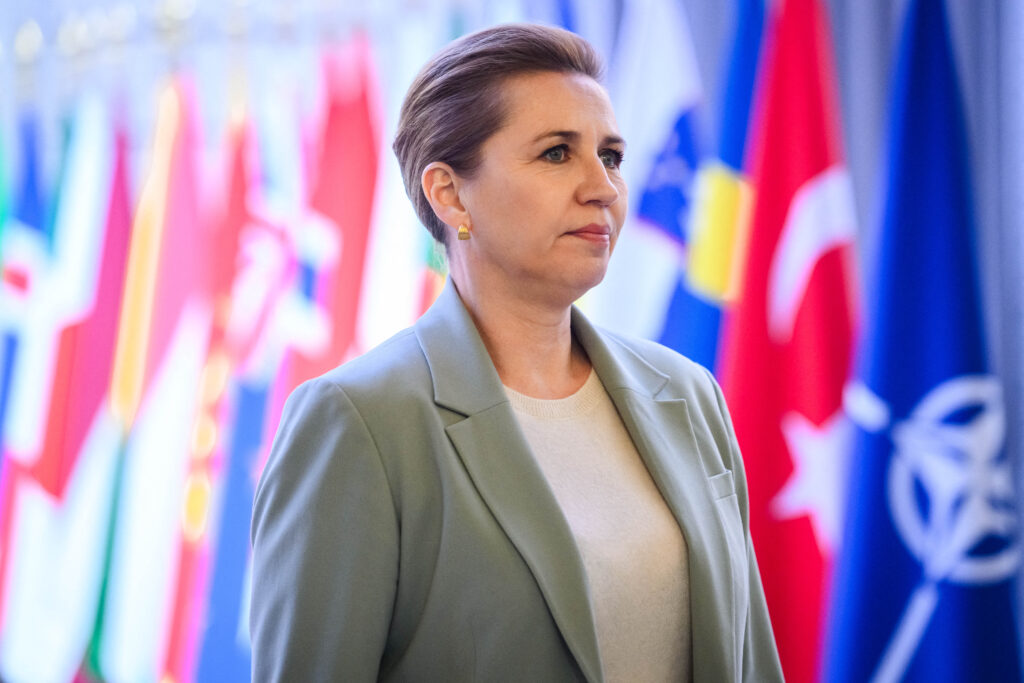
Copenhagen certainly feels that way. In the past year, Denmark has substantially increased its military support in the Arctic. In January 2025, it committed 14.6 billion kroner ($2.05 billion) to Arctic defense, followed by an additional 27.4 billion kroner ($2.7 billion) later in the year. Denmark has also invested in its relationship with Greenland, including a formal apology for government abuses against Inuit women involving forced birth control in the 1960s and 1970s. On Monday, Greenland’s prime minister, Jens-Frederik Nielsen, downplayed concerns of a military takeover and repeated to the Trump administration that Greenland is not for sale. Nor, he said, are the people of Greenland interested in voluntarily becoming part of the United States.
The Trump administration’s latest escalating rhetoric about seizing Greenland has sparked intense activity in European capitals in support of Greenland and Denmark. Statements clarifying that Greenland belonged to the Greenlanders came quickly from the Nordic and Baltic capitals, and then British Prime Minister Keir Starmer followed suit, before he was joined in a statement on Tuesday by France, Germany, Italy, Spain, Poland, and Denmark. NATO ally Canada has been explicit in its support as well, and Ottawa is opening a consulate in Greenland to strengthen relations further.
For NATO, Rutte’s ambition to keep the issue off the table in the Alliance is getting increasingly difficult. Rather, he is cautiously joining the diplomatic efforts to prevent a US intervention. On Tuesday, he said that NATO “collectively . . . has to make sure that the Arctic stays safe.” He added, “We all agree that the Russians and Chinese are more and more active in that area.”
Meanwhile NATO officials continue their important work to strengthen the role of the Alliance in Arctic security through increased surveillance, patrolling, exercises, and training. This work embodies the Alliance’s collective efforts to ensure security while addressing the concerns of underinvestment expressed by the Trump administration. Allies should promptly increase these efforts even further.
So far, Denmark has rejected an offer from France to send troops to Greenland as a signal of European solidarity, likely to avoid provoking the United States. US Secretary of State Marco Rubio has also signaled a preference for negotiations to US lawmakers, indicating that the military threat is primarily being used to force Denmark to sell Greenland.
Regardless, diplomacy seems like the most reasonable, albeit challenging, option. Those European countries that have been able to establish good communication channels with the Trump administration, such as the United Kingdom, Germany, France, Italy, and Finland, should side with Denmark and lead efforts to settle the crisis, in a similar manner as Europe was able to support Ukraine in the peace process after Trump’s Alaska summit with Russian President Vladimir Putin. Rutte, another voice that has good relations with Trump, needs to engage further, as well.
The argument should be that the survival of NATO is at stake if the United States intervenes to seize Greenland, and that such a development would be contrary to US national interests. For example, the Trump administration’s own National Security Strategy (NSS) emphasizes that it is a US interest to maintain strategic stability with Russia. For that, the United States needs its European bases. Proximity matters, as the operation this past summer against Iran’s nuclear facilities clearly illustrated. Furthermore, the NSS outlines how the United States depends on Europe to succeed with its economic agenda elsewhere.
The US Congress recently went further and conditioned a range of measures in its latest defense bill to preserve NATO and US engagement in Europe. Engaging with members of Congress in Washington, DC, and with the delegations soon visiting the World Economic Forum in Davos and the Munich Security Conference is therefore crucial, as well.
Should the darkest hour come and the United States uses military force to annex Greenland, the essence of Article 5 and collective defense within NATO would lose its meaning. As Norwegian Minister of Foreign Affairs Espen Barth Eide recently put it: “The idea of NATO will be broken if the US takes Greenland.” It would be perfectly clear to Russia, China, and other adversaries that credible extended deterrence no longer exists for Europe or Canada, and that the United States has lost its closest and most powerful allies.