
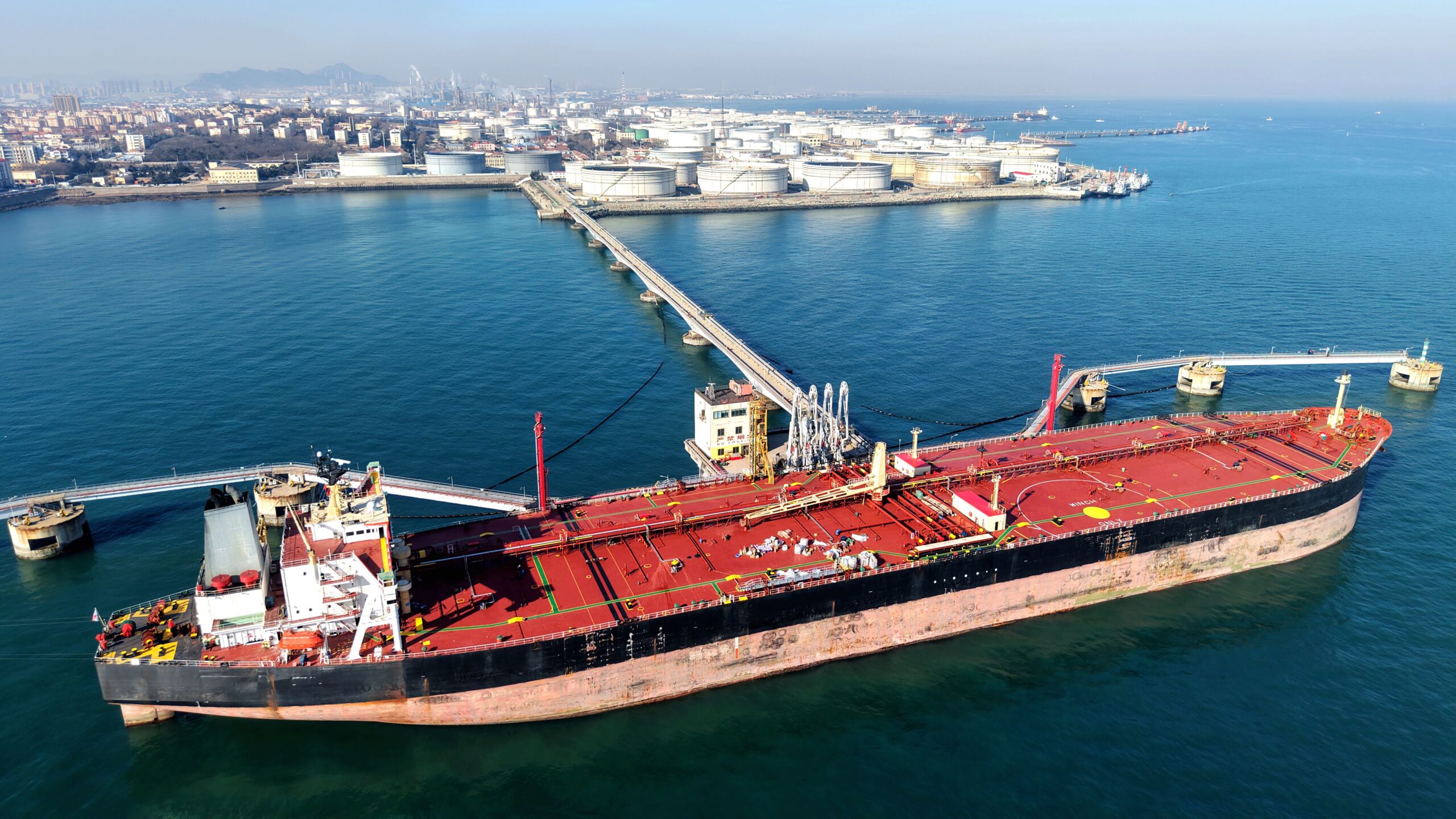
WASHINGTON—The Trump administration’s decision to launch air strikes against the Iranian regime could prove enormously consequential for global oil and gas markets. Even as the strikes and Iranian retaliation continue, it’s worth examining the potential impact of the war on China and East Asia more broadly. A crisis that hits oil supplies clearly harms Beijing’s strategic interests, but one that affects liquefied natural gas (LNG) could end up advancing them.
China, the world’s largest oil importer, would suffer significant economic costs from a long-term, large-scale oil outage in the Middle East. Still, it would fare better than other regional economies, such as Japan, South Korea, and Taiwan. Not only does the People’s Republic of China (PRC) enjoy greater domestic oil production than any of those Asian democracies, but its economy is about as oil-intensive as Japan’s or Taiwan’s, and much less so than South Korea’s. Accordingly, while an oil crisis would bring real pain to the PRC, it might empower Beijing relative to its regional rivals.
While China would suffer from oil outages, a Middle East crisis with disproportionate LNG outages might benefit the PRC. Natural gas accounts for a relatively small share of China’s primary energy consumption, the country enjoys substantial domestic production, and it can tap pipeline imports from Russia, Central Asia, and Myanmar. Significantly, many of the PRC’s competitors or rivals—the European Union, Japan, South Korea, and Taiwan—are substantially or even wholly reliant on LNG imports for their natural gas consumption. Dutch TTF natural gas prices are up more than 50 percent against last Friday’s close, fueling concerns of an energy-induced inflationary spike. In addition, LNG outages in Qatar, the world’s second-largest producer, would benefit the US LNG complex—and fuel accusations that Washington was reaping windfall benefits from a war it started. Beijing may therefore judge that another LNG-tinged crisis would impose little economic cost on it while potentially further antagonizing Washington’s already-fraught ties with its allies.
Ominously, Russian President Vladimir Putin said this week that he would deprioritize natural gas exports to Europe as “other markets are opening up.” But the Russian leader is once again lying—he has no major pipeline export alternative to Europe, not even China. Instead, he appears to be establishing Russia’s baseline negotiating position ahead of a likely crisis in LNG markets.
While Tehran has so far not targeted significant regional oil infrastructure in its retaliatory strikes, it still might. With the United States and Israel showing no signs that they will stop targeting Iran’s political leadership, the remnants of the Khamenei regime are becoming increasingly desperate and are taking more risks. Even a trigger-happy regional commander could act independently from the regime. If Iranian forces do start targeting regional oil exports en masse, it could quickly raise Beijing’s ire. On the other hand, large-scale LNG outages might be more palatable for Beijing while harming Tehran’s adversaries—and Iran has not refrained from targeting LNG infrastructure so far. US and allied policymakers should closely follow Beijing’s actions and rhetoric, especially if a Middle East energy crisis disproportionately affects LNG. And from the present crisis, Indo-Pacific capitals should draw important lessons, not the least of which is the importance of strengthening energy security ahead of a potential Taiwan crisis.
The Strait of Hormuz’s vulnerabilities
Iran’s ability to threaten the world economy centers around the Strait of Hormuz. Traffic along this maritime bottleneck has already ground to a halt amid the threat of attacks, which could send the prices of oil and other commodities higher and potentially trigger a global economic crisis. East Asian economies would be particularly impacted by a closed strait. In 2025, around 78 percent of all Middle Eastern crude oil exports to China, Japan, South Korea, and Taiwan flowed through this important chokepoint. While Saudi Arabia and the United Arab Emirates have pipeline capacity of about 2.6 million barrels per day to reach Red Sea ports, this is only a fraction of even their own domestic production, and most Gulf states would not be able to find alternative shipping routes.
East Asian economies are particularly vulnerable to a Middle Eastern oil crisis, and Japan, South Korea, and Taiwan are among the most exposed.
Conversely, the PRC imports less via the Strait of Hormuz and has insulated itself, to a degree, from a potential long-term oil outage through rapid vehicle electrification and robust domestic oil production. It has also diversified energy sources—mostly coal, but also renewables. Indeed, China is far less exposed to energy imports than its regional rivals.
Japan, South Korea, and Taiwan have virtually no domestic crude production and rely almost exclusively on imports. The PRC, meanwhile, meets over a quarter of its oil demand through domestic production. Moreover, the economies of Taiwan and South Korea are much more oil-intensive than that of the PRC, meaning that mainland China generally requires fewer barrels of oil than its rivals to produce one thousand dollars of gross domestic product.
The PRC is therefore better positioned to withstand a major Middle East oil supply disruption relative to regional rivals. Of course, oil is but one of many macroeconomic variables, so the PRC’s economy could still underperform relative to other regional players—especially Taiwan and South Korea—if, for example, the artificial intelligence boom continues along its current trend. However, in addition to its oil production, the PRC’s current stockpiles of crude oil leave it relatively well-prepared for a crisis.
PRC and East Asia crude oil inventories
Japan has robust import coverage. At present, Japanese onshore crude inventory is holding at 350 million barrels, according to Kpler data. Assuming 2025’s average refinery runs of 2.4 million barrels per day persist in 2026, Japan has nearly 150 days of oil supply in its reserves. This figure is even higher, at 182 days, when accounting only for domestic transportation fuel demand (gas oil/diesel, gasoline, jet). In other words, Japan’s refineries could supply its domestic fuel needs, at current activity levels, for 182 days if it seeks to only satisfy domestic needs and eschews exports.
While Taiwan and South Korea appear more exposed to a prolonged oil supply disruption at first glance, they are more secure if one distinguishes between only domestic consumption and total demand, which includes crude oil ultimately destined for export as a petroleum product. Based on our measures of Taiwanese and South Korean inventory levels and refinery runs, Taiwan can cover thirty-nine days, while South Korea has just thirty-three days of cover. But both could sustain domestic consumption for much longer. Taiwan, for example, is mandated to hold at least ninety days of cover for current core transportation fuel demand; South Korea has 107 days, with the potential to increase this further with additional policy adjustments to lower domestic retail consumption.
For instance, in April 2024, Taiwan held that its domestic inventories equated to about 167 days of supply for all petroleum products. Taiwan no longer appears to report inventories data, although its Energy Administration at the Ministry of Economic Affairs reports that domestic inventories are compliant with statutory mandates requiring commercial and governmental inventories to hold at least ninety days of consumption.
The governments of Japan and South Korea report that they have at least 254 days and 210 days, respectively, of supply, while Taiwan has enough for about 120 days, according to The New York Times.
The PRC has the largest onshore crude stockpiles in the world, with inventory levels estimated at 1.2 billion barrels as of January 2026 with builds amounting to 100 million barrels over the previous year, per Kpler data. With average refinery runs of 15.5 million barrels per day in 2026, less domestic crude production of 4.3 million barrels per day, this implies around 108 days of import cover. On the other hand, if the PRC decided to also maximize domestic consumption and eschew exports of petroleum products, its supply would extend to 130 days.
China may also be able to obtain another 38 million barrels of floating Iranian crude on tankers, many of which are located offshore of Malaysia or China. While the status of these Iranian barrels is currently unclear, the PRC’s existing inventories leave it relatively well positioned to weather an oil crisis, at least compared to its regional rivals.
LNG’s role in energy, by economy
But a crisis may not only exist solely or even largely in the oil domain: LNG outages could also damage East Asian economies. If Tehran disproportionately targets LNG infrastructure in the Gulf, then its relationship with Beijing may be a significant or even primary factor, as the PRC is much less reliant on LNG imports than other energy importers. Unlike many of its democratic rivals across Europe and the Indo-Pacific, natural gas is a small share of China’s primary energy consumption, and the PRC produces much of its needs domestically. East Asian economies should be alert to the possibility that Tehran will disproportionately target regional LNG infrastructure—not necessarily because it was directed by Beijing, but because the Iranian leadership will likely seek to maximize Western pain while minimizing Chinese anger.
If Iran does target regional LNG infrastructure, Qatar, the world’s second-largest LNG exporter, could be hit hard. Significantly, Iran drone strikes have already hit Qatar’s Ras Laffan facility, and the complex accounts for about 20 percent of global LNG exports. LNG outages in Qatar would hold significant geopolitical ramifications, as the fuel is only semi-fungible, meaning transportation of the fuel faces infrastructure constraints and bottlenecks. As seen below, the PRC is less exposed to Qatari LNG than Taiwan, South Korea, or Japan. Moreover, as much of its LNG imports satisfy southern Chinese power demand, China can also replace its LNG imports, to a degree, by shifting to other forms of electricity, such as coal or renewables.
Furthermore, if Middle Eastern LNG outages persist, prices may spike even further. There is virtually no global spare capacity right now. Any unplanned incremental expansions would take well over a year, and European natural gas storage levels are low.
If prices continue to spike, this would boost LNG exports for the United States—already the world’s largest LNG exporter—at the expense of consumers across Europe and the Indo-Pacific. While this development would produce short-term commercial benefits for the United States, it would also potentially widen diplomatic fissures between Washington and its allies across Europe and the Indo-Pacific. Washington would be in the awkward position of receiving commercial benefits, at the expense of its allies, from a war it initiated. This dynamic could be a diplomatic boon for Beijing, especially since its media outlets falsely blamed the United States for the 2022 LNG price spike arising from Russia’s full-scale invasion of Ukraine.
Energy security risks and lessons
As the world’s largest energy importer, China has a lot to lose from a conflict in the Middle East. Nevertheless, in certain scenarios, Beijing could reap geopolitical benefits that offset some or perhaps even all of the economic costs. Accordingly, policymakers should watch for signs that Tehran is disproportionately targeting LNG infrastructure, pursue short-term mitigation steps, and consider the long-term consequences of the conflict.
Short-term risk mitigation steps are straightforward. To guard against any short-term price spikes, the United States may need to tap its Strategic Petroleum Reserve (SPR) in coordination with its allies and partners. In addition, Washington may need to incentivize domestic crude oil and natural gas production. In some cases, export projects could be accelerated, perhaps via financing from the Office of Energy Dominance Financing or the Export-Import Bank. Furthermore, agreeing to fill the SPR at a price floor could provide certainty for long-term production, likely sending domestic crude oil production higher. If the crisis metastasizes, however, other measures may be warranted.
The long-term consequences of this crisis are potentially alarming. It could provide a template for Beijing if it attempts to conquer Taiwan via coercion. The PRC’s energy security is transforming in important ways as it becomes increasingly self-reliant. While Beijing is, for now, highly exposed in an oil crisis, its vulnerability will be substantially reduced in a few short years. Vehicle electrification and improving fuel economy have ended Chinese total transport fuel demand growth. Domestic gasoline consumption has already peaked. If—when—China commercializes more advanced batteries, such as semi-solid state or solid-state batteries, its overall demand for oil will likely decrease further. In 2025, China marginally increased domestic crude oil production, and it could likely expand further if energy security becomes an overriding priority; Beijing could also quickly increase overland crude oil pipeline connectivity with Russia by expanding the mainland Chinese leg of the East Siberia-Pacific Ocean pipeline. In sum, while Beijing remains vulnerable to an oil crisis, it is narrowing its oil exposure to seaborne volumes. If vehicle electrification and battery advances accelerate, Beijing’s interests could shift, including in the Middle East.