
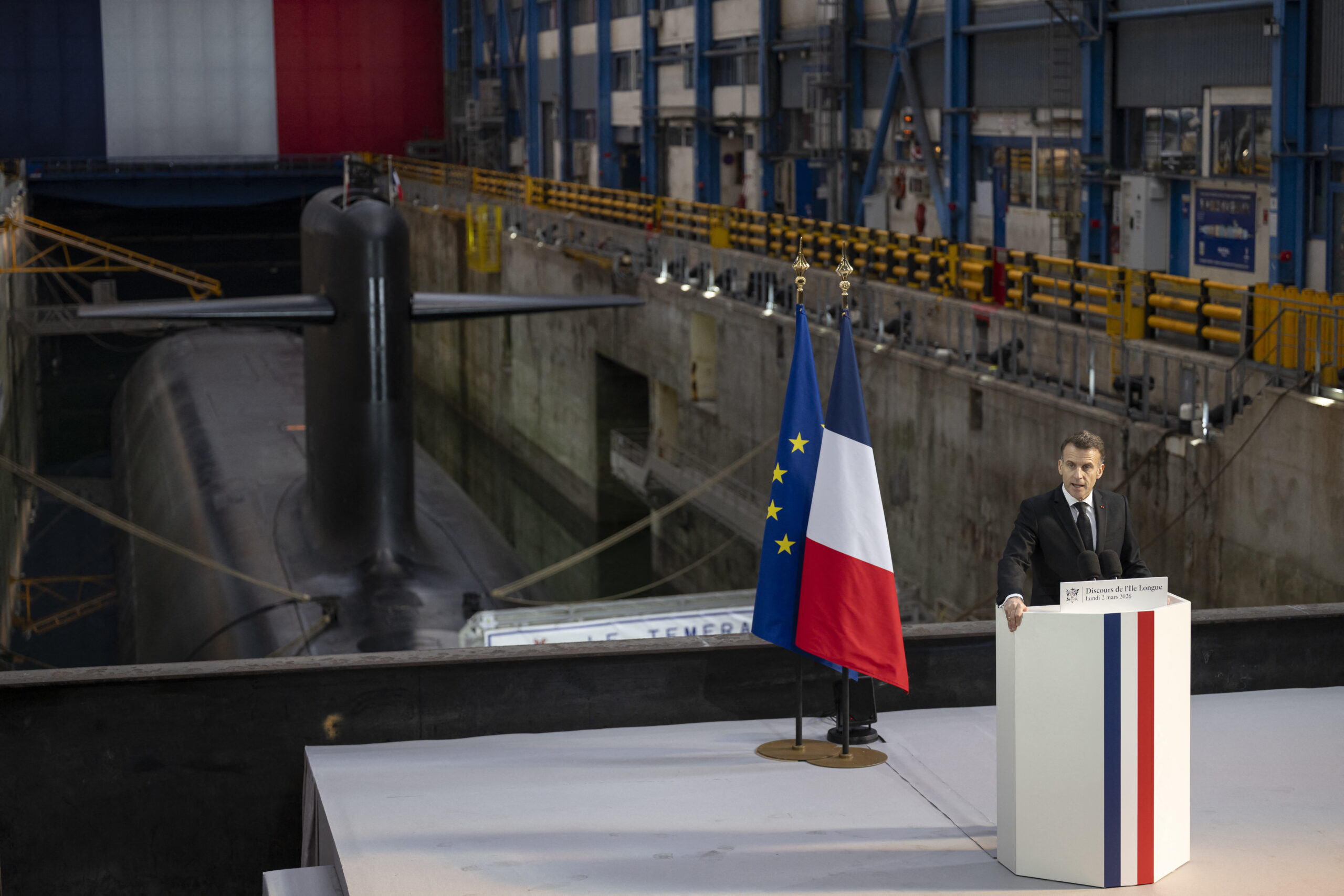
WASHINGTON—Backed by the French submarine Le Téméraire, French President Emmanuel Macron on Monday laid out changes to the French nuclear posture, announcing a doctrine of “forward deterrence.” With this new doctrine come four important changes: France will increase the number of warheads in its arsenal. It will simultaneously stop disclosing the size of its total stockpile to maintain strategic ambiguity. It will allow for forward-basing of nuclear weapons outside French territory. And it will enhance bilateral collaboration on deterrence with key European partners.
The dimensions of France’s nuclear shift
Macron’s speech marks the most substantial shift in French nuclear posture in decades. First, France will increase the number of nuclear weapons in its force de dissuasion (deterrent force) for the first time since 1992. This change reflects the belief that France’s current arsenal is too small to credibly project deterrence beyond its borders, particularly amid concerns about its ability to penetrate Russian air defenses. In tandem with this numerical increase, France will withhold total stockpile counts, a move aimed at complicating adversary targeting and nuclear planning through strategic ambiguity.
France will also allow the temporary deployment of nuclear-armed aircraft to allied European countries. Crucially, there will be no nuclear sharing or delegated authorities to any other nation, meaning the sole decision-making authority remains with Paris. Nonetheless, stationing nuclear forces outside French territory adds strategic depth and visibly underscores France’s commitment to European partners.
In addition, France will work with other European countries to develop a shared understanding of the threat, coordinate responses, and improve coordination on escalation dynamics in a conventional conflict environment. Beyond collaboration with Germany and the United Kingdom, the first stage will involve Poland, the Netherlands, Belgium, Greece, Sweden, and Denmark, including visits to strategic sites and joint exercises.
Immediately after Macron’s speech, German Chancellor Friedrich Merz announced the establishment of a Franco-German nuclear steering group and said that Germany would provide conventional support in French nuclear exercises before the end of the year. Polish Prime Minister Donald Tusk declared that these advancements in nuclear deterrence will ensure “that our enemies will never dare to attack us.”
Macron also made the case for continued strategic support by European partners on conventional arms. He specifically cited the need for collective resources to develop early-warning capabilities, advanced anti-drone and anti-missile defense systems, and deep-precision strike capabilities. This aligns with the French doctrine of épaulement (mutual support), where conventional forces support nuclear operations, but goes further by operationalizing this concept and framing conventional actions as subnuclear steps on the escalation ladder.
What was France’s previous nuclear doctrine—and why is it changing now?
Macron’s speech expands previous declarations to adapt to an unpredictable security environment. In March 2025, the French president launched a “strategic debate” on using France’s deterrent to protect Europe. Monday’s speech reaffirmed that the country’s “vital interests” extend beyond its borders—and reinforced this rhetorical shift with concrete changes to France’s deterrence posture.
What do the changes mean for France’s current arsenal? At present, according to open-source reporting, the French nuclear force comprises roughly three hundred warheads, including air- and sea-based legs—a modest arsenal compared to the US and Russian forces, which have 1,700 and 1,718 deployed warheads, respectively. This force has traditionally been underpinned by a doctrine of sufficiency and sovereignty.
Augmenting the size of the French nuclear arsenal marks a significant departure from the principle of sufficiency. Historically, the French deterrent was designed to impose unacceptable costs in response to adversary attacks on French vital interests—likely meaning a counter-population targeting strategy that could be accomplished with a single retaliatory strike. Macron’s announcement signals a clear intent to expand the operational scope of the French deterrent. France has the technical capacity and reserve materials to add warheads, but large-scale expansion is limited by its 1996 halt to fissile material production. Without clarity on the scale of the planned increase, it is difficult to assess if the stockpile change is intended to allow for a new targeting strategy.
Consistent with the French tradition of nuclear independence, Macron did not, for example, announce any further integration into NATO’s nuclear planning body. By maintaining an independent nuclear force, France adds an alternate decision-making center to NATO’s deterrent posture. This complicates adversary calculations and necessitates new forums for allied coordination beyond NATO’s nuclear planning framework.
Macron’s speech came amid a larger debate about greater European strategic autonomy and meaningful burden-shifting in NATO’s deterrence mission. This policy reorientation reflects deep and growing unease among some US allies in Europe following the release of the 2026 US National Defense Strategy and the 2025 US National Security Strategy, both of which signal a clear US preference for offloading regional security responsibilities onto allies. These documents reignited dormant debates over the viability and desirability of a European-based deterrent.
What’s next?
Macron’s speech is significant, but its ability to reassure allies and deter Russia remains uncertain. Notably absent from Macron’s list of partners are the Baltic states, Norway, and Finland—countries that directly border Russia. Though it is unclear why they are not participating in the new French nuclear security architecture, their absence underscores the enduring limitations of France’s nuclear posture as an extended deterrent.
Macron also reaffirmed France’s rejection of tactical nuclear responses and nuclear warfighting, reflecting both political will and the lack of sub-strategic options in the French arsenal. This continuity, however, limits France in the face of Russia’s advanced sub-strategic capabilities and its emphasis on heightened aggression at the onset of a conflict. Russia’s nuclear arsenal includes roughly 1,500 non-strategic warheads, and perceived imbalances in nuclear capabilities vis-à-vis NATO could embolden the Kremlin to employ low-yield nuclear weapons—for which France lacks credible, flexible response options.
Some European allies may worry that Macron’s decisions could be reversed by a Euroskeptic successor after next year’s presidential election. One prominent 2027 challenger, Jordan Bardella, has been outspoken against the Europeanization of the French deterrent. Indeed, France’s nuclear umbrella, like the US umbrella, offers no iron-clad guarantee. If nonnuclear allies feel insufficiently protected, some—particularly those under significant threat from Russia—could be tempted to pursue indigenous weapons programs.