
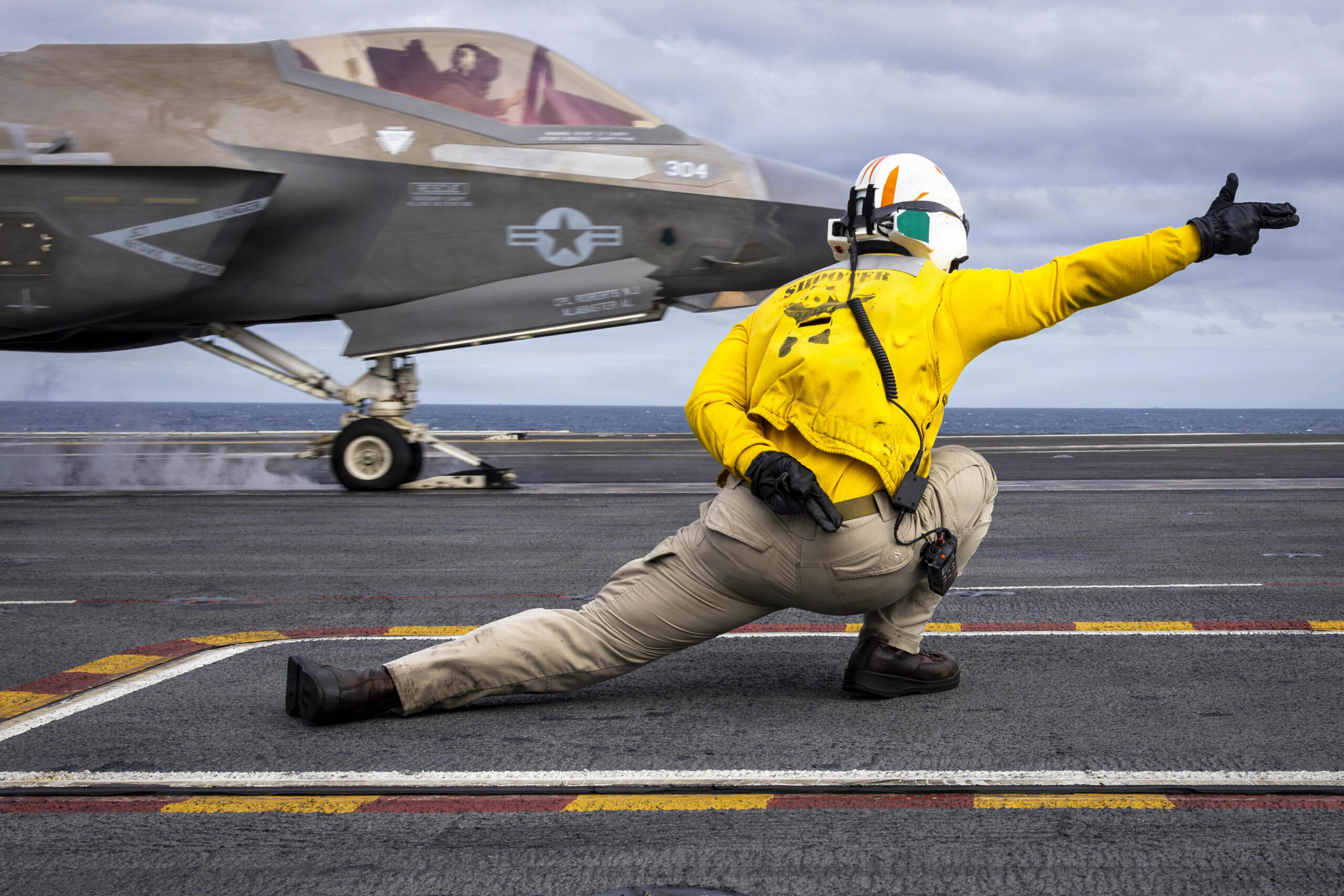
“We’re watching Iran,” US President Donald Trump told reporters Thursday as he returned from the World Economic Forum in Davos, Switzerland. “We have a big flotilla going in that direction, and we’ll see what happens.” For the past week, a US carrier strike group led by the USS Abraham Lincoln has proceeded west from the South China Sea to the Persian Gulf near Iran.
Earlier this month, as anti-regime protests in Iran spread and reports of Iranian security forces killing demonstrators emerged, Trump pledged that the United States would “come to their rescue.” Is the arrival of US naval forces near Iran a prelude to a strike on the regime? For answers, we turned to Nate Swanson, who was the director for Iran at the National Security Council in the Biden White House and a member of the Trump administration’s Iran negotiating team:
1. What are Trump’s options in Iran?
We are in unprecedented territory. Prior to Operation Midnight Hammer in June, the United States had never directly attacked Iran. The United States spent years developing the technology and expertise necessary to successfully carry out an operation against Iran’s nuclear program. Initiating strikes to protect protesters is an entirely different set of targets and objectives that are likely being developed in real time.
As the USS Abraham Lincoln enters the region, Trump likely has a range of options that fall into following broad categories.
- Symbolic strikes: This could include strikes on conventional targets, such as Iran’s nuclear or missile program. While these strikes would do little to tangibly help the protesters, it will ensure that nobody can accuse the president of drawing “red lines” and then ignoring them.
- Strikes targeting the security apparatus: Trump likely has intelligence on a range of facilities and personnel connected to the Islamic Revolutionary Guard Corps, law enforcement forces, and the paramilitary Basij militia that may be connected to the crackdown on the protest movement. Cyberattacks against the security apparatus also fall into this category. These strikes might provide a measure of revenge and consolation to the protesters, but it’s unclear what impact this would have in preventing the regime from cracking down. Iran has more than a million individuals in its security apparatus. A one-off strike is unlikely to change the regime’s calculus about killing protesters. A sustained campaign against security personnel is plausible, but it would require a durable commitment that the Trump administration has thus far avoided in its use of military force.
- Economic targets: During confrontations between Iran and Israel over the past year, there was speculation that Israel might attack Iranian economic targets. This could include oil export terminals, such as Kharg Island in the Persian Gulf, as well as critical natural gas infrastructure. Such an operation would be risky and could impact energy markets, but it would also get the attention of a government that is teetering on the brink of economic collapse.
- The supreme leader: Many protesters in Iran and observers outside of the country are clamoring for a strike that removes Iran’s Supreme Leader Ayatollah Ali Khamenei. While it’s unclear whether such a strike is feasible (much less advisable), it would be a game changer. Iran’s supreme leader is the highest political and religious authority inside Iran. There has only been one prior succession in the history of the Islamic Republic, and there is no consensus successor for Khamenei. Removing him creates an unprecedented power vacuum, and it is impossible to predict what comes next.
- Non-kinetic options: There are numerous tangible non-kinetic options that the United States can take. Former US Deputy Special Envoy for Iran Abram Paley and I offered our own suggestions for supporting protesters, including pausing non-protest-related policy initiatives. Realistically, none would likely be decisive or would change the trajectory of the current protests. They are geared toward the next round of protests and ensuring protesters have the tools to make their own decisions about Iran’s future.
2. Would a US strike help Iranian protesters?
I am skeptical it will have a major impact, but it’s impossible to predict, because the success of a strike would best be measured on the impact it has on both the protesters’ and the regime’s psyche. Maybe a strike will provide such a significant morale boost to the protesters that they decide to keep protesting to the point that regime fissures emerge, defections ensue, and the Iranian regime collapses. An alternative is that the Iranian regime kills more of its own people. This scenario has parallels to Hungary in 1956 and Kurdish Iraq in 1991, where the United States called for the people to rise up, but had limited resources to offer, and the protesters were brutally crushed.
In all strike scenarios, the administration will need to consider and articulate a vision for what comes next. The regime might fall and a pro-Western democracy could emerge, but an equally plausible scenario is that an even more hardline government emerges, one that is even more eager to develop nuclear weapons and utilize its missile arsenal. This concern is partially why several Gulf nations have advocated against striking Iran.
Finally, it seems highly unlikely that US troops would be deployed on the ground in Iran. This means a political transition in Iran won’t happen because US soldiers liberate Iran or because an outside force intervenes. Instead, it will have to be a change driven by Iranians.
3. What should we expect from the Iranian regime?
Having the USS Abraham Lincoln in theater serves two functions. First it allows the United States to more easily defend against any retaliation from Iran, thus providing greater optionality for a strike. It also provides a psychological advantage. Iran knows that any actions it takes in response to a US action could be met with a further escalation from US forces.
This dynamic will likely deter Iran from doing anything overly escalatory. The Iranian regime will likely calibrate its response to be proportional (in its estimation) to that of any US action. For example, if the United States hits Iran with symbolic strikes, Iran will likely do something symbolic as well. Iran’s attack against US forces in Qatar in June is a useful example of what a response could look like. This scenario allows both sides to claim victory and de-escalate.