
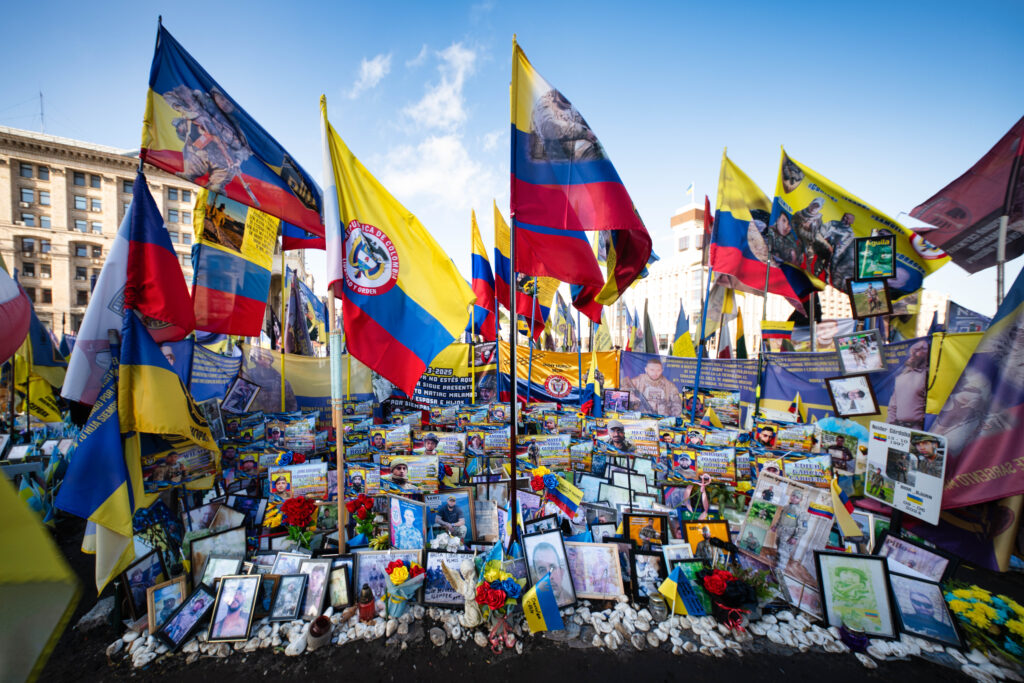
WASHINGTON—In a memorial park in Kyiv, Colombian flags form a striking patch of what has become a dense blanket of tributes to the fallen. An estimated 300 to 550 Colombian nationals have been killed fighting for Ukraine since Russia’s full-scale invasion began. Though official figures are unavailable, estimates suggest that approximately 25 percent of personnel from the sixty-five countries that have joined Kyiv’s ground forces have come from the Andean nation.
Much has been written about how these fighters perform and perish. Less attention has been paid to why they arrive at all. This is not a story of mercenaries or idealists. It is a symptom of unresolved governance questions: how Colombia transitions its veterans to civilian life and how the international community regulates cross-border military labor. Decades of internal conflict produced a large pool of seasoned fighters, from soldiers versed in the fundamentals of combat to elite counterinsurgency operators. These skills have become commodities on the global market.
Colombian President Gustavo Petro’s administration has not responded by embracing the country’s role as a de facto supplier of allied combat power; instead, it has recast this flow of fighters as a crisis of exploitation. As winter deepened on the front line in late 2025, I interviewed a Colombian veteran in Kyiv, who shared with me a warning that carries a grim weight: “Tell Colombians not to go there, because more die than return.” Yet still they go—drawn not by glory, but by the grim calculus of limited options.
On December 2, 2025, a forum on this topic held at Universidad Sergio Arboleda in Bogotá convened by the Corioli Institute (of which I am the founder and executive director), the Governance, Policies, and Strategic Security Agency, and several other partners, exposed the far more complex reality driving this exodus and the emerging struggle to govern it.
When reintegration fails, military labor moves
One must look beyond the label of “mercenary” to understand why a Colombian soldier ends up in the Donbas. Across the Bogotá forum, veterans, researchers, and officials converged on a shared pattern: professional soldiers with fifteen to twenty years of counterinsurgency experience retire in their late thirties or early forties, only to fail to reintegrate into an economy that has no place for them. Formal transition and retraining programs exist; however, their disconnectedness from labor-market realities leaves veterans without a credible civilian off-ramp.
A typical mid-level officer earns roughly four million pesos (just over one thousand dollars) per month in active service, with that figure dropping to four hundred dollars for rank-and-file soldiers. Upon retirement, income often falls by half. With anemic transition programs and the domestic private security sector saturated, the contrast with Ukrainian frontline pay is stark. Salaries for soldiers in Ukraine participating in combat operations run from $3,000 to $5,000 a month (including any time in captivity and rehabilitation following injury), plus a potential $25,000 signing bonus and a $350,000 death benefit to families in the event the soldier is killed in combat. While language barriers and a multitude of bureaucratic hurdles have resulted in substantive challenges in obtaining death benefits and repatriating fallen soldiers’ remains, the economic arbitrage remains compelling for those feeling functionally stranded between illegal employment and economic exclusion. Ukraine becomes, as one participant of the forum in Bogotá put it, “the first real door that opens.”
Bogotá’s legal turn: Moral framing vs. practical limits
Such structural pressures and their consequences have shaped Bogotá’s response, which has adopted a tone of criminalization and moral condemnation. At the presidential level, the legal turn has been driven by Petro’s broader rhetorical and policy pivot against what he calls mercenarismo. Since 2024, he has described recruitment for foreign wars more broadly as a form of “human trafficking converting men into merchants of death,” arguing that, in the case of Ukraine, commanders treat Colombians as an “inferior race. . . and cannon fodder.” He called on Ukrainian President Volodymyr Zelenskyy to free Colombian “mercenaries” from these armies and argued that veterans should not be permitted to, among other illicit activities, put their skills in the service of “other wars abroad” due to the fact that their training had been paid for by the Colombian people.
In December 2025, the Colombian House of Representatives approved a bill with ninety-four votes in favor (with seventeen against) to ratify the 1989 United Nations (UN) Convention against mercenaries. Under that UN convention, a mercenary is defined as a specially recruited person who takes part in hostilities for private gain, is promised material compensation substantially higher than that paid to regular combatants, neither a national nor resident of a party to the conflict, not a member of the armed forces of a party, and not sent on official duty by a state that is not party to the conflict. Colombians fighting in Ukraine’s International Legion—or its army’s regular assault units following the dissolution of the legion in December 2025—are thus not mercenaries according to this definition. They receive the same pay as regular combatants and are members of the state’s armed forces.
Legal experts at the forum warned of the pitfalls of collapsing state military service, private security contracting, and outright mercenary activity into a single category. Blurring these definitional boundaries undermines critical outcomes such as who gets prisoner-of-war status, consular protection, and veterans’ rights. Forum participants described a “witch hunt” that strands hundreds of veterans in a legal gray zone in which they could face prosecution at home for service that is perfectly legal under international law. Meanwhile, the economic realities pushing them to leave in the first place remain completely ignored.
Petro’s reductive framing risks returning fighters to Colombia as stigmatized subjects instead of veterans with recognized needs. Many returning Colombian veterans of the war in Ukraine are simultaneously traumatized, severely wounded, politically delegitimized, and exposed to prosecution. This convergence of stigma and legal peril creates a dangerous reintegration vacuum, one likely to be filled by criminal organizations eager to recruit highly trained personnel who feel abandoned by the state.
Policy priorities for Colombia and its partners
While the forum focused on Colombians’ participation in the war in Ukraine, the scale of Colombian veterans’ movements is global. More than merely joining state-backed armed forces in Eastern Europe, they are also being actively recruited by (and sometimes lured by false promises into) nonstate armed groups across the geopolitical spectrum, from the Rapid Support Forces in Sudan to Mexican cartels. This transnational demand for Colombian combat labor creates a complex threat landscape where the line between lawful military service and criminal activity is increasingly blurred. Any effective response must thus confront illicit and exploitative recruitment networks without mistaking them for the problem itself. Rather, policymakers should address the structural failures that make fighting for foreign forces a rational choice for many veterans. They should also preserve clear legal distinctions so that those who serve through lawful pathways are not further marginalized when they return.
- Prioritize the genuine implementation of the 2019 Veterans Law to transform it from a hollow framework into a viable civilian off-ramp. This requires the Ministry of Defense’s veterans directorate to embed financial planning and transition support throughout the military lifecycle. Meanwhile, the Ministries of Labor, Education, and Health must build education and employment pathways aligned with actual market demand to address the governance failures driving veterans abroad.
- Establish a permanent interministerial national mechanism and a dedicated Colombia–Ukraine liaison capacity to manage the transnational market for combat labor. Led by the Foreign Ministry (Cancillería) and linking the Ministries of Defense, Justice, and Labour, this body would coordinate veteran policy, regulate recruitment networks, and manage repatriation claims. It would also invest in data systems in collaboration with international partners to distinguish lawful service from illicit trafficking to help protect returnees.
- US policymakers and US Southern Command should treat veteran reintegration as a critical node of regional security cooperation to prevent criminal networks from capturing US-trained expertise. US military assistance should match operational training with robust reintegration support to deny cartels access to elite combat and drone skills. This directly supports US priorities on counternarcotics and transnational crime. Force development without credible transition pathways creates downstream security risks.