Bottom lines up front
- After one year in power, Friedrich Merz’s government in Germany is deeply unpopular.
- Despite real progress on foreign and security policy, Germany’s struggling economy and lack of clear leadership remain significant weaknesses for the governing coalition.
- Without major changes, it is uncertain if the Merz government will last the full parliamentary term.
After just a year in office German Chancellor Friedrich Merz faces increasing questions about the future of his government. Merz has failed to restore confidence in the German government and in a poll from the end of March, 86 percent of Germans were dissatisfied or very dissatisfied with the work of the government, 1 percent of Germans were very satisfied and only 12 percent were satisfied with the government’s work.
US policies are worsening these challenges—the economic effects of the Iran war have led the German economics ministry to halve its growth forecast while raising its inflation projection for 2026. Business expectations are at their lowest level in almost three years. Merz’s attempt to balance continued transatlantic cooperation with increasing European capabilities is being tested by US President Donald Trump’s continued attacks on NATO, lack of support for Ukraine, and incoherent Russia policy.
The German constitutional system is designed to provide stable but not necessarily strong government. Merz’s coalition has agreed to modest reforms since taking office while failing to provide a clear roadmap to restoring economic growth. And without that growth, the government will not be able to win back public support. It could persist through the end of the parliamentary term in 2029, but pressures could lead to its premature collapse and slide Germany into a crisis of governability.
What has the Merz government accomplished?
Domestically, the government has passed over 170 laws, the most important of which include restrictions on migration, reform of the Burgergeld minimum-income guarantee, and stabilization of pensions (though seen as inadequate by some key economists). The cabinet just agreed to a reform of health insurance, but it will likely face a difficult passage in the Bundestag; other major measures still pending are further pension reform, income tax reform, and a new budget.
On foreign and security policy, the removal of the debt brake for defense spending has allowed a massive rearming of Germany to begin which has increased the country’s clout across Europe. Merz has established good working relations with his European counterparts, repairing tattered ties to France while expanding German outreach to the country’s northern and eastern neighbors. Merz’s early support for Trump’s 5 percent defense spending goal mobilized other countries to come on board and is creating a basis for a stronger and more self-reliant Europe. But Merz’s initial success establishing a good working relationship with Trump has not survived the US war on Iran and the president’s reaction to Merz’s criticism of US actions, including via off-the-cuff public statements.
Merz’s government has worked within NATO and the European Union to support Ukraine and make up for the reduction in US financial aid. It is a major contributor to NATO’s system financing the delivery of key US military equipment and arms. Germany has deepened its relationship with Ukraine and now acknowledges the central role it plays in European security and the lessons it can provide for European defense. Yet, this is mostly a continuation of the previous government’s policy and parallels what is happening across most of northern Europe.
It’s the economy, but the government isn’t helping
No German government will be seen as successful without renewed growth. Add to that a growing concern that Germany has no credible strategy to deal with the decline of the auto sector and reliance on trade in a more competitive international environment, the high cost of energy, and a lack of sufficient investment in infrastructure and education. In addition, there is widespread public and business unease with growing debt despite support for increased defense spending.
Merz’s uneven leadership has contributed to the government’s woes. His frankness and off-the-cuff manner are sometimes admired but also get him in trouble domestically and with foreign counterparts. He lacks a close circle of advisers and does not look to those he has for advice. His chancellery has failed to effectively coordinate policy or advance his agenda. It has also bungled matters, such as the selection of constitutional court judges, that have damaged the government’s standing. The cabinet is generally viewed negatively; the only standouts are Defense Minister Boris Pistorius and Interior Minister Alexander Dobrindt, both of whom already enjoyed strong executive records.
Merz’s own center-right parliamentary group, the Christian Democratic Union/Christian-Social Union (CDU/CSU), remains unhappy with the distribution of ministries and the creation of the special investment fund—seen by many members as the “original sins” of the coalition. And with the Social Democratic Party (SPD) controlling the finance and labor ministries, there is no way for Merz to override the center left on key reform issues.
This government generally reflects the dilemma of a constitutional and party system that provides stability but not necessarily strong government and presents significant checks on change. The danger is less instability than a weak coalition crawling to the next election, further undermining support for centrist parties. The lack of a viable alternative and the experience of the previous government reinforce the reluctance of Merz or the SPD to pull the trigger to end the coalition. However, with economic prospects so negative, a coalition collapse remains a not insignificant possibility. In addition to future unforeseen events, there are several key dates that will test the coalition over the life of this parliamentary term.
Elections this September in the eastern German states of Sachsen-Anhalt and Mecklenburg-Vorpommern and the city-state of Berlin will almost certainly test the governing parties due to the expected strength of the extreme-right Alternative for Germany party (or AfD), which is currently leading the polls in the two eastern states, and the likely difficulties in government formation. If the SPD loses control of Mecklenburg-Vorpommern or fails to win the 5 percent of the vote required to remain in the Sachsen-Anhalt state parliament—the most recent polling from March has it at 6 percent—it is hard to see how the party’s current federal leadership survives. All the resulting unhappiness will complicate final passage of a federal budget later in the year, although the reform of the debt brake does provide the government with some breathing room.
In 2027, state elections in Saarland, Schleswig-Holstein, North Rhine-Westphalia in April, followed by elections in Bremen in May and Lower Saxony in the fall as well as the election of a federal president on January 30 could be additional points of coalition tension.
Merz faces reelection as CDU party chair in early 2028, and without some economic growth a challenge to his leadership could develop. Serious signs of this would come either from the caucus or from key Christian Democratic state party leaders.
Will Merz’s government collapse?
The German constitution makes it difficult to remove a chancellor against his will, and early elections require action by the chancellor and the assent of the federal president. However, the previous coalition did not last a full parliamentary term. There are several scenarios for at least a partial change in government.
A failed vote of confidence and an early election
Merz has rejected suggestions he should call a vote of confidence, which can be only proposed by the chancellor, but there are press reports he has considered using this instrument to keep his caucus in line. A vote of confidence can be a general declaration of support for the chancellor or can be tied to specific legislation. A failed vote of confidence is the only way to trigger an early election, but even in that case the president has the choice of allowing the chancellor to remain in office or to call new elections.
Germany’s president, Frank-Walter Steinmeier, is known to oppose holding new elections because of the likelihood it will most benefit the AfD; in 2018 when coalition negotiations between the CDU/CSU and the Greens failed, he urged the CDU/CSU and SPD to come to an agreement for a new government (which extended the existing grand coalition).
Minority government
There is increasing press speculation that the coalition will not last the entire parliamentary term. Some Christian Democratic caucus members would prefer a minority government to further compromise with the SPD. In such a scenario, Merz could demand the SPD agree to specific reforms or face dismissal. His predecessor Olaf Scholz fired his coalition partner finance minister over the budget in 2024, leading to the coalition’s collapse. Then Chancellor Helmut Schmidt dismissed the Free Democratic Party (FDP) ministers from his cabinet in 1982. Neither case worked out well for the incumbent; in 1982, the FDP, which had been the junior partner in Schmidt’s coalition, voted with the CDU/CSU in a constructive vote of no confidence to elect Helmut Kohl chancellor. In 2024, Scholz tried to govern without a parliamentary majority but quickly consented to call a vote of confidence, which he lost, leading to the 2025 election that brought Merz to power.
Another possibility would be the SPD leaving the coalition over policy differences or splitting due to its leadership concessions to Merz. In either case Merz remains chancellor until a new chancellor is selected (or until he decides to call a vote of confidence he knows he will lose to get to a new election).
Replacement by another CDU/CSU chancellor
Severe CDU losses in future state elections could elicit a challenge to Merz’s leadership, but rivalries within the party could get in the way of agreement on a replacement. Henrik Wuest, the minister-president (MP) of North-Rhine Westphalia, CDU/CSU caucus chair Jens Spahn, or Bavarian MP Markus Soeder are possibilities. Any new chancellor needs to be elected by the Bundestag, so the Christian Democrats will need SPD buy-in.
Can anything turn the government around?
A serious attempt by Merz and Lars Klingbeil—finance minister, SPD co-chair, and vice-chancellor—to present a united front and a common approach to reforming government would help to restore confidence in the government—but only with some economic growth. Much will depend on the future of US-EU trade relations, with enough stability to give Germany’s trade export dependent businesses room to rebound.
The consensus to continue to rebuild the military and support Ukraine looks strong across the centrist parties and with the public, and these efforts have been unaffected by coalition difficulties. They are almost certain to continue through the life of this coalition and will be a condition for forming a future government.
About the author
Phyllis Berry is a nonresident senior fellow with the Europe Center and in the Transatlantic Security Initiative within the Atlantic Council’s Scowcroft Center for Strategy and Security. She was the national intelligence officer for Europe at the National Intelligence Council from June 2021 to March 2025.
Related reading


Explore the program

The Europe Center promotes leadership, strategies, and analysis to ensure a strong, ambitious, and forward-looking transatlantic relationship.
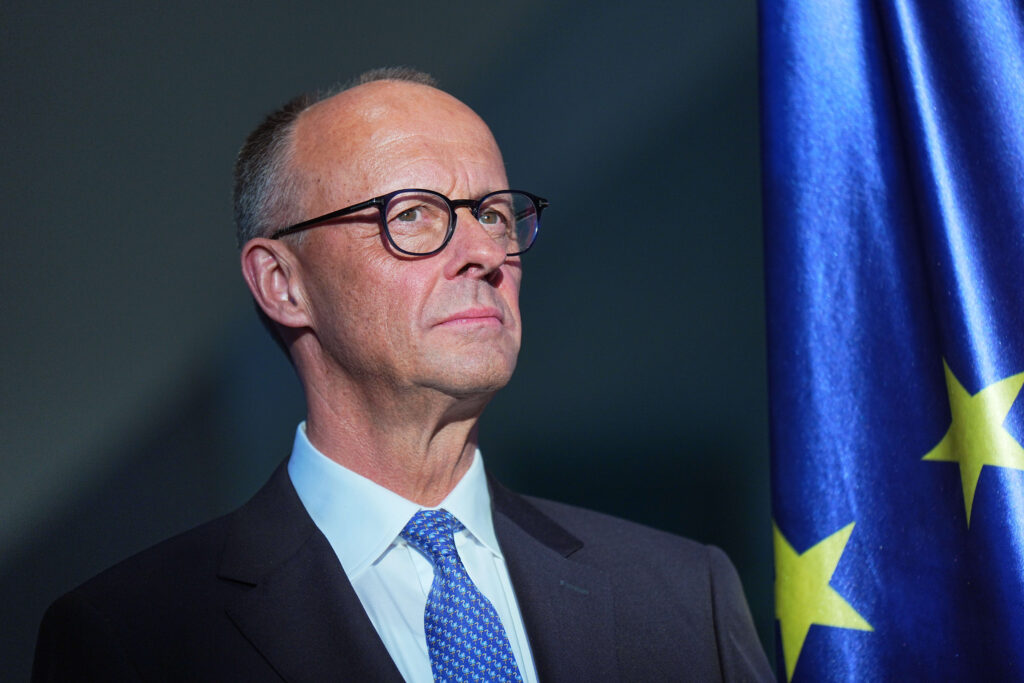
Image: The new Federal Chancellor Friedrich Merz (CDU) speaks during the handover of office in the Chancellery. Michael Kappeler/dpa via Reuters Connect.