Can the EU’s mutual-defense clause replace NATO’s Article 5?
Bottom lines up front
- Amid US military disengagement, the EU is considering how to put its mutual defense clause, Article 42.7, into use.
- The clause is not likely to replace NATO’s Article 5, but it offers an opportunity to bolster EU and transatlantic security planning.
- The EU’s military, financial, and humanitarian assistance to Ukraine should be the model the bloc follows in situations where it activates Article 42.7.
Table of contents
- Introduction
- Europe’s security predicament
- Article 42.7 is no Article 5
- Playing to the EU’s strengths
- Building an Article 42.7 for the future
- Conclusion
Introduction
In Brussels, officials are gathering behind closed doors to simulate responses to an attack on a European country that would trigger a collective defense response. Such gatherings are unsurprising occurrences in NATO headquarters, but these discussions are happening within the walls of the European Union (EU) headquarters.
NATO is not the only game in town when it comes to mutual defense agreements. Article 42.7 of the EU’s Lisbon Treaty offers member states security guarantees similar—at least textually—to those afforded by NATO’s Article 5 collective defense clause. Yet Article 42.7 has remained secondary to NATO’s Article 5 and conceptually underdeveloped.
This may be changing. “The time has come to bring Europe’s mutual defense clause to life,” European Commission President Ursula von der Leyen declared at the Munich Security Conference in February. In early May, EU ambassadors began simulations to put Article 42.7 into operation: “mapping what we have done, what the possibilities are, who does what in what case, and how we are all working together,” as the EU’s top diplomat Kaja Kallas described it.
What should the EU’s mutual defense apparatus look like in practice? And how should Washington understand the EU’s Article 42.7?
It would be a mistake for policymakers in Washington to equate Article 5 and Article 42.7 or to view a more robust EU mutual defense policy as duplicative of NATO. Instead, Washington should applaud an operationalized Article 42.7 which leverages the EU’s strengths, which would contribute to a stronger transatlantic security arrangement. How the bloc responded to support Ukraine after Russia’s full-scale invasion should be the model for future planning around Article 42.7 scenarios.
Europe’s security predicament
Europe has many reasons to reevaluate the levers available to protect itself.
Start with the immediate dangers Europe faces. Russia’s invasion of Ukraine is the most acute security threat to the bloc. EU member states have been victims of state-sponsored attacks directed by Moscow, Russian drone incursions have violated European airspace, and gray-zone action continues to target critical infrastructure at sea and in cyberspace.
Threats to Europe also extend beyond Russia. In March, drones from the Middle East struck Cyprus, though they were targeting a British military base on the island. Other EU countries in the region could be vulnerable to further such strikes, by either Iran or its proxies, and EU member states’ civilian and military assets in the region could be realistic collateral targets as the conflict continues.
Europe’s security architecture is also under threat from the United States weakening its commitment to the continent. President Donald Trump and his administration have directed historic ire toward the NATO Alliance, the anchor of transatlantic security for the last seven decades. Trump labeled NATO a “paper tiger” after European allies refused to support the US operation against Iran. Secretary of State Marco Rubio said the United States would need to “reexamine whether or not this Alliance that has served this country well … is still serving that purpose.” He has continued his criticism, asking “what’s the purpose of the Alliance” when allies deny the US basing rights.
Following criticisms from German Chancellor Friedrich Merz of the war in Iran, Trump announced troop drawdowns from Germany—along with the likelihood that Washington would scupper plans to deploy Tomahawk long-range cruise missiles in the country. The administration was purportedly drawing up options to punish certain allies such as Spain, whose government refused the US access to its air bases to launch strikes on Iran.
The administration has also announced the surprise cancelation of troop deployments of four thousand US troops to Poland, a country that Defense Secretary Pete Hegseth described as one of the United States’ “model allies that step up” and would thus receive “special favor.” (Trump later announced a new deployment of five thousand troops to the country.) Additionally, the Pentagon has already warned European allies of delivery delays for US weapons, including missile systems, as Washington replenishes its stockpiles depleted by the Iran war.
Beyond the uncertain US commitments to European security are the direct threats Trump has made against Europe. Trump spent weeks early in the year musing about taking Greenland—an autonomous territory of Denmark, a NATO and EU member state—and even entertaining the idea of taking it by force. In Europe, the episode has sparked a deep crisis of confidence in the United States.
At the same time, European policymakers have been hesitant to articulate a vision of a European security architecture without the United States. Some European diplomats have quietly worried that an embrace of Article 42.7 could accelerate a US withdrawal from Europe. Any action perceived as Europe preparing to act independently from the United States, the thinking goes, could serve as proof to Europe skeptics in Washington that there is little need for the United States to come to Europe’s defense.
This line of thinking is flawed. With or without NATO, the EU will be responsible for supporting its members who sit outside the NATO Alliance—Cyprus, Ireland, Malta, and Austria. Europe should not deter itself out of concern about what the United States, and especially this highly mercurial administration, might do. The administration has already telegraphed—and announced plans for—a decreased US role on the continent regardless of any planning around the EU’s mutual defense. Most importantly, Article 42.7 will not provide the same guarantees as NATO’s Article 5.
Article 42.7 is no Article 5
NATO’s Article 5 and the EU’s Article 42.7 both carry legacies from the immediate post-World War II years, but only Article 5 combines bureaucratic integration and military planning to signal its seriousness.
For the past seventy-seven years, the NATO Alliance has been the standard bearer of transatlantic defense. Created in the aftermath of World War II to guard against another destructive conflict in Europe and to deter Soviet aggression, it is the most successful military alliance in history, largely because of Article 5 of its founding Washington Treaty. Article 5 states:
The Parties agree that an armed attack against one or more of them in Europe or North America shall be considered an attack against them all and consequently they agree that, if such an armed attack occurs, each of them, in exercise of the right of individual or collective self-defense recognized by Article 51 of the Charter of the United Nations, will assist the Party or Parties so attacked by taking forthwith, individually and in concert with the other Parties, such action as it deems necessary, including the use of armed force, to restore and maintain the security of the North Atlantic area.
Any such armed attack and all measures taken as a result thereof shall immediately be reported to the Security Council. Such measures shall be terminated when the Security Council has taken the measures necessary to restore and maintain international peace and security.
Article 5 has only been triggered once, in response to the September 11, 2001, attacks against the United States.
The EU’s Article 42.7 is younger than Article 5 but brings with it a history of European defense efforts. It was formalized in the Lisbon Treaty, signed in 2007 as one of the core treaties establishing the current functioning of the EU. It states:
If a Member State is the victim of armed aggression on its territory, the other Member States shall have towards it an obligation of aid and assistance by all the means in their power, in accordance with Article 51 of the United Nations Charter. This shall not prejudice the specific character of the security and defense policy of certain Member States.
Commitments and cooperation in this area shall be consistent with commitments under the North Atlantic Treaty Organisation, which, for those States which are members of it, remains the foundation of their collective defense and the forum for its implementation.
The EU’s mutual assistance clause draws its origins from the Western European Union, a now-defunct political and military body—part of a long history of intra-European defense efforts—and was, by negotiation and compromise, included in the Lisbon Treaty. Article 42.7 has only been activated once, by France in response to the 2015 terrorist attacks in Paris.
Textually, Article 42.7 might appear stronger than NATO’s Article 5. Article 42.7 stipulates that nations have an “obligation of aid and assistance by all means in their power” toward a member state that is “victim to an armed aggression.” NATO’s Article 5 specifies action in the event of an “armed attack,” which presents a higher threshold. French President Emmanuel Macron has argued that Article 42.7 represents a more powerful commitment to collective security than NATO’s Article 5.
However, the EU’s mutual defense clause is no Article 5. NATO’s Article 5 clearly outlines that an attack on one is an attack on all, language absent from Article 42.7. The EU article also only references “aid and assistance” rather than the explicit reference to military action in NATO’s Article 5.
What truly separates the two articles is not their text but the systems, capabilities, and action built around them. NATO’s Article 5 benefits from a well-developed bureaucratic and institutional apparatus. Through political coordination of the North Atlantic Council and military planning, the Alliance’s collective defense clause is entrenched in decades of signaling and action. The deployment of allied forces across Europe, unified capability planning, a robust system of command and control, frequent joint military exercises, and alignment on standards, coupled with a nuclear umbrella, form the Alliance’s functional deterrent power.
The EU’s Article 42.7 has few such systems around it. The EU has some defense structures in place, such as the Military Committee of the European Union, which consists of the chiefs of defense of all member states. The EU operates its own military missions and operations—including in Bosnia, Somalia, and Mozambique—and naval operations in places such as the Red Sea, the Horn of Africa, and the Mediterranean Sea. The bloc also maintains EU battlegroups of 1,500 multinational troops and in 2025 stood up the EU Rapid Deployment Capacity, a military instrument of up to 5,000 troops to respond to crisis operations. But these structures are either untested or modest in the case of the latter, and in the case of the former would not play any formalized role in the event of an Article 42.7-like scenario in the case of the former. When France invoked Article 42.7 in 2015, for example, Paris needed to negotiate bilaterally with other states, without EU-wide action.
Even if member states give the EU a more official role in the planning and implementation of Article 42.7, the EU’s bureaucratic rules and lack of speed are significant constraints. Another article of the EU’s treaties, Article 44, allows for the European Council to “entrust” civilian or military action to a group of willing capable countries. But the EU’s penchant for unanimity, consultations, and consensus risk paralyzing decision-making. Discussion around structural changes to adjust EU decision-making procedures, whether through treaty change or other creative solutions, will be required if the EU is to be a serious actor in the continent’s defense. This creates a credibility gap for the bloc. Von der Leyen addressed this reality in her Munich address. “It is our collective commitment to stand by each other in case of aggression,” she said. “But this commitment only carries weight if it is built on trust and capability.”
This means Europe’s Article 42.7 is not a replacement for NATO’s Article 5, as the economic, military, and political costs to construct a similar apparatus around it remain too high. Europe and the EU are already working to strengthen their own capabilities to respond to new geopolitical tensions and US disengagement, increasing coordination on military production and financing for procurement and projects to develop much-needed battlefield kit and strategic enablers. While worthwhile, these efforts will not recreate the structural integrity that underpins Article 5. However, these difficulties are not reasons to abandon the idea of a role the EU could play in the event of armed aggression. The EU has real strengths it can bring to bear in such a scenario. A clear picture of what the EU’s Article 42.7 allows will strengthen European efforts to take more ownership of the defense of the continent and thus strengthen the transatlantic Alliance.
Playing to the EU’s strengths
One advantage the EU has is that Article 42.7’s framing provides flexibility when responding to aggression; it lets European member states dictate the scope and scale. Second, the EU’s mutual defense clause allows the bloc to employ a wide range of tools. The EU has significant economic, diplomatic, security, and even humanitarian levers it can pull. For example, when France invoked Article 42.7, it sought to work alongside member states to develop a joint diplomatic approach toward the Middle East and to bolster internal security through intelligence sharing and policing efforts—areas in which NATO would have been constrained. There is an opportunity for Europe to operationalize 42.7 without duplicating NATO’s overarching responsibilities.
Third, the EU’s threshold for action can be lower than NATO’s—allowing for action, as some European military officials have conceptualized, “below Article 5.” This could enable a stronger “division of labor” between the EU and NATO, with the EU focusing on gray-zone attacks and NATO focusing on large, existential military ones. Even if both Article 42.7 and Article 5 are triggered, the EU can use its diverse toolkit to complement NATO’s abilities.
Such an approach would be useful if Russia decides to test Article 5 by deliberately launching a hybrid attack against Europe that falls below the threshold for activation. Article 5 would serve as a tool of last resort, allowing the EU and member states to take bold action under the deterrent umbrella of the NATO Alliance.
Building an Article 42.7 for the future
As EU officials and member states look at operationalizing Article 42.7, EU diplomats will not have need to look far for policy options. The bloc’s support for Ukraine offers a useful basis from which policymakers should work.
Since Russia’s full-scale invasion of Ukraine in February 2022, the EU has served as a platform for European coordination on Ukraine, mobilizing more than $223 billion in support to Ukraine across financial, military, and humanitarian assistance. Financial support—the EU most recently finalized a €90 billion loan to the country—has helped keep Ukraine’s government afloat. Weapons transfers through the European Peace Facility helped provide Ukraine with the military equipment it needed (the first time the EU provided lethal military aid to a nonmember third country), and sanctions against Russia have created real difficulties for the Russian war effort. The bloc also facilitated the production of 155-millimeter (mm) artillery shells and other kit by providing funds for orders.
The EU was able to accomplish this support while respecting some member states’ limitations, such as Irish or Austrian military neutrality and even Hungary’s often-utilized threat of a veto—although it did frequently delay and derail prompt action. The EU succeeded by leaning into its strengths, which has kept Ukraine in the fight. These same policy options should be considered if Europe needs to respond to another attack on the continent.
None of these policy options are incompatible with NATO’s Article 5. Sanctions, asset freezes, and the coordination of financial support are all actions that NATO cannot take. Articulating clearly that the EU would be prepared to again trigger these policies to support an affected member state—in addition to the power of NATO’s Article 5—would give Europe an emboldened security umbrella.
These plans will still require refinement. For example, Hungary’s veto of sanctions, military aid, and financial assistance endangered action and delayed support Ukraine desperately needed. Even with former Prime Minister Viktor Orban gone, there is still a risk of that pattern repeating if another opposing voice emerges.
Discussions about the EU’s mutual defense clause must also be forward looking. Russia’s war in Ukraine has reenergized the EU’s accession efforts for Ukraine, Moldova, and longtime candidate countries in the Western Balkans. Many of these would-be members, Ukraine and Moldova in particular, face serious risk of continued or new armed aggression. EU membership for these countries, as it is currently envisaged, would fall under the EU’s mutual defense clause. EU policymakers should already begin planning for scenarios involving these members that could trigger Article 42.7, especially as they are likely to become EU members before they join NATO.
Ukraine’s EU accession should be top of mind. It will be difficult to predict either the pace of Ukraine’s accession or the resolution of the fighting in the country. Peace talks could foreseeably end the fighting before Ukraine joins the bloc—or a deal imposes an uneasy armistice without any formal conclusion of the war—but Russia’s persistent designs on Ukraine make the return of conflict in some form likely. Even in the event of a peace deal, Russia’s frequent use of hybrid and gray-zone attacks will probably continue. Although to a significantly smaller scale than the fighting in Ukraine, the Western Balkans is also a complex region featuring countries with a history of violence that must be managed. Brussels policymakers, therefore, should develop an understanding of how the EU’s mutual defense clause will apply in the event of conflict in these would-be members.
Conclusion
Regardless of how the EU’s discussions around Article 42.7 proceed—and even if discussions result in few real changes—the fact that the EU is considering how to stand up Article 42.7 reveals the discomfort that currently sits at the heart of transatlantic relations. But even if weakened, NATO will remain the bedrock of European defense. The EU’s Article 42.7 cannot and should not seek to replicate it; EU member state leaders are clear on that point. Article 5 provides a degree of collective support and backing to the Euro–Atlantic area that is unrivaled by the EU’s Article 42.7. Nonetheless, Article 42.7 still has a role to play and, as with many issues in transatlantic security, Europe’s support for Ukraine since 2022 should be the model.
European policymakers should not let concerns about any US overreaction deter their own planning. They should instead make the case that formalizing the bloc’s mechanisms in support of its members means Europe is stepping up and will benefit Euro–Atlantic security. That argument should have supporters on both sides of the Atlantic. A framing of Article 42.7 as additive to the transatlantic alliance—and therefore to the United States’ interests—will help dispel the myth of a transatlantic decoupling. Washington should even support the EU’s thinking around Article 42.7. An articulation of what the EU can do in the event of a conflict, or in response to developments below the threshold of war, is also in service of the US goals described in the administration’s own National Security Strategy and National Defense Strategy.
This point should be made clear in EU strategies, including in the forthcoming EU security strategy set to be released this summer, and by EU leadership and heads of government. EU officials can also assuage any concerns about duplication or redundancy by building out a consultative mechanism for non-EU members who will play an important role in European security: the United Kingdom, the United States, Norway, candidate countries, and even those further afield.
Europe should not need to question the US commitment to the transatlantic alliance, but there is an opportunity to turn this unfortunate tension into a real boost to transatlantic security for Europe and the United States alike.
About the authors
James Batchik is an associate director at the Atlantic Council’s Europe Center, where he serves as the staff lead for programming on the European Union, the United Kingdom, Germany, and the center’s transatlantic digital and tech portfolio.
Katherine Johnson is a media relations assistant with the Atlantic Council. Previously, she was a young global professional with the Atlantic Council’s Europe Center.
Related content


Explore the program

The Europe Center promotes leadership, strategies, and analysis to ensure a strong, ambitious, and forward-looking transatlantic relationship.
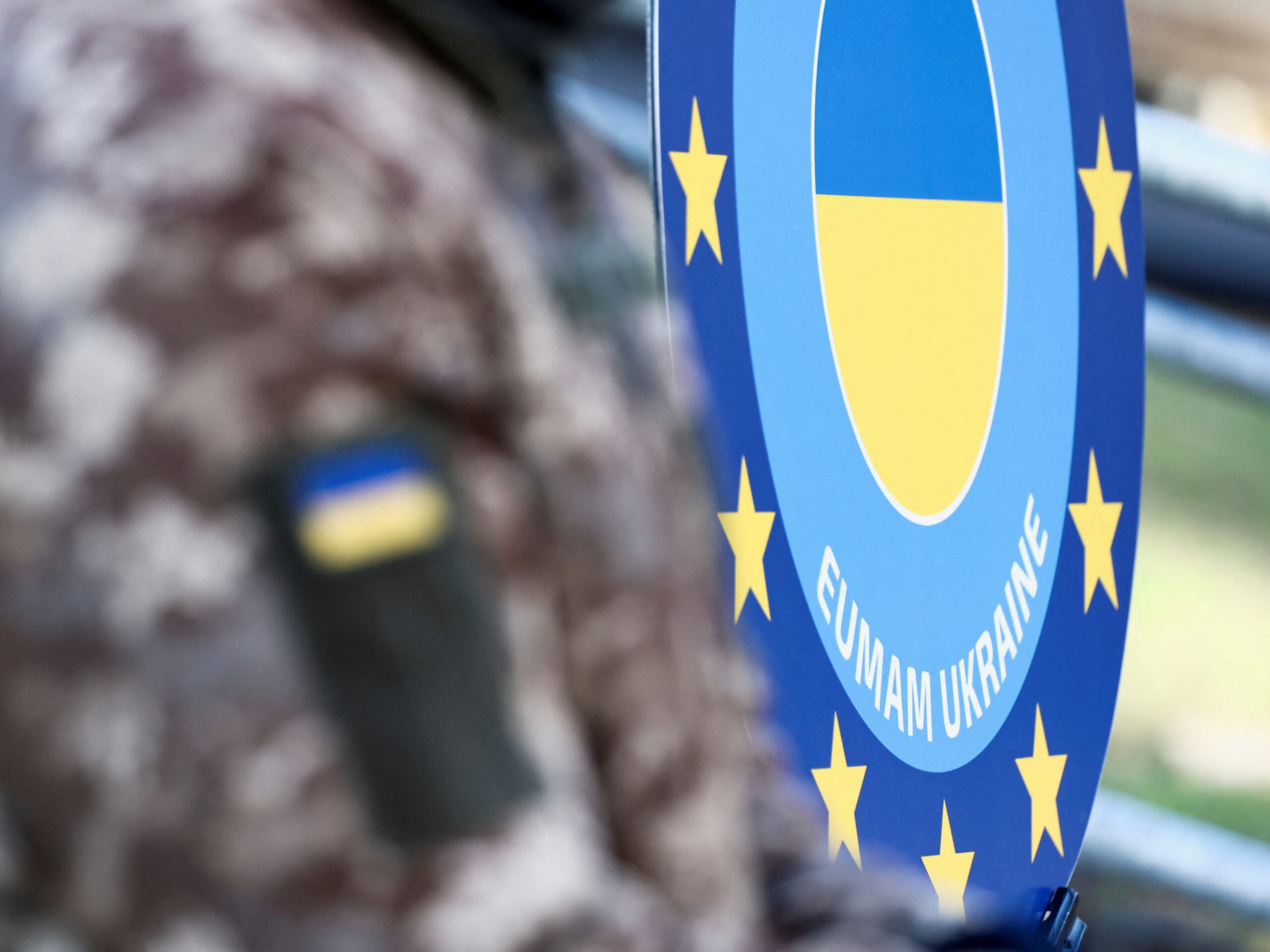
Image: A view of the EU Military Assistance Mission in support of Ukraine logo during a maintenance training on Leopard 1 A5 tanks, at the German army Bundeswehr base in Klietz, Germany, February 23, 2024. REUTERS/Liesa Johannssen.