Last year’s Group of Twenty (G20) Summit in Johannesburg, the first ever held in Africa, put the continent’s prosperity at the top of the agenda. Accordingly, Africa’s mounting debt crisis featured prominently. Today, many countries on the continent are trapped in a vicious cycle: shocks beyond their borders and domestic economic challenges force higher expenditures despite low revenue, driving increased borrowing amid rising interest rates and falling credit ratings.
But that is just the beginning. As money is paid out to service this debt, it is diverted from social services and the stimulation of economic activity, which can lead to fewer jobs, lower tax revenue, and slower growth. In 2026, borrowing across the continent will continue to rise, and with it, the impact of debt crises on citizens’ lives. What, then, is the state of debt across Africa, and what can be done to address it? With the African Union as a core member, part of this answer may lie with the G20—and the other part, with homegrown strategies.
Understanding debt distress in Sub-Saharan Africa
The situation in the region is, in short, concerning. Currently, twenty-two low-income countries in Sub-Saharan Africa are in or at high risk of debt distress, as designated by the World Bank. This assessment is based on a variety of structural and economic factors and measures a country’s debt-carrying capacity and debt-burden indicators against country-specific thresholds.
But debt is not an abstract concept, and a country that struggles to service its debt faces consequences beyond the disdain of foreign creditors. When a country stops paying, its reputation in global financial markets takes a hit. Large debt obligations may discourage new investment and economic growth—a phenomenon known as debt overhang. In these instances, creditors lose confidence in the country’s ability to repay its debts in full, making it harder to obtain new, affordable financing.
At the same time, a reliance on borrowing leads to a reliance on rating agencies that view African nations as far more risky than local or regional credit agencies suggest. This can cause a country’s ratings to plummet during times of struggle, making it even more difficult for countries to access financing, even as they recover. In other words, heavier debt loads in African nations are associated with weaker sovereign credit ratings, which in turn raise borrowing costs, creating a cycle that makes it harder for countries to stimulate the growth needed to reduce debt in the long run. Today, African nations often face interest rates topping 10 percent, whereas many Group of Seven countries borrow at rates closer to 2 to 3 percent.
Why this debt matters
There are two compelling reasons why debt in Africa warrants particular attention from the global community. The first is that Africa’s debt is largely external. Yes, countries such as Japan and the United States maintain debt-to-GDP ratios much higher than those of Sudan, Guinea, and Malawi. But with debt denominated in foreign currencies, African governments are forced to spend far more on servicing their debt if exchange rates fluctuate and domestic currencies weaken. By contrast, a weaker US dollar can provide breathing room for countries, as their domestic currencies gain value against it.
The external nature of Africa’s debt also makes it difficult to restructure. China has come to the forefront as a creditor for African nations, but its selective participation in international debt relief efforts complicates coordinated efforts to restructure and diminishes the effectiveness of the Paris Club process. African nations have also seen a nearly 15 percent increase in debt held by private creditors from 2010 to 2021—a rate faster than any other developing region—which further complicates efforts to reach restructuring agreements by adding more, differing actors to coordination efforts.
The second reason for paying close attention is that many countries in debt distress are classified as low- or lower-middle income. This presents a significant challenge. Low-income countries are designated as such by the World Bank due to a gross national income below a certain threshold. Low income leads to a lowered ability to fund social services and infrastructure, which is particularly harmful for countries that are already fiscally constrained by high debt loads, limiting their ability to deliver services to their citizens. In fact, according to the United Nations Conference on Trade and Development, more than half of Sub-Saharan Africa’s population lived in countries that spent more on interest payments than on education and health in 2023.
The impact of the global community—and its limits
Let’s go back to Johannesburg for a moment. As a high-level convening body, the G20 mostly engages in agenda-setting through acknowledgments and rhetoric regarding debt conversations. During the last summit in late November 2025, host nation South Africa highlighted debt sustainability as one of its four core priorities—a focus reflected in the G20 Leaders’ Declaration. By elevating this notion to the global stage, the G20 moved debt higher up on the agenda.
Moreover, the G20 has considerable convening power. Through its G20-Africa High-Level Dialogue on Debt Sustainability, which was held two weeks before the G20 Summit itself, the G20 brought together finance ministers, central bank governors, and African Union officials to identify practical solutions to excessive debt burdens. Additionally, the Africa Expert Panel on Debt—composed of senior African economic and financial leaders—produced a report on a new debt refinancing initiative and a borrower’s club for debtor countries.
The G20 is also capable of taking action through concrete measures and critical commitments—though this has proved the exception rather than the rule. In May 2020, for instance, the G20 implemented the Debt Service Suspension Initiative (DSSI), which suspended $12.9 billion in debt-service payments for eligible countries to allow governments to focus resources on saving lives and adapting rapidly to the COVID-19 pandemic. Of the seventy-three low-income countries eligible for the pause, only forty-eight participated in the initiative before its expiration in December 2021—accounting for just a quarter of the debt the G20 initially pledged to suspend.
Following the DSSI, the G20 established the Common Framework for Debt Treatments, aimed at providing coordinated debt relief for countries facing unsustainable debt by bringing together official bilateral creditors and requiring comparable treatment from private creditors. The initiative coalesces creditors in a so-called “official creditor committee” before negotiations with private creditors, acknowledging the changing creditor landscape beyond the Paris Club. But so far, only four countries have made requests for debt relief under the framework. And criticism is loud regarding its slow pace, procedural complexity, insufficient debt relief, and its preference for debt reprofiling over outright reduction.
The Common Framework for Debt Treatments requires urgent reform to account for the mismatch between lengthy restructuring timelines and the urgent need for immediate financing, as well as China’s role in debt negotiations. To address debt sustainability over the long term, discussions must shift focus from debt levels alone to the structural features of domestic economies and the international financial system that transform manageable debt into distress.
At last year’s G20 Summit, broad acknowledgment of the mounting debt crisis marked a step in the right direction, but commitments on debt remained largely rhetorical. While much was said about the issue, actionable steps proved elusive. With limited enforcement mechanisms and a reliance on consensus, the G20 is only as strong as the collective commitment behind it, and the lack of reform to its own processes left many observers disappointed.
Debt relief requires growth and homegrown strategies
To address the debt crisis, the answer cannot just be to spend less money. After all, it is nearly impossible to reduce debt through austerity measures alone. The G20, led by the African Union, must prioritize growth in countries facing debt distress, and a first step toward this is economic diversification.
As shown in the graph below, many countries in debt distress already struggle to sustain economic growth due to high levels of commodity dependence. While commodity exports are not inherently bad for growth, reliance on energy, agricultural, or mining exports exposes economies to volatile international prices that are largely beyond national control. When prices surge, revenues increase. When they fall, however, growth slows—and in the worst cases, economies can tip into recession. This dynamic played out between 2013 and 2017, when falling commodity prices triggered slowdowns in sixty-four commodity-dependent countries. For countries already in debt distress, stimulating growth precisely as revenues decline poses a particularly acute challenge.
For a country such as the Republic of the Congo, for instance, where 94 percent of exports are commodities, debt repayment is complicated not only by exchange-rate volatility but also by exposure to commodity price shocks that undermine steady growth.
Efforts have also focused on addressing the economic extractivism that has plagued African nations by shifting toward domestic processing and reducing reliance on raw-material exports—particularly as debt-servicing costs rise faster than countries’ ability to acquire foreign currency.
Against this backdrop, African leaders remain confronted with politically unpopular choices, including austerity measures and tax increases—decisions that risk deepening domestic grievances amid already difficult economic conditions. Yet continental and regional institutions have begun advancing strategies to foster growth, generate wealth, and build a financial architecture better suited to a rapidly developing continent.
African nations are not poor—and they are far from monolithic. Across the continent, countries continue to grapple with their own unique political, economic, and social dynamics; however, there exists immense human-capital, natural-resource, and infrastructure potential. As debt outpaces growth and shrinking fiscal space threatens progress, the solution to debt crises in African nations lies in global and regional cooperation. The G20 must support the African Union as it steps up to help countries manage and service their debt and must listen to homegrown strategies related to credit rating and growth promotion to secure a more stable and prosperous future.
Development needs remain urgent—and shortfalls in funding for health, education, and social services continue to impact citizens’ everyday lives. The global debt system must shift away from prioritizing wealthy lenders over the development and well-being of citizens. As African governments and regional institutions continue working to reduce heavy debt burdens and promote sustainable growth, the international community must listen to—and act on—the reforms and recommendations emerging from the continent, ensuring countries are not forced to choose between paying for the past and investing in a better future.
Juliet Lancey is a consultant and a former young global professional with the Atlantic Council GeoEconomics Center.
Related Reading
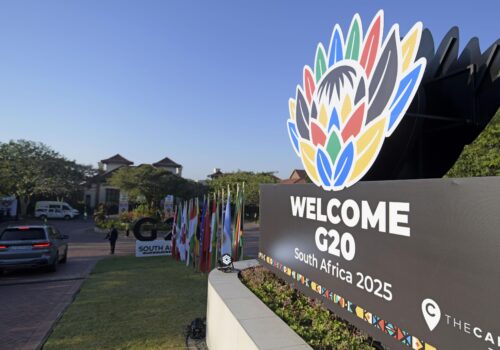
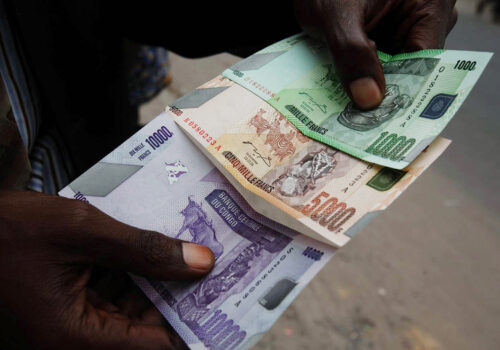

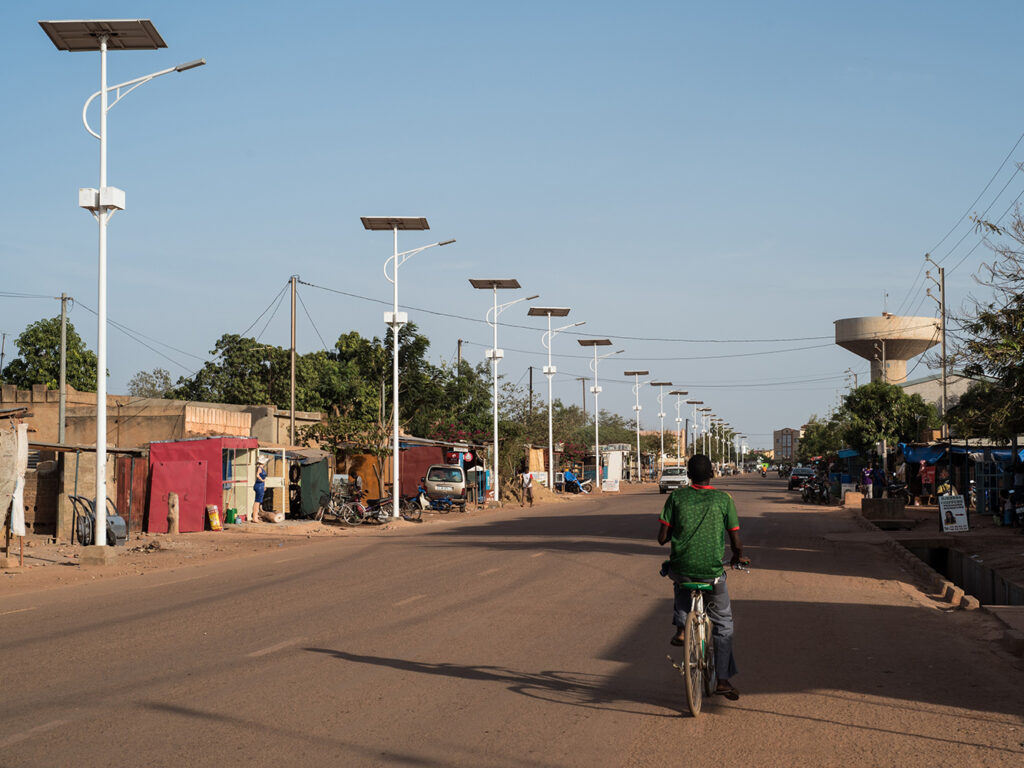
Image: A street in the capital equipped with solar street lights in Burkina Faso/Ouagadougou on April 20, 2016. Photo by Nicolas Remene/Le Pictorium via Reuters.