
WASHINGTON—A twenty-seven-mile stretch of land running through southern Armenia is poised to reshape the geopolitics of the South Caucasus. On January 13, US Secretary of State Marco Rubio and Armenian Minister of Foreign Affairs Ararat Mirzoyan announced a detailed framework to implement the Trump Route for International Peace and Prosperity (TRIPP). This US-brokered corridor, which promises to become a vital connectivity link between Europe and Asia, could go down as one of US President Donald Trump’s most impressive foreign policy achievements of his second term.
TRIPP’s connectivity potential
The idea for a US-brokered transport route in southern Armenia that would link the main part of Azerbaijan to Baku’s Nakhchivan exclave grew out of 2025 peace talks between the two countries coordinated by US officials. Azerbaijan wanted to implement a crucial element of its 2020 cease-fire agreement with Armenia—unfettered transport access to Nakhchivan. At the same time, Armenia sought to maintain control over its sovereign territory along the proposed twenty-seven-mile route across its land.
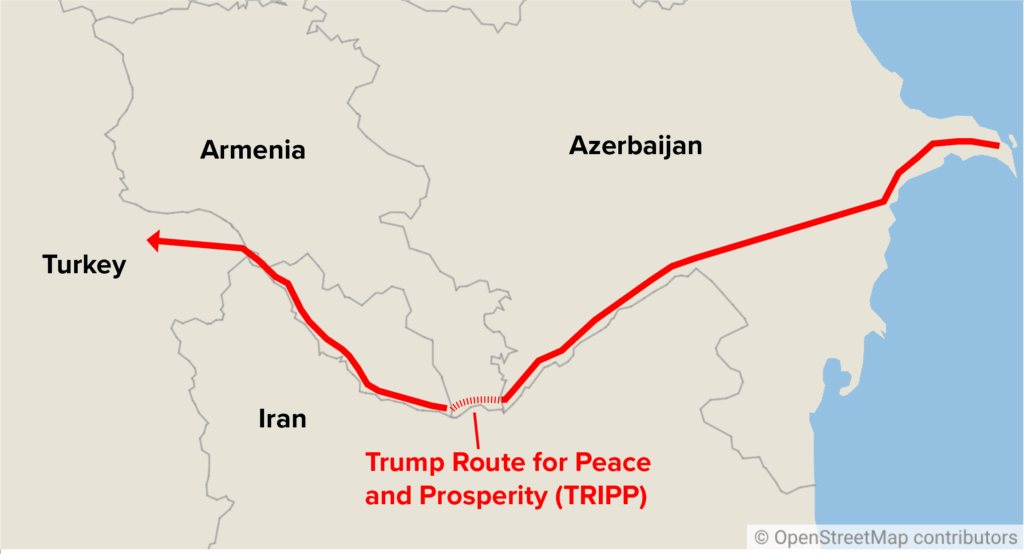
In stepped Trump and his team with a creative solution: a US-led consortium would construct and manage the route, in concert with Armenian authorities, that would in turn safeguard Azerbaijani access to Nakhchivan. At a summit at the White House this past August, Armenian Prime Minister Nikol Pashinyan, Azerbaijani President Ilham Aliyev, and Trump agreed to implement TRIPP with a view toward a comprehensive Armenia-Azerbaijan peace deal. This was a significant achievement: Armenia and Azerbaijan had clashed for more than thirty years, and they had fought a handful of wars in that time that killed tens of thousands.
But no details about how TRIPP would be built and managed were made public officially until this past week. In a joint statement, Rubio and Mirzoyan announced a new TRIPP Development Company (TDC) to construct the initial rail and road elements of the project, with the United States taking a 74 percent controlling stake for forty-nine years, which will revert to a 51 percent stake for the following fifty years. The agreement envisions the United States government providing upfront capital to develop the route and making a financial return via the TDC over the life of the project through transit fees and commercial opportunities along the route, in addition to construction contracts to US companies. Armenia will earn revenue based on its minority stake in the TDC, plus taxes and customs duties along TRIPP.
It’s an arrangement that should work well for both parties. The White House can tell Americans that they are getting an economic return for US diplomatic engagement in the South Caucasus and opening new opportunities for US companies. At the same time, Pashinyan can sell the agreement as a means of attracting high-quality Western infrastructure investment—something he had pursued through his Crossroads of Peace initiative—that can help position Armenia as a regional transport hub, all while maintaining control over Armenian territory.
TRIPP could provide spillover benefits to Washington, Yerevan, and the broader Caspian region, as well. The US government has been quietly supportive of the Middle Corridor, a multi-modal trade route that connects Central Asia to Turkey and Europe via the Caspian Sea and infrastructure chokepoints in Azerbaijan and Georgia. Washington and its European partners see the Middle Corridor as a way for overland trade with Asia to bypass Russia, including the potential export of critical minerals and rare earths from Central Asia. The South Caucasus and Central Asian countries seek prosperity through better integration with global markets. TRIPP provides another route across the Caucasus, increasing transport volume capacity as Azerbaijan and Kazakhstan work to build port capacity to meet trade demand.
The successful implementation of TRIPP would make it cheaper and faster to ship products and critical raw materials from Central Asia to Europe and beyond.
But cheaper, faster, better connectivity also carries some risks. The South Caucasus has at times swelled into a hotbed for sanctions evasion to both Russia and Iran, and possibly even evasion schemes between Moscow and Tehran. TRIPP can be a success as a regional trade route, but realizing its full potential relies on demand for trade between Europe and Asia. High transport costs along the Middle Corridor due to geopolitical instability or project economics—or an unforeseen increase in willingness to ship goods via Russia or Iran—could derail TRIPP’s prospects.
Pashinyan looks west
The finalization of TRIPP is not only an achievement of the Trump administration, but also a new peak of Pashinyan’s shift away from Russia. For thirty years, Armenia relied solely on Moscow for its security, leading to Russian domination of the country’s internal and foreign politics. When Russia failed to intervene during the 2020 Karabakh War, Pashinyan made a change. Understanding that a peace deal with Azerbaijan was the only way to remove Russian leverage and therefore achieve true independence, the Armenian prime minister staked his political future on such a deal. Simultaneously, he inked major defense deals with India, France, Greece, and Cyprus, among others.
But the United States is the only power capable of truly offering Armenia an exit ramp from Russian domination. By conducting peace negotiations under US auspices and placing US interests directly over TRIPP, Pashinyan and Aliyev have protected the most sensitive part of the deal with a US deterrent. But more than that, they tied the success of the peace process to closer relations with Washington. As Aliyev attested at the peace summit, “If any of us—Prime Minister Pashinyan or myself—had in mind to step back, we wouldn’t have come here.”
Yet Russia is not the only neighbor disturbed by a growing US presence in the South Caucasus. Iran has consistently called any change of the status quo to its northern border with Armenia a “red line.” In 2022, Tehran even staged large-scale military exercises on the Azerbaijani border when it thought Baku may try to take over the area by force. Recently, Ali Velayati, a senior advisor to Ayatollah Ali Khamenei, threatened to turn the South Caucasus into a “graveyard for the mercenaries of Donald Trump.” However, Iran is weaker than it has been in decades, and Pashinyan has taken advantage. As protests threaten the stability of the Iranian regime, Tehran weakly voiced concern that Washington could use TRIPP “within the framework of its security policy,” a far cry from red lines, graveyards, and military exercises.
Last month, Pashinyan sent Deputy Foreign Minister Vahan Kostanyan, responsible for TRIPP coordination with Washington, to Israel to discuss the corridor. Kostanyan’s visit showed that Pashinyan would not make the same mistake with Iran as it did with Russia, instead choosing to align with the US-backed regional order.
Such moves come at a key time. With parliamentary elections set for 2026, Pashinyan needs to show that his pursuit of peace and ties with the West have been successful. Already, there are some signs. Azerbaijan has begun to ship oil and gas to Armenia, driving fuel prices down by 15 percent. Meanwhile, incoming stability and regional integration with Azerbaijan and Turkey have the potential of transforming Armenia into a transit country and providing easy access to the European market.
Russia has organized against Pashinyan ahead of the elections in the way it knows best—information operations. Last month, Armenian outlet Civilnet reported a spike in fake news targeting Armenian authorities, often spreading through anonymous social media accounts and Russian-language Telegram channels. Moscow will almost certainly seek to expand these efforts ahead of the election.