

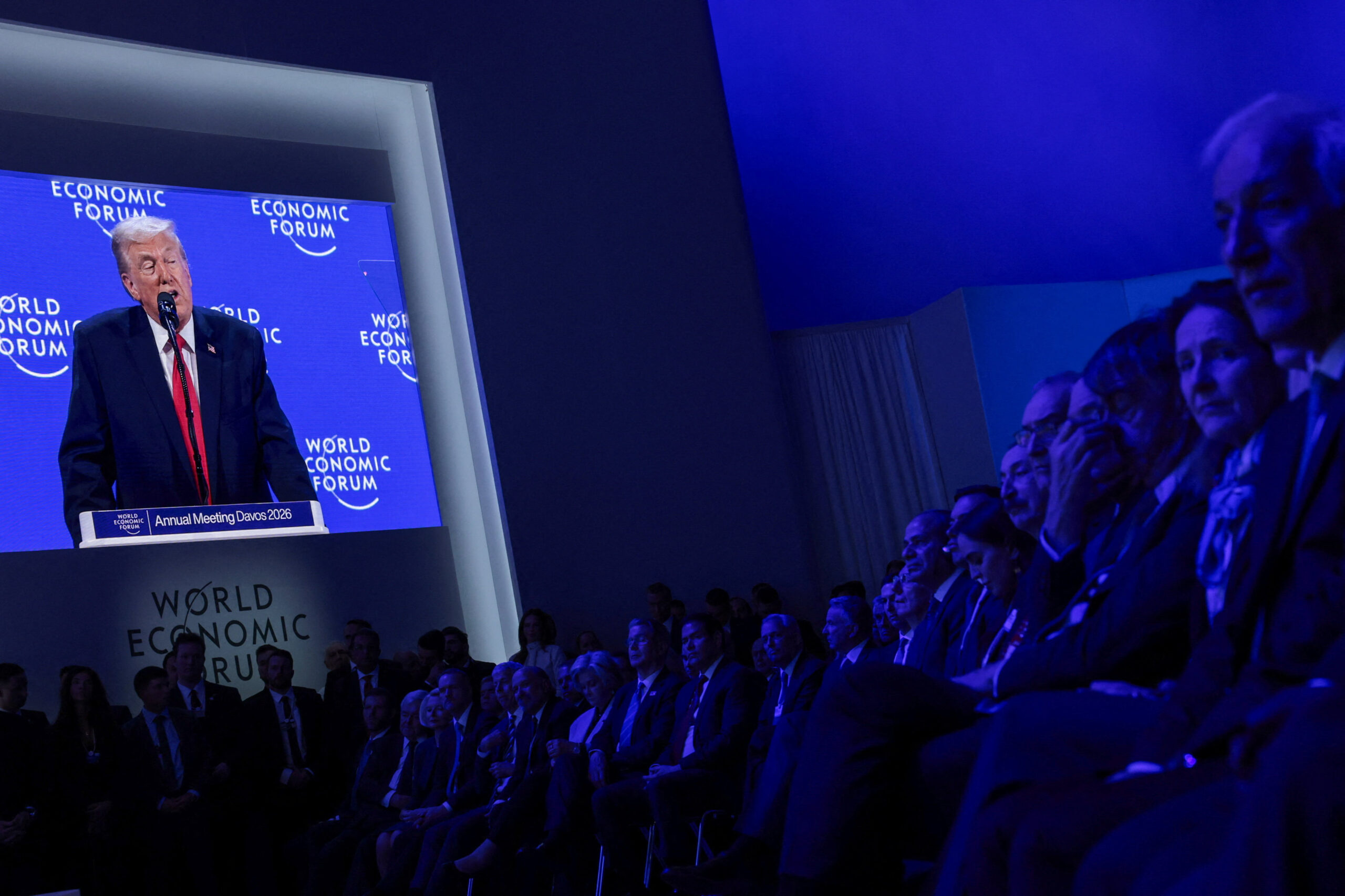
A senior European official, who was in Davos this past week for the World Economic Forum, refers to US President Donald Trump’s approach to Europe as “shock therapy.” After enduring several tough doses in the first year of Trump’s second term—on Ukraine, on tariffs, on Europe’s so-called “civilizational erasure,” and then on Greenland—the patient’s condition is shaken, the official says. But it is stronger.
I asked this European official for further explanation. Shock therapy, after all, is more commonly a description of electrical currents treating mental illness than a theory of international affairs. In the context of European-US relations in 2025 and 2026, he said, shock therapy refers to the “rapid, disruptive, and painful transitions” forced on Europe by Trumpian jolts to the traditional transatlantic security and trade partnership.
Europe isn’t enjoying the treatment, he said, but it is responding to it—more consequentially with every shock. Europeans have long spoken somewhat helplessly about the chronic conditions they suffer: a lack of economic competitiveness, an inability to provide for their own security, and insufficient political unity. Together these conditions have resulted in the continent’s inability to translate the weight of its 450 million people, $22 trillion-plus gross domestic product (GDP), and advanced market into geopolitical heft.
This diagnosis hasn’t changed. But European leaders now recognize that, in the face of Trump’s United States, the continent must fundamentally treat its maladies or further surrender global relevance. What’s also changed for Europe is a growing recognition that it can no longer rely on the post–World War II global order, whose institutions and rules provided the safe context for the creation and growth of the European Union (EU).
Trump’s dramatic climbdown this week from his ultimatum that Europe either give him Greenland or face tariffs had many sources, ranging from market jitters over EU countermeasures and congressional opposition to a lack of popular American support. Most significant in Europe was that it triggered greater unity among the EU’s twenty-seven members against Trump, even among the right-wing parties that usually back him, than at any time previously.
Even after the immediate crisis was defused in Davos on Wednesday, EU leaders still met at an emergency summit in Brussels on Thursday. The Atlantic Council’s Jörn Fleck and James Batchik write about how that meeting signaled “a quiet yet dogged determination . . . to strengthen Europe’s ability to withstand US pressure in any future scenarios.”
If this change is permanent
It took a Canadian in Davos to best describe the abrupt changes unsettling European countries—and other nations that he referred to as middle powers. “We are in the midst of a rupture, not a transition,” said Prime Minister Mark Carney. Great powers, he continued, “have begun using economic integration as weapons, tariffs as leverage, financial infrastructure as coercion, supply chains as vulnerabilities to be exploited.” His conclusion: “You cannot live within the lie of mutual benefit through integration, when integration becomes the source of subordination.”
However, it was European Commission President Ursula von der Leyen who captured the historic moment at Davos for a continent whose current boundaries, ideologies, and collaborative structure have been forged by the previous shocks of World War I, World War II, and the Cold War. Where she agreed with Carney, without mentioning Trump by name, is that his administration is sweeping away the nostalgia of common cause that has helped hold together the transatlantic alliance for eight decades.
“Of course, nostalgia is part of our human story. But nostalgia will not bring back the old order,” she said in a speech less celebrated than Carney’s but just as consequential. “And playing for time, and hoping that things will revert soon, will not fix the structural dependencies we have. So, my point is, if this change is permanent, then Europe must change permanently, too.”
The will to match the ambition
What many in the Trump administration have missed, with their focus on Europe’s weaknesses, is that the EU has been seizing upon the Trump moment for new trade deals. Von der Leyen came to Davos from Paraguay, where she signed the EU-Mercosur trade agreement, through which the EU and Latin American countries have created what she called “the largest free trade zone in the world, a market worth over 20 percent of global GDP; thirty-one countries with over 700 million consumers.”
Her next lines were aimed at Trump, without naming him. “So, this agreement sends a powerful message to the world that we are choosing fair trade over tariffs, partnership over isolation, sustainability over exploitation, and that we are serious about de-risking our economies and diversifying our supply chains.”
For those paying attention, that was something new. De-risking has been a term that Europe has associated with China until now, but in Davos this past week European political and corporate leaders increasingly applied it to the United States. A few US companies complained privately in Davos that European officials cancelled meetings—presumably to send a message. US companies with big business and investments in Europe sound more alarmed than ever that their European partners will look for ways, wherever they can, to operate without them. One US business leader told me that EU regulators are talking openly about more aggressively reducing their reliance on US technology, social media, and payment giants over the next three to five years.
Though misgivings about dealing with China remain substantial, European leaders believe they must hedge, if only to signal to Washington that they have alternatives. As evidence of this, European leaders are lining up to visit Beijing to drum up business. Carney was there just before Davos. British Prime Minister Keir Starmer and German Chancellor Friedrich Merz will each visit in the coming days. French President Emmanuel Macron, who visited China in December, said in Davos that Europe needs to seek more Chinese foreign direct investment.
In her Davos speech, von der Leyen spoke about new trade agreements in the past year alone with Mexico, Indonesia, and Switzerland (while Trump has been slapping tariffs on them) and a new arrangement soon with Australia. The EU is also “advancing,” she said, with the Philippines, Thailand, Malaysia, and the United Arab Emirates. This weekend, she is in India, whose officials prioritized the EU after Trump’s tariff hit on them.
“There’s still work to do, but we are on the cusp of a historic trade agreement” with India, von der Leyen said. Then, channeling Trump-like language that no EU leader would have used previously, she said, “Indeed, some call it the mother of all deals. One that would create a market of two billion people, accounting for almost a quarter of global GDP and, crucially, that would provide a first-mover advantage for Europe with one of the world’s fastest-growing and most dynamic countries.”
At the same time, European Union countries have launched a surge in defense spending of some €800 billion through 2030. That pledged surge, von der Leyen said, had helped triple the market value of European defense companies since January 2022, making them one of the best global investments anywhere in that time.
“All of this would have been unthinkable even a few years ago,” she said. “This now only shows how economy and national security are more linked than ever, but also what we can do when Europeans have the will to match the ambition.”
Interrupting the equilibrium
One of the other quiet takeaways from Davos was just how serious European policymakers are about economic integration. “The long-debated savings and investment union is now on a fast track, and Trump is a major factor,” says Josh Lipsky, chair of international economics at the Atlantic Council, who was in Davos this past week. “The stark realization that the US can’t always be relied on as an economic partner put new urgency in the minds of every finance official. I expect this is finally going to get done.”
NATO Secretary General Mark Rutte, the European who negotiated the deal that defused what might have been the worst transatlantic crisis in decades, gave Trump credit in Davos for a more determined Europe. “I’m not popular with you now because I’m defending Donald Trump,” he said, “but I really believe you can be happy that he is there. He has forced us in Europe to step up.” He added, “Without Donald Trump, this would never have happened.”
Whether Europe’s new steeliness endures beyond Davos remains to be seen. As a life-long Atlanticist, one who runs an institution dedicated to shaping the global future alongside US partners and allies, I regret the nature of the therapy but hope the eventual outcome will be a stronger and more confident Europe within a restored and resurgent transatlantic community, one up to the challenges of the coming century.
One can only hope that it won’t require an ever more severe shock to get there, more than likely administered by autocratic powers such as Russia and China, sensing a moment of opportunity provided by weaknesses among democratic allies.
Shock therapy succeeds in medicine not because it heals but because it interrupts a potentially fatal equilibrium and creates a window for recovery. Applied to Europe, Trump’s shock has broken decades of strategic complacency and forced long-postponed decisions on defense, trade, and autonomy. Both in medicine and politics, a jolt can restart the system, but only sustained care determines whether it survives.
Frederick Kempe is president and chief executive officer of the Atlantic Council. You can follow him on X @FredKempe.
This edition is part of Frederick Kempe’s Inflection Points newsletter, a column of dispatches from a world in transition. To receive this newsletter throughout the week, sign up here.