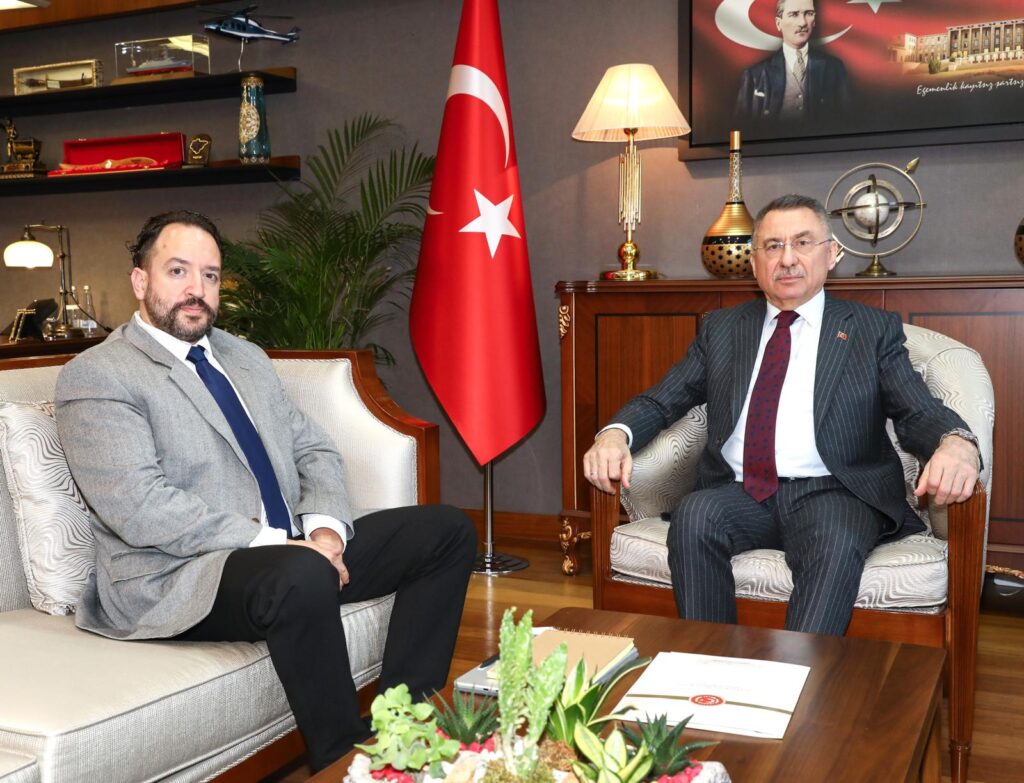
Fuat Oktay is the chairman of the Turkish Grand National Assembly’s (Türkiye’s Parliament) Foreign Affairs Committee. He previously served as a vice president of the Republic of Türkiye. The Defense Journal of the Atlantic Council Turkey Program recently interviewed Oktay, covering US- Türkiye relations, the Turkish defense industry, and NATO.
The interview was conducted on February 18, 2026 and has been lightly edited for style.
DJ: Recent developments in Syria appear to have removed a long-standing elephant in the room in US–Turkish relations. Washington and Ankara now seem aligned on preserving Syria’s territorial integrity and on the primacy of a centralized government in Damascus under President Ahmed al-Sharaa’s leadership. How do you assess this convergence, and what does it signal for the future of US–Turkish security cooperation?
Oktay: It is true that Türkiye and the United States have converged in recent years on a number of foreign policy issues. This convergence is visible not only in Syria, but also in efforts to end the war in Ukraine, support a durable framework in Gaza, and encouraging progress in the Azerbaijan-Armenia peace process, among other areas. This convergence is for the establishment of sustainable peace and stability in our region. Our region is tired of conflicts and war. The issues in our region should be solved through dialogue and not through armed clashes and war.
In Syria, Türkiye has been supporting the unity and territorial integrity of this country since the very beginning. Now both Türkiye and the United States support Syria’s territorial integrity and unity and recognize the importance of a centralized and effective government in Damascus. A united, stable, inclusive, and prosperous Syria is, first and foremost, in the interest of the Syrian people. It is also in the interest of the broader region.
This convergence reflects a realistic reading of regional dynamics and a mutual understanding that sustainable solutions require regional actors and inclusive diplomacy.
It is the right time to reinforce the positive momentum in Türkiye–US relations to a resilient, future-oriented, principled relationship, grounded in mutual respect and strategic responsibility.
DJ: Do you see this more constructive atmosphere on Syria translating into movement on bilateral defense ties? In your view, what should both sides do to enhance the defense portfolio? And to follow up, what are the odds of Türkiye’s eventual return to the F-35 program in the near to medium term?
Oktay: Defense cooperation should be viewed in the wider context of the overall relationship. One of the main drivers of a more constructive atmosphere has been the direct and cordial dialogue between President [Recep Tayyip] Erdoğan and President [Donald] Trump. Strong engagement at the leadership level has generated momentum across multiple areas of cooperation.
Economically, our bilateral trade volume is approaching $40 billion, and we share the objective of reaching $100 billion. Major items—such as Turkish airline companies’ aircraft purchases, long-term LNG [liquefied natural gas] arrangements, and potential future cooperation in civil nuclear energy—can further deepen our economic ties.
In this spirit, defense cooperation should mirror the positive trajectory in our bilateral relations, as well as the growing convergence on regional policy issues. For this reason, it is important to overcome the existing restrictions affecting Türkiye in the defense industry domain. Restrictions between allies are, by definition, inconsistent with the spirit of alliance and partnership.
At present, there are efforts at the governmental level in both countries to identify a workable path forward, including on the question of Türkiye’s access to the F-35 program. In February, as the Foreign Affairs Committee of the Turkish Grand National Assembly, we visited Washington, DC, and held constructive discussions with our counterparts in both the Senate and the House of Representatives. We conveyed our view that it is neither coherent nor sustainable to maintain such restrictions among partners and allies. We hope to see tangible progress at the congressional level to strengthen defense industry cooperation.
DJ: Türkiye’s defense industry has undergone a remarkable transformation over the past decade. Where do you see Turkish defense industrial capabilities today, and what do they represent for both Türkiye and the NATO Alliance? Looking ahead, what should be Ankara’s strategic priorities in this domain?
Oktay: Türkiye’s defense industry has achieved significant and sustained progress over the past two decades. During this period, we have transitioned from an import-procurement model toward a high-volume domestic design and production model, with a growing export dimension.
The share of local and national production in the defense industry has increased from around 20 percent to more than 80 percent, and we expect this rate to reach 85 percent in the near future.
Today, Türkiye is producing manned and unmanned fighter aircraft, such as the Kaan and Kızılelma jets, warships, armored vehicles, missiles, and rockets, as well as advanced sensors and related systems. At the same time, Türkiye is increasingly localizing critical electronic subsystems, including avionics, data links, communications, and mission computers, as well as smart munitions. Defense exports have now surpassed $10 billion annually. Turkish defense industry exports and cooperation cover 185 countries covering all continents, including such NATO members as the US, UK, Spain, and Italy.
In summary, Türkiye has become an important global producer of advanced defense technologies. These capabilities—both in production scale and technological innovation—represent a valuable contribution to NATO’s collective security, and particularly to European security. In this context, the inclusion of Türkiye in European defense industry initiatives is essential in order for both NATO and Europe to fully benefit from Türkiye’s achievements in this field.
DJ: The KAAN fighter program is widely viewed as a cornerstone of Türkiye’s future force structure. What vision do you associate with KAAN, both in terms of operational capabilities and Türkiye’s broader ambitions for defense cooperation and access to new defense markets?
Oktay: KAAN is among the most advanced fifth-generation fighter projects currently under development. It reflects core fifth-generation design requirements such as low observability, sensor fusion, and network-enabled operational concepts.
KAAN will represent a significant capability enhancement for the Turkish Air Force and will strengthen NATO’s southeastern flank. In addition, the program is a major driver of innovation for Türkiye’s broader aerospace ecosystem, with spillover effects across engineering, production, and advanced systems integration.
A number of countries have expressed interest in acquiring or co-producing KAAN. Last year, an agreement for forty-eight KAANaircraft was signed with Indonesia, and several other countries remain in close contact with Türkiye regarding potential cooperation.
DJ: The next NATO summit will be hosted in Ankara. What does this mean symbolically and strategically for the Alliance and for Türkiye? How do you assess Türkiye’s role within NATO today—and NATO’s importance for Türkiye?
Oktay: We look forward to hosting NATO’s next summit in Ankara on July 7–8, 2026. The summit will be an important opportunity to review progress in implementing the Hague commitments and to take decisions that further strengthen NATO’s deterrence and defense posture.
As the war in Ukraine has heightened Europe’s security concerns and uncertainty is affecting transatlantic relations, the Ankara Summit will be a critical meeting. Key issues will be discussed, and major decisions will be taken on the future direction of the Alliance.
Türkiye has always played, and continues to play, a vital role in the security of the entire Euro-Atlantic region. Türkiye holds NATO’s second-largest army and remains among the top contributors to NATO operations and missions, supporting both the Alliance’s southeastern and eastern flanks. We have already exceeded the 2-percent benchmark in defense spending, and we remain committed to further strengthening our contributions.
As we are committed to the security of our allies, we likewise expect them to be fully committed to Türkiye’s security and defense.
DJ: Türkiye’s influence across the Turkic world has grown, particularly through the Organization of Turkic States. How would you characterize Ankara’s strategic vision in this space, and what does the geopolitical horizon suggest about Türkiye’s long-term role across this geography?
Oktay: Türkiye has deep historical and cultural ties across the Turkic world. The Organization of Turkic States (OTS) is today the principal political framework for multilateral cooperation in this space. It reflects a shared vision to deepen integration and promote regional peace, stability, and prosperity. The OTS also functions as a catalyst for stronger regional ownership, and with the establishment of multiple sub-institutions, it is evolving rapidly into a more structured and specialized organization.
In parallel, the Parliamentary Assembly of Turkic States (TÜRKPA) serves as the main platform for strengthening parliamentary cooperation among Turkic states and supporting broader integration efforts. At the parliamentary level, we have also developed a mechanism for bringing together the Foreign Relations Committees of the Parliaments of Turkic States. The first such meeting took place in Azerbaijan, and the second meeting was held in Istanbul last year.
Through these institutions—along with strong bilateral relations—Türkiye is expanding cultural, political, and economic cooperation and coordination among Turkic states, with the objective of promoting peace and prosperity across Central Asia and the Caucasus.Bottom of Form
Fuat Oktay is the Chairman of the Foreign Affairs Commission of the Grand National Assembly of the Republic of Türkiye. He served as the last Undersecretary of the Prime Ministry between 2016 and 2018. In the first cabinet of the Presidential Government System, he served as Türkiye’s first Vice President between 2018 and 2023.
Explore other issues
Explore the program
Within the Atlantic Council’s longstanding commitment to strengthening the transatlantic relationship, the Atlantic Council Turkey Program conducts research, provides thought leadership, and offers a platform for strategic dialogue between the US, Turkey, and NATO allies to address the region’s toughest challenges and explore opportunities, including in the fields of energy, business & trade, technology, defense, and security.