The renminbi is winning over Africa—but can it rival the dollar?
The dominance of the US dollar in the global financial system is well established, and Africa is no exception. Across the continent, the currency is deeply embedded in trade, finance, and debt markets. But while the dollar has brought certain efficiencies and simplified trade, it is also a symbol of structural dependence—and economic vulnerability.
Every fluctuation in the dollar directly affects African balance sheets, as roughly 60 percent of the continent’s external public debt is denominated in dollars. Nearly all critical imports are priced and settled in dollars—and even intra-African trade is often transacted in dollars and routed through correspondent banking networks, costing Africa more than $5 billion in fees per year. In North and West Africa, the euro adds an additional layer of dependence, as the CFA franc zones are pegged to the euro.
In recent years, African governments have taken more active steps to reduce this reliance, and volatile US tariff policies over the past year have further accelerated efforts to diversify trade settlement mechanisms. Africa is attempting to address these vulnerabilities, at least in part, through a regional payment system. Progress, however, has been uneven—and in the meantime, an alternative to the dollar has quietly gained ground: China’s renminbi is making inroads across Africa’s trade and finance networks.
Africa’s push for local-currency payments
In 2022, Afreximbank and the African Continental Free Trade Area Secretariat launched the Pan-African Payment and Settlement System (PAPSS), designed to enable cross-border payments in local currencies without routing transactions through the dollar.
It’s a novel initiative that bets on digital innovation as a substitute for a monetary union and a capital markets union. By debiting and crediting local-currency accounts at participating central banks, PAPSS removes correspondent banks and intermediary currencies from the chain. The system claims it can reduce transaction fees by up to 70 percent.
Membership has expanded to seventeen central banks, more than 150 commercial banks, and fourteen payment switches. Interoperability agreements with other regional systems—such as BUNA, the Arab Monetary Fund’s cross-border and multi-currency payment system—also seek to eliminate intermediary currencies from cross-regional trade.
Yet the system remains in its early stages. Public data on transaction volumes and settlement values are limited, making it difficult to evaluate the scale of adoption. Onboarding across diverse regulatory regimes has taken time—and structural constraints persist. Chronic currency volatility and sovereign credit downgrades may discourage firms from shifting away from hard currencies, even if local-currency settlement becomes technically easier.
PAPSS is strategically vital—but for now, its economic footprint remains modest.
Across the continent, the renminbi is gaining ground
While PAPSS represents a long-term, intra-African solution to dollar dependence, a more immediate and externally driven shift is also underway. Africa has become a key arena for China’s experimentation with the internationalization of the renminbi. As China’s economic engagement with the continent deepens—and as US engagement has waned over the past year—the use of the renminbi in African economies has accelerated.
In 2025, Africa emerged as China’s fastest-growing export market, with Chinese exports to the continent rising by 27 percent year over year. Simultaneously, China announced that it would institute a zero-tariff policy for fifty-three African countries. Trade expansion alone, of course, does not guarantee currency adoption. But Beijing has paired commercial incentives with financial plumbing designed to normalize renminbi settlement in trade, investment, and finance across the continent.
Several African countries, including South Africa, Egypt, Nigeria, Mauritius, and Morocco, have signed currency swap agreements with China, giving them liquidity to pay directly in renminbi. Zambia is in talks with China over a potential currency swap agreement. Some countries also accept renminbi for domestic transactions. In Zambia, Africa’s second-largest copper producer, mining companies can now pay royalties and taxes in renminbi. Meanwhile, in Nigeria and Kenya, informal networks allow local traders to pay intermediary logistics firms in local currency, which then convert the funds into renminbi for Chinese suppliers.
Usage of China’s Cross-Border Interbank Payment System (CIPS) is also growing in Africa. In 2024, CIPS processed 47,000 cross-border renminbi transactions between China and African countries, a year-over-year increase of 20.4 percent, with the value of these transactions totaling 238.34 billion renminbi, a year-over-year increase of 160.9 percent. Growth is likely to continue as Afreximbank and South Africa’s Standard Bank joined CIPS in 2025. Standard Bank, the largest commercial bank on the continent, is among the first major financial institutions globally to join China’s payment infrastructure. Afreximbank has also indicated that it intends to finance more projects in renminbi through its CIPS membership, marking a strategic shift away from dollar-based funding.
China has also pledged to open its domestic debt markets to African issuers through renminbi-denominated Panda bonds. Both Egypt and Afreximbank have issued Panda bonds, raising 3.5 billion renminbi ($478.7 million) and 2.2 billion renminbi ($299.9 million), respectively. Other countries and multilateral lenders, including the Africa Finance Corporation and Kenya, have expressed interest in issuing bonds this year. In parallel, Kenya and Ethiopia have negotiated agreements to convert existing dollar-denominated debt into renminbi.
The path forward is multipolar—but it comes with its own risks
While these developments incrementally normalize the renminbi as a reserve, settlement, and financing currency across segments of African economies, they do not automatically dethrone the US dollar. Although reliance on the dollar is receding in some areas, full dedollarization remains distant. The dollar’s entrenched global role, combined with Africa’s structural dependencies, still anchors much of the continent’s external economic activity to the US currency.
Remittances illustrate this reality clearly: representing an estimated 5.1 percent of Africa’s GDP in 2024 and constituting one of its largest sources of external finance, they remain overwhelmingly dollar denominated. Additionally, dollar-backed stablecoins are gaining traction across Africa as a lower-cost alternative for cross-border transfers, reducing the fees traditionally associated with currency conversion in remittance flows. This has reinforced the dollar’s relevance even as the infrastructure around it evolves.
What is emerging, therefore, is not displacement but diversification. There is a clear appetite for a more multipolar monetary landscape—one that reduces the costs and vulnerabilities of single-currency dependence. While the dollar will likely continue to play a vital role, the use of the renminbi is expanding. Yet as Africa continues down this road, caution is warranted. Reducing reliance on the dollar only to substitute it with dependence on the renminbi carries its own strategic risks, particularly given the renminbi’s partial convertibility, China’s capital controls, and the potential for political leverage in times of financial stress.
In the long run, Africa’s strongest path forward lies not in substituting one external anchor for another, but in deepening regional economic integration. Systems like PAPSS offer a way to reduce dependence on both the dollar and the renminbi while simultaneously strengthening intra-African trade—a critical objective for a continent that continues to suffer from some of the lowest levels of regional trade globally. Achieving this outcome, however, will require more than technology. It will demand political resolve, sound macroeconomic management, and sustained commitment to institutional reform.
Lize de Kruijf is a program assistant at the Atlantic Council’s Economic Statecraft Initiative within the GeoEconomics Center.

Housed within the GeoEconomics Center, the Economic Statecraft Initiative (ESI) publishes leading-edge research and analysis on sanctions and the use of economic power to achieve foreign policy objectives and protect national security interests.
Further reading
Tue, Oct 7, 2025
How a weaker US dollar can help debt-burdened African countries
New Atlanticist By Bart Piasecki
Trump’s drive to weaken the US dollar is having global side effects. For some African countries, it is helping to ease immediate fiscal pressures.
Wed, Feb 4, 2026
Understanding the vibe shift on the dollar
Econographics By Daniel McDowell, Bart Piasecki, Jessie Yin
Gold prices surged to record highs last week, driven by trade tensions, tariffs, and dollar uncertainty. For some, the rally signals rising skepticism about the greenback’s stability—even as policymakers insist the US remains committed to a strong dollar.

Thu, Jan 15, 2026
What to watch as China prepares its digital yuan for prime time
Econographics By Alisha Chhangani
The changes China is implementing around the e-CNY signal a more mature phase for the digital yuan—and an overall shift toward a much broader geopolitical ambition.
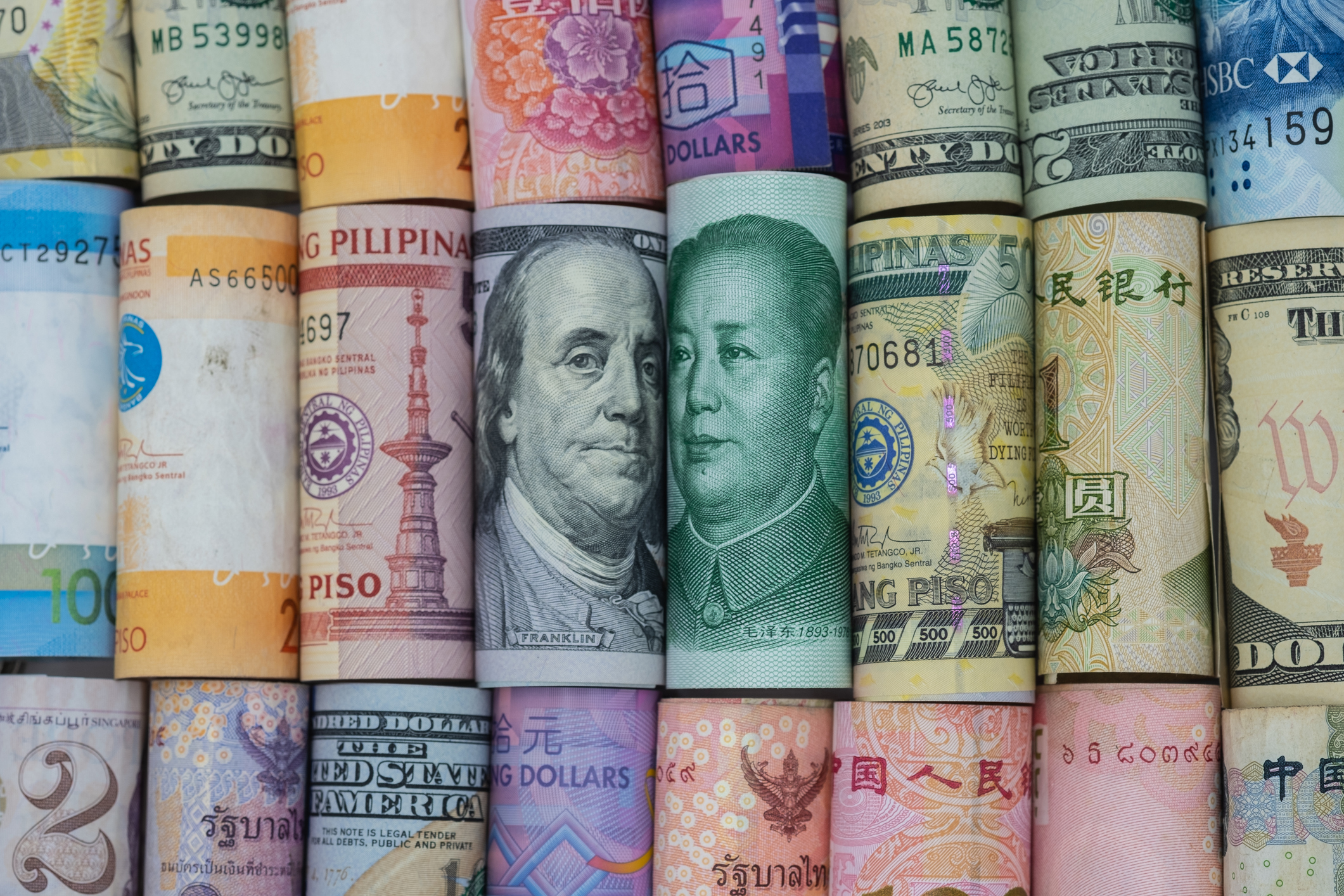
Image: US dollar and China Yuan banknote with multi countries banknotes. Its is symbol for tariff trade war crisis or unfair business of 2 biggest economic countries in the world.