

The US and Israeli militaries are hammering Iran for a second week. Iranian forces and proxies are striking back across the Middle East. Global financial and energy markets are full of volatility. And questions abound about the future trajectory of this conflict and its wider consequences.
Below, Atlantic Council experts pierce the fog of war with clarifying answers to twenty of the most pressing questions about these fast-moving events.
Click to jump to a question
1. Is the US accomplishing its goals in the war?
2. Is Israel achieving its aims in this conflict?
3. Will the US put boots on the ground in Iran?
4. What would be an acceptable end to this war for the Iranian regime?
5. What would be an acceptable end to this war for the US?
6. What do we know about Iran’s new supreme leader?
7. What happens if the Iranian regime collapses?
8. How is the Iranian opposition responding to the conflict?
9. Is Iran’s nuclear stockpile a danger?
10. What threat does Iran pose to the US homeland?
11. What impact is this war having on US weapons stockpiles?
12. What’s the economic impact on Americans?
13. How is this conflict changing global energy markets?
14. What happens if Kurdish groups launch an armed resistance in Iran?
15. What impact will this conflict have on China?
16. What impact will this conflict have on Russia?
17. Will the Houthis in Yemen get involved?
18. How will this conflict impact Gaza?
19. How will the war impact US-Gulf relations?
20. What other countries could get involved if this war expands?
1. Is the US accomplishing its goals in the war?
Washington’s stated goals have included degrading Iran’s nuclear program, ballistic missiles, navy, drones, and control of its terror proxies. The United States is well on its way to achieving these objectives. All of these capabilities are badly degraded with, for example, more than fifty Iranian naval vessels resting on the sea floor. Going after remaining missile and drone manufacturing capabilities will likely take a couple of more weeks, at which point US President Donald Trump will be able to declare victory.
A better government in Iran that is more cooperative internationally and that respects the human rights of its people is also desirable, but that outcome is largely in the hands of the Iranian people.
Regardless of who governs next, Iran will be much weaker for years to come and less able to threaten the United States.
—Matthew Kroenig is vice president for geostrategy and fellows and senior director of the Atlantic Council’s Scowcroft Center for Strategy and Security.
2. Is Israel achieving its aims in this conflict?
Israel almost certainly has set as a strategic objective the collapse of the Iranian regime. That is an expansion of initial goals following the June 2025 twelve-day war. In that conflict, Israeli and US strikes significantly set back the Iranian nuclear program. But some Iranian ballistic missile attacks also managed to penetrate Israeli and US missile defenses. Given the limited stockpile of interceptors, and Iranian ambitions to ramp up production of ballistic missiles that could reach Israel from roughly two thousand to ten thousand—meaning that they could overwhelm Israeli defenses and pose a strategic threat—Israel was prepared to strike at this threat later in 2026.
But that changed following the popular protests against the regime in January, when it appeared that the Islamic Republic’s internal weakness matched the damage to its nuclear program and deterioration of its regional position and proxy network over the past two years. So in addition to degrading the missile threat by striking launchers, storage sites, and production facilities, Israeli targeting since the beginning of the war has included regime leadership (starting with the supreme leader and others in the conflict’s opening minutes), state security organs that participated in the crushing of the protests (the Islamic Revolutionary Guard Corps, Basij militia, and police), and oil storage tanks in Tehran described as essential to the regime’s war machine.
It is understandable that Israelis would seek the demise of the regime. For decades, they have lived with a major regional player openly and ideologically committed to Israel’s destruction, seeking strategic weapons to advance that aim, and arming and funding proxy terror groups that have spilled no small amount of Israeli blood. Tens of thousands of rockets and missiles have been launched against Israeli civilian targets over the past twenty years by Iran and its proxies. Seeing an opportunity to change this reality, which much of the world has taken for granted, has broad appeal in Israel. So far, with a few deadly Iranian missile attacks but Israel’s defenses otherwise holding, the campaign seems to most Israelis to be both necessary and being conducted at a tolerable price.
What is less clear is how well the Israeli goal of regime change matches the United States’ objectives, or if it does, how long that will remain the case. Trump and his administration have offered inconsistent explanations of the war’s strategic objectives, but at least some of those calls—for “unconditional surrender” and creating the conditions that allow the Iranian people to take over their institutions—are consistent with Israeli goals. But as oil prices spike, markets dip, shipping and supply chains are disrupted, and Iran continues to find gaps in its Arab neighbors’ air defense and cause economic and infrastructure damage, it is possible to imagine Trump seeking an earlier off-ramp with a claim of having significantly defanged the regime. Further, the prospects of regime collapse followed by chaos, civil war, instability spilling over into neighboring countries, and refugee flows is of potentially far greater concern to the United States and its Arab partners than to Israel. If such a gap between Israeli and US goals opens up, expect Trump to be the determiner of when the war ends and to impose that endpoint on Israel, even if it is short of regime change.
—Daniel B. Shapiro is a distinguished fellow with the Atlantic Council’s Scowcroft Middle East Security Initiative. He served as US ambassador to Israel from 2011 to 2017 and most recently as deputy assistant secretary of defense for the Middle East.
3. Will the US put boots on the ground in Iran?
The United States is not mobilizing conventional ground forces either in the region or in the United States. Iran is a massive country with very difficult topography and would require hundreds of thousands of troops to occupy. Any use of ground forces would likely be limited to special operations forces for specific missions. Trump has espoused military objectives that are achievable through air and sea power without the need for a ground invasion. The military can seed the conditions for regime change by accomplishing its objectives, but a transition to an organic protest movement that the military doesn’t control or a negotiated settlement with the current regime is a political objective.
Looking back to the Iraq war, Trump has cited the deployment of conventional ground forces and the disbanding of the Iraqi army and government as the reasons the United States became ensnared in a costly insurgency. He is seeking to avoid that by not deploying ground forces and preferring to work with a member of the existing government—if the regime is willing to change its approach. If those conditions come together, Trump can achieve his military objectives and leave at a time of his choosing without a transition to a new government.
—Alex Plitsas is a nonresident senior fellow with the Middle East Programs’ Scowcroft Middle East Security Initiative and leads the initiative’s Counterterrorism Project. He previously served as chief of sensitive activities for special operations and combating terrorism in the Office of the Secretary of Defense.
4. What would be an acceptable end to this war for the Iranian regime?
There is an assumption among some in Washington that Iran will stop fighting when Trump and Israel want to end this war. This is the same reasoning that led the Trump administration to assume Iran would capitulate in nuclear talks and not respond forcefully to the war that Trump and Israel initiated on February 28. This is a very different conflict than the twelve-day war in 2025 or other conflicts in which Iran rapidly de-escalated.
The Iranian regime perceives that it is in an existential conflict, and it does not appear to be interested in an immediate off-ramp. From Iran’s perspective, a cessation of hostilities would merely be a temporary respite, before the United States or Israel restart the conflict once they have replenished their military supplies.
Therefore, a slow, protracted, war of attrition is probably Iran’s intended outcome. Iranian leaders are calculating that their country is more willing to take casualties and absorb pain than either the United States or Gulf countries. Therefore, if Iran retains the military capability (including asymmetric threats) to inflict pain on the United States and the Gulf, as well as keep energy prices high, then Iran is more likely to determine the end of the conflict than the United States is. In fact, Iran may only accept an off-ramp if it ensures there is not another near-term war. This would likely entail compelling Trump to enforce a cease-fire that Israel adheres to. This type of belligerent approach is a risky gamble for Iran, as it increases the chances that the United States doubles down on the war and that it draws in the Gulf, but it is also probably a risk the remnants of the regime are willing to take.
—Nate Swanson is a resident senior fellow and director of the Iran Strategy Project at the Scowcroft Middle East Security Initiative. Beginning in 2015, he served as a senior advisor on Iran policy to successive administrations, including most recently as director for Iran at the National Security Council.
5. What would be an acceptable end to this war for the US?
The United States is going to come out ahead in this war in almost every conceivable outcome. The president has smashed Iran’s missile capabilities, supported the destruction of some additional nuclear facilities, and killed scores of Iran’s top leaders. Tehran was unwilling to trade its uranium enrichment capability and has never countenanced negotiations on its missiles or proxies. Now it has less of all three.
Iran, of course, also has a vote on ending the war, but once the threat to the regime is gone—and it looks like it’s receding—Iran will eventually return to business as usual. It could keep the Strait of Hormuz closed, but that would require continuing to expose itself to attack and pressure, and it does need oil revenue, too. Israel could conceivably continue the war alone but would likely scale down—think Gaza—once the United States indicated its desire to stop.
Perhaps the only unacceptable outcome for the war is if a sustained opposition movement emerges and either suffers more brutality on the streets of Tehran or manages to liberate some territory and then is violently suppressed by the regime. The conditions required for a US win also change if there is a mass casualty terrorist attack at home or overseas directly related to the war, which the United States would need to justify with a more acute strategic objective. If the regime thus wanted to inflict harm on the United States, it might well strike at the homeland, goad Washington into making a sustained effort to replace it, and then try to make the United States suffer further as a result.
—Andrew L. Peek is the director of the Adrienne Arsht National Security Resilience Initiative of the Scowcroft Center for Strategy and Security. He was previously the senior director for European and Russian affairs at the National Security Council and the deputy assistant secretary for Iran and Iraq at the US Department of State’s Bureau of Near Eastern Affairs.
6. What do we know about Iran’s new supreme leader?
Iran’s new supreme leader, fifty-six-year-old Mojtaba Khamenei, is the son of the recently deceased Supreme Leader Ali Khamenei. Many analysts believe that Mojtaba will be a continuation—and potentially more extreme version—of his father. However, less is known about the younger Khamenei, as he rarely speaks or appears in public.
What we do know is that the new supreme leader was trained by a string of hard-line, anti-Western clerics, played a prominent role in past repression of protesters, and was recently embroiled in a corruption scandal. As a former member of the Islamic Revolutionary Guard Corps (IRGC) and an active participant in Iran’s intelligence and defense, he was reportedly the IRGC’s favored candidate. However, his selection is controversial even within the remnants of the Islamic Republic. According to reports, his appointment contravened his father’s written wishes and was opposed by senior political figures in Iran. In this sense, Mojtaba Khamenei’s selection is about more than just succession. It is about stabilizing a system at a moment when uncertainty poses a strategic risk to the regime.

In the short term, Mojtaba Khamenei will likely be focused on Iranian defense, ensuring relative domestic stability, and power projection. Israel and the United States have already expressed opposition to his ascension, leaving open the possibility—perhaps even likelihood—that he will be targeted in future US or Israeli military actions.
—Nate Swanson
7. What happens if the Iranian regime collapses?
The end of the regime is less likely to foster democracy as it is to birth what some are calling “IRGCistan”—a military-dominated state in which the new supreme leader, Mojtaba Khamanei, is a partner but not the final or ultimate authority, as his father was, and with power firmly vested in the hands of the IRGC. Such a result would provide three pathways forward.
An IRGC-run Iran could initially be a bigger regional and domestic threat, staking out even harder-line stances in seeking to consolidate power and focused on ensuring no other insider can outflank it. Second, it could seek to quickly gain the support of the Iranian people by showing greater flexibility for a deal with the United States in exchange for an economic boost in the form of sanctions relief. Third, it could lead to a period of confusion and jockeying for power in which Western states will have to decide how much to try to jump into the fray and influence the outcome.
—Jonathan Panikoff is the director of the Scowcroft Middle East Security Initiative and a former deputy national intelligence officer for the Near East at the US National Intelligence Council.
8. How is the Iranian opposition responding to the conflict?
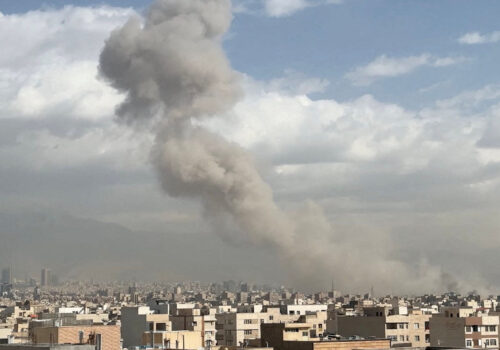
Many in the Iranian opposition both inside and outside of Iran had welcomed targeted military strikes on regime officials and targets in the lead-up to the war. The thinking was that there was no other way to dislodge a violent regime that over forty-seven years had resisted international pressure, sanctions, and multiple internal nationwide anti-regime protests. The war’s opening salvo in killing then Supreme Leader Ali Khamenei and top regime officials was celebrated widely in Iran and seen as an optimistic start to what many believed would be certain regime change. But with Israel’s strikes on oil depots in Tehran that sent a black smoke cloud over the sky in the second week of the war, along with the destruction of cultural heritage sites, moods have started to shift. Some question how much they are willing to sacrifice for a free Iran and whether the regime—which so far has proved resilient—will actually fall, or whether all the war did was replace one Khamenei with another Khamenei who is thirty years younger.
But bright spots remain. Many Iranians say there is no turning back now and that the regime has to go or else it will emerge more brutal than ever before. There are reports of people organizing to take to the streets once the bombing stops. Reza Pahlavi, the son of the deposed shah, continues to offer to act as a transitional leader for Iran to guide the country to free and fair elections and has attracted new key constituencies to broaden his tent. Inside Iran, seventy opposition activists have joined to form a new group called the Strategic Council of Republicans Inside Iran. Their names have not been declared publicly, but they have made their leadership known to Western governments. And outside Iran, opposition figures are meeting to discuss core transitional issues and encourage pluralistic politics.
—Gissou Nia is the director of the Atlantic Council’s Strategic Litigation Project and a board member of the Iran Human Rights Documentation Center.
9. Is Iran’s nuclear stockpile a danger?
Since Israel’s attacks on Iran’s nuclear facilities in Natanz, Isfahan, and Fordow in June 2025, it has been difficult for experts to assess how much of Iran’s nuclear stockpile remains accessible and potentially dangerous. Prior to those attacks, Iran’s stockpile had been estimated at about 440.9 kilograms of 60 percent enriched uranium.
According to the International Atomic Energy Agency, the existing stockpile is “mainly” at Isfahan, while other parts of the stockpile may have been destroyed last year. Some experts believe that the stockpile is largely inaccessible and buried underground. After receiving a briefing from the Trump administration, US Rep. Bill Foster (D-IL) raised concern that the administration “never had a plan for that nuclear stockpile of enriched uranium—to destroy [it], to seize it, or to put it under international inspection.”
If the nuclear stockpile is still accessible, then its future may parallel the political future of Iran; a regime that is compliant with US requirements may wish to take measures to safeguard the stockpile and could even allow inspections to resume. However, if the regime feels that it remains under threat, then it could be more motivated to rebuild military and nuclear weapons capabilities. Additionally, if Iran devolves into political chaos and civil war, then the stockpile could fall into the hands of rogue elements with nefarious purposes.
—Jennifer T. Gordon is the director of the Nuclear Energy Policy Initiative and the Daniel B. Poneman chair for nuclear energy policy at the Atlantic Council’s Global Energy Center.
10. What threat does Iran pose to the US homeland?
Iran’s long history and experience in asymmetric warfare—including being a state sponsor for terrorism and perpetrator of cyberattacks—suggests that the kinetic portion of this conflict could be just a start. In retaliation for the death of IRGC Quds Force Commander Qasem Soleimani in 2020, for example, Tehran sought to murder both Trump and then National Security Advisor John Bolton. While no specific threats have been identified, the Federal Bureau of Investigation and the Department of Homeland Security (DHS) appear to be on high alert. Press reports indicate that the DHS warned of potential lone wolf attacks, which are notoriously difficult to identify in advance, in response to the conflict.
Iran’s proxies across the Middle East are another arrow in Tehran’s quiver. Tehran has cultivated, armed, trained, and financed a network of non-state armed organizations operating across the region with links to Africa and parts of Latin America. These groups include Lebanese Hezbollah, Palestinian militant organizations such as Hamas and Palestinian Islamic Jihad, Shia militias in Iraq and Syria, and Yemen’s Houthi movement. Together and individually, they enable Iran to project influence, deter adversaries, and retaliate asymmetrically while preserving a degree of paper-thin plausible deniability.
Currently, Iran’s proxy network remains operational, although increasingly constrained. Hezbollah retains significant military capabilities, though persistent Israeli attacks and the potential that Lebanese authorities work to limit the group’s activities could challenge its efforts to mount a campaign. In Iraq, Iranian-backed militias wield influence yet risk nationalist backlash and sanctions. The Houthis have demonstrated reach but face sustained military pressure.
—Ingrid Small is the deputy director of the Scowcroft Middle East Security Initiative at the Atlantic Council. She previously served as a senior analyst and analytic methodologist in the US intelligence community for over three decades.
All statements of fact, opinion, or analysis expressed above are those of the author and do not reflect the official positions or views of the US government. Nothing in the contents should be construed as asserting or implying US government authentication of information or endorsement of the author’s views.
11. What impact is this war having on US weapons stockpiles?
The problem of prioritizing near-term requirements over long-term priorities is not new. This is why the recently released National Defense Strategy rightly called for being clear-eyed about available military resources and emphasized a ruthless prioritization on homeland defense and China, along with rebuilding the US defense industrial base.
But now the Iran war is degrading US military readiness for homeland defense and China.
While the cumulative readiness impacts of this decision are difficult to quantify in the near-term, the war in Iran will likely drain inventories of critical munitions and parts, with knock-on effects across the force from training schedules to unit strength.
Major assets employed for the war in Iran that are also relevant to homeland defense and/or China include air defense systems, long-range standoff weapons, naval vessels, strategic airlift and aerial refueling, and intelligence, reconnaissance, and surveillance assets. Moreover, military planners must consider the resources required to monitor, deter, or fight North Korea, Russia, and China simultaneously in the event they join a Pacific conflict or a worst-case homeland defense scenario.
How quickly the United States can regenerate readiness for homeland defense and great power competition remains an open question and will depend both on the Trump administration’s decisions and factors outside the administration’s control.
—Joe Costa is the director of the Forward Defense program of the Scowcroft Center for Strategy and Security at the Atlantic Council. Previously, he served as deputy assistant secretary of defense for plans and posture in the Office of the Secretary of Defense.
12. What’s the economic impact on Americans?
Most Americans are likely to feel the war in two ways—gas prices and groceries. Nearly 20 percent of the global oil supply transits through the Strait of Hormuz and right now movement is at a standstill. It’s true that the United States is far less reliant on energy imports than it was during the previous two Gulf wars, but the nature of the energy market is that a price spike quickly impacts everyone around the world. And that’s exactly what has happened.
After some wild swings, the price of oil as of Wednesday is sitting at about ninety dollars a barrel—up from sixty dollars in December. Many Americans are driving by gas stations and seeing a first number starting with a “3.” It may not be long before that becomes a “4”—and it could get worse, depending on how long the crisis lasts. This is something that will be particularly painful for Americans who already list cost of living as one of their top concerns in surveys. The administration is taking a series of actions to try and relieve the pressure: It’s coordinating with allies to put more oil on the market. It’s providing shipping insurance to convince tankers to make the passage. And it’s even temporarily relieving some sanctions on Russian oil. But none of those steps will stop prices from surging higher as long as transit remains blocked and oil production in the Gulf continues to be a target of Iranian drones.
High gas prices would be bad enough, but expect the cost of other items to tick up, too. Everyday grocery items could soon become more expensive as goods transited across the country on trucks face higher diesel fuel costs.
All of this creates a headache for Trump’s choice to chair the Federal Reserve, Kevin Warsh. Up until the start of the conflict, inflation pressures had been cooling. But if the war continues and Warsh is confirmed, he will face a president who wants lower interest rates but an economy facing price pressures. That means all those looking for relief on mortgage rates and car loans may have to wait a little longer.
—Josh Lipsky is the chair of international economics at the Atlantic Council and the senior director of the GeoEconomics Center. He previously served as an advisor at the International Monetary Fund.
13. How is this conflict changing global energy markets?
The conflict is forcing energy markets to price in geopolitical risk that, until recently, was largely theoretical. For years, governments have assessed the energy security vulnerability posed by the Strait of Hormuz, a chokepoint responsible for roughly one fifth of global oil and gas flows. Today, that vulnerability is no longer a contingency exercise. Even in an otherwise well-supplied market, traders are confronting the real consequences of supply chains tied to a region capable of removing millions of barrels per day from the global market. Oil may be relatively fungible, but the world cannot quickly replace a sudden loss of fifteen million barrels per day. As the conflict persists, the economic knock-on effects compound, and Tehran may be gaining a new layer of deterrence if even the threat of short-range drone or missile attacks can trigger geoeconomic disruption by intermittently halting traffic through Hormuz.
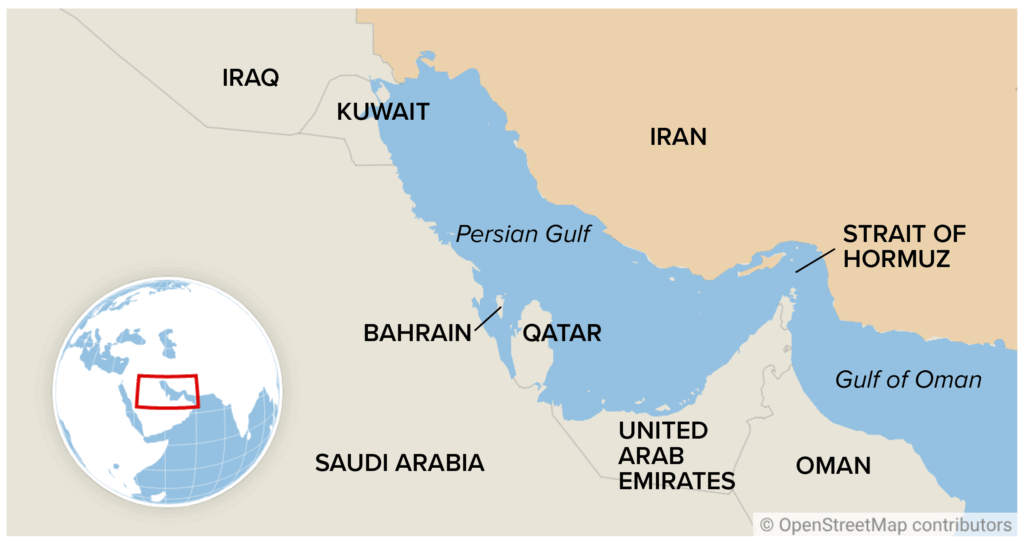
Natural gas markets are even less flexible. Liquefied natural gas (LNG) export infrastructure takes years—often more than a decade—to move from concept to first cargo, leaving Europe and East Asia structurally exposed. Emerging economies may increasingly forgo planned gas buildouts in favor of alternative energy sources. At the same time, upstream capital may pivot toward the Western Hemisphere—particularly the United States, Guyana, and Canada—where geopolitical risk is perceived as lower. That shift could further entrench North America as a global energy powerhouse while simultaneously accelerating political support in vulnerable capitals for technologies less dependent on Hormuz, including solar and battery storage.
—Landon Derentz is vice president, energy and infrastructure, senior director, and Morningstar Chair for Global Energy Security at the Atlantic Council Global Energy Center. He previously served as director for energy at the White House National Security Council.
14. What happens if Kurdish groups launch an armed resistance in Iran?
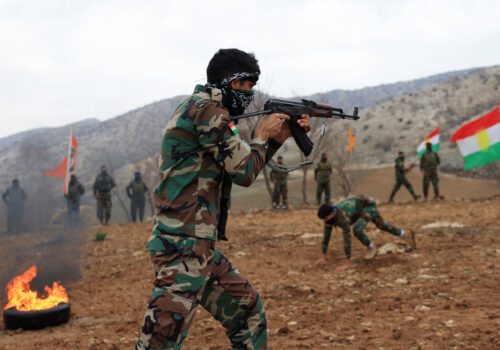
The Kurdish coalition’s entry into the war could hand Tehran a political opening even as it creates a military problem. Kurdish fighters might stretch Iranian forces and expose weak control in the northwest. But Tehran could also use the specter of separatism to rally Persian nationalism, split the opposition, and frame the war as foreign-backed dismemberment rather than domestic revolt, giving itself a justification for mass arrests and violence against Kurds inside Iran.
If Kurdish forces receive sufficient support, they could serve several strategic purposes. They might pin down Iranian security forces in the west, giving space for unarmed protesters in major cities to demonstrate without being massacred. They could stretch the regime’s resources thin and reduce pressure on the Gulf states and Israel. And if the Kurds were to take and hold territory in northern Iran, they could create a buffer zone beneficial to Israel and the West.
For all these reasons, any support for the Kurds should go beyond military backing. It must include political support for Kurdish autonomy in a post-regime Iran, so that the Kurds do not end up being used once again as expendable forces.
—Yerevan Saeed is a nonresident senior fellow with the Iraq Initiative in the Atlantic Council’s Middle East Programs.
15. What impact will this conflict have on China?
Beijing is in wait-and-see mode. China was Iran’s major oil buyer, but that dependence was mainly one-way: China was buying around 80 percent of Iran’s oil exports, but those purchases accounted for less than 15 percent of China’s total imports.
Chinese leaders have always known that, as a net oil importer, the straits of Hormuz and Malacca (two narrow sea lanes that ships must traverse to deliver oil from the Middle East to China) presented a major energy security risk. Beijing has long feared that Washington would target Chinese oil tankers in a future US-China crisis, and it has been working furiously to reduce those risks. Today, due to that contingency planning, China is less dependent on imported oil than many observers realize. China is working to electrify the nation’s auto fleet and making shocking progress (electric vehicles can run on coal-fired power, which China has in abundance). And Chinese leaders took advantage of the past few years of low oil prices to go on a buying spree, beefing up their domestic reserves to plan for a future supply crisis such as the one they are now facing.
Overall, China is perhaps more prepared than any other major economy to face the energy crisis that could emerge from the situation in Iran. And Chinese leaders are very good at strategic planning. They will be looking for ways to turn this situation into an opportunity. Already, for example, the United States is reportedly moving some of its most advanced missile defense units from the Indo-Pacific to the Middle East—removing systems that, in Beijing’s view, directly threatened China’s security interests in the region. It is impossible to overstate the degree to which those movements are a massive win for Beijing. And if the United States ends up stuck in another Middle Eastern quagmire that cedes the Indo-Pacific to China, the wins will keep coming.
—Melanie Hart is the senior director of the Atlantic Council’s Global China Hub. She previously served as senior advisor for China in the Office of the Undersecretary for Economic Growth, Energy, and the Environment at the US Department of State.
16. What impact will this conflict have on Russia?
The conflict in the Middle East is already playing into Russia’s hands.
The war in Iran has created global anxiety around the supply and availability of crude oil coming out of the Gulf. Earlier this week, oil prices surged to the highest they have been since 2022. To quell oil market fears, the Trump administration eased sanctions on Russian oil. Last Thursday, the US Treasury’s Office of Foreign Assets Control issued a general license to allow for the delivery and sale of sanctioned Russian oil to India for thirty days. Meanwhile, reporting indicates that the administration is considering additional sanctions relief for Russia to enable the sale of Russian Urals.
This is a win for Russia. Russia’s economy has been in a steady decline since its 2022 invasion of Ukraine. Low oil prices combined with significant Western economic pressure including sanctions on oil majors and shadow fleet vessels as well as the oil price cap, reduced Russia’s energy revenue. US sanctions relief helps Putin sell Russian Urals, generating income for Moscow’s war machine.
It’s important to note that US sanctions relief does not equate to sanctions relief from the United Kingdom, the European Union, or other Western partners. If the United States eases sanctions on Russian oil but its partners do not, then there could be significant confusion in the compliance space. Financial institutions and the private sector will have to navigate a complex sanctions landscape and may risk exposing themselves to British or European sanctions if they facilitate the sale of Russian oil. Hopefully, the US administration is considering these challenges and coordinating its decisions with its coalition of partners that have sanctioned Russia in response to the war in Ukraine.
Meanwhile, Qatar’s LNG capacity remains offline. Russian LNG is not sanctioned, and Russia remains a global supplier of LNG. If the Middle East conflict continues and Qatar is not able to restart its LNG infrastructure quickly, then we could expect to see Russia increasing its LNG exports in attempts to fill the gap and generate income.
—Kimberly Donovan is director of the Economic Statecraft Initiative within the Atlantic Council’s GeoEconomics Center. She is a former senior Treasury official and National Security Council director.
17. Will the Houthis in Yemen get involved?
Coming to Iran’s defense does not provide the Houthis with the same domestic and reputational benefits that their involvement in the Gaza war did. It also carries new risks, particularly related to the detente the Houthis have had with Saudi Arabia since 2022. The Houthis could still decide to get involved in the Iran war, especially if they calculate that it makes sense to break that detente as Saudi Arabia doubles down on its support to the Houthis’ main rival inside of Yemen, the internationally recognized Yemeni government.
There are three scenarios for Houthi involvement:
- Limited strikes on Israel to demonstrate solidarity with Iran;
- Limited strikes on Red Sea shipping as they seek to test whether this is a new red line for Saudi Arabia or extract new concessions, given that Riyadh is depending on the Red Sea to maintain some oil production with the Strait of Hormuz effectively closed; or
- Widespread Houthi attacks on Red Sea shipping, Saudi Arabia, and/or ground offensives inside of Yemen aimed at finally seizing Yemen’s oil and gas resources. This third scenario risks reigniting the Yemen war after years of calm and opening up a major new front in the region.
—Allison Minor is the director of the Project for Middle East Integration with the Atlantic Council’s Rafik Hariri Center & Middle East Programs. She previously served as US deputy special envoy for Yemen and as director for Arabian Peninsula affairs at the National Security Council.

18. How will this conflict impact Gaza?
Hamas would not have been what it is over the past twenty years without direct financial and material support from the Islamic Republic of Iran, which turned the terror group into one of its chief proxies, given its presence at Israel’s doorstep. Despite differences in religious orientation and doctrine between the Muslim Brotherhood offshoot and the primary Shia force in the world, Tehran has effectively used Hamas to ensure that there wouldn’t be peace or long-term stability between Palestinians and Israelis, prolonging the conflict, which is foundational for the theocratic regime.
Iran helped undermine the Oslo process of the 1990s, militarize the Second Intifada in the early 2000s, and turn post-2005 Israeli withdrawal from Gaza into a “resistance” citadel. Thus, the October 7, 2023, attack on Israel and Gaza’s subsequent decimation would not have occurred without cumulative Iranian involvement. Furthermore, the regime is constantly meddling in the West Bank, supporting rogue Palestinian militants and plots to destabilize the Palestinian Authority and encourage heavy-handed Israeli military actions, hoping this could trigger chaos and a “Third Intifada.”
A severely weakened regime in Tehran that lacks financial means and reach will likely roll back Iran’s involvement in the Palestinian issue and minimize meddling and sabotage by IRGC agents and officers. This would have various political implications, making groups like Hamas much more vulnerable and unable to rely on Iranian support for armed resistance, while weakening the pro-Iran faction within the group’s politburo.
Alternatively, there is a small but not insignificant risk that the battered and angry remnants of the regime may deploy its limited resources in support of extreme terror activities in Israel and Gaza and the West Bank by using Palestinian elements either sympathetic to Tehran’s cause or purely lured in by financial incentives. Nevertheless, Iranian-aligned elements of Hamas and other Palestinian groups will experience significant setbacks that compound the calamity faced by the Palestinian national project in the aftermath of October 7, further strengthening Israel’s position in the conflict and bolstering its desires for how Gaza’s future trajectory and prospects should unfold.
—Ahmed Fouad Alkhatib leads Realign For Palestine, an Atlantic Council project that challenges entrenched narratives in the Israel and Palestine discourse and develops a new policy framework for rejuvenated pro-Palestine advocacy.
19. How will the war impact US-Gulf relations?
The war will have lasting impacts on US-Gulf relations, but those impacts are still evolving in the war’s second week. In the near term, Gulf countries will seek stronger US security support, including munitions and other air defense support to help defend against Iranian attacks. They will also want clearer US security guarantees over the long term. How the United States responds to these requests will shape Gulf countries’ calculus as they grapple with whether the benefits of housing US military bases are worth the growing risks those bases bring.
Another critical factor will be what the Iranian threat looks like after US operations conclude and the degree to which the United States coordinates with its Gulf partners as it concludes its operations. Early signs suggest the Iranian regime will prove resilient, and Iran has demonstrated that it can terrorize its neighbors with low-cost drones and disruptions to the Strait of Hormuz that are difficult to eliminate with an air campaign alone. Alternatively, regime collapse and a civil war inside Iran could have lasting consequences for Gulf security. If the Iran that emerges from this war poses a long-term threat to Gulf national security and economic growth, and if Gulf countries assess that the United States is not doing enough to help them combat that threat, then it will create a crippling strain on US-Gulf relations.
—Allison Minor
20. What other countries could get involved if this war expands?
While the United States and Israel are leading operations against Iran, it is Arab Gulf countries that have found themselves on the front lines. The vast majority of Iranian missile and drone attacks have targeted Gulf countries, particularly the United Arab Emirates (UAE). Gulf countries are weighing how best to deal with the Iranian threat both now and in the long term, but it remains unclear if they will choose to confront Iran militarily, pursue targeted actions to restore a degree of deterrence, or seek to negotiate a new detente with Iran. Thus far, the Gulf countries have not responded militarily to Iranian attacks and have refuted claims suggesting otherwise. The UAE is reportedly considering non-kinetic means to restore deterrence with Iran, while Oman is actively pursuing negotiations.
Lebanon and Iraq are also being pulled into the conflict: Israel launched a major campaign in Lebanon following attacks from Hezbollah that included airstrikes in southern Beirut and an expanded Israeli military presence in southern Lebanon. The Lebanese government sees the campaign as a threat to its efforts to navigate Lebanon out of an economic and political crisis and is actively pursuing negotiations with Israel and the United States while demonstrating that it is willing to crack down on Hezbollah in new ways.
The United States is conducting strikes on Iran-backed militias in Iraq in response to attacks on US bases and diplomatic facilities inside the country, and the stoppage of traffic through the Strait of Hormuz has forced Iraq to halt oil production. All this comes as Iraq navigates difficult government formation negotiations and threatens to disrupt an era of relative stability in the country.
—Allison Minor
