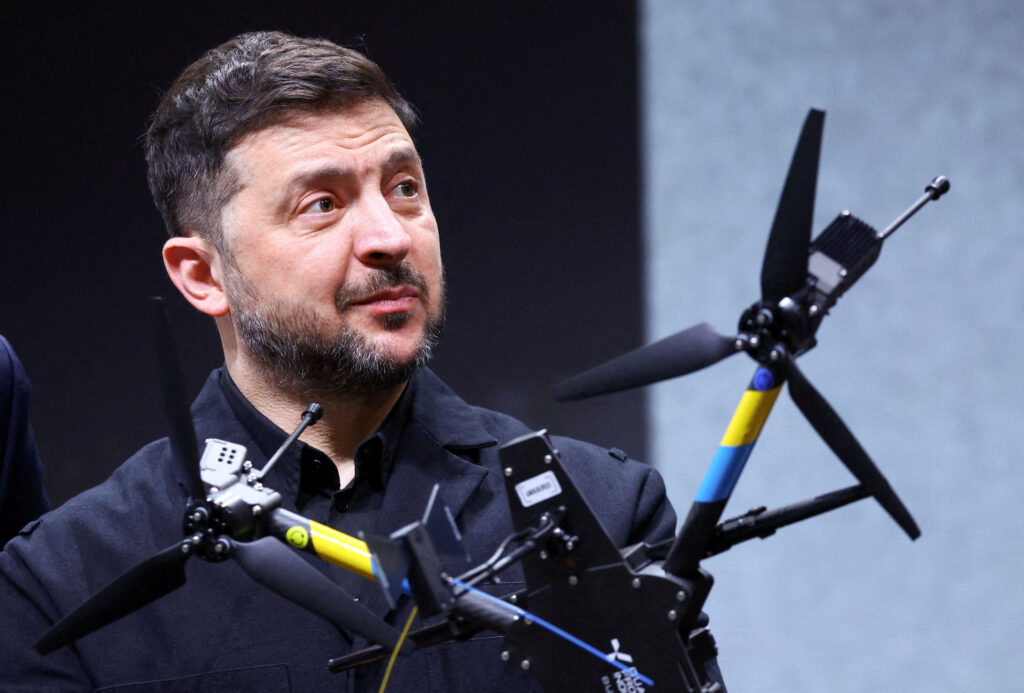
Ukrainian drone warfare experts arrived in the Middle East this week to defend the region against Iranian attack drones. Teams of Ukrainian specialists will help coordinate air defense operations in Qatar, Saudi Arabia, and the United Arab Emirates, and will also reportedly work alongside American colleagues to protect US military bases in Jordan.
News of these landmark deployments came also exactly one year after Ukrainian President Volodymyr Zelenskyy’s infamous Oval Office meeting with US President Donald Trump, which saw the US leader tell his Ukrainian counterpart, “You don’t have the cards.” Twelve months on, it would appear that Zelenskyy does in fact have some trump cards of his own.
The Iran war has sparked a sudden surge in international demand for Ukraine’s unique drone warfare expertise. As hostilities have spread across the Gulf region, more and more states are now looking to Kyiv for support as they seek to counter swarms of Iranian attack drones that are threatening to overwhelm or exhaust conventional missile-based air defenses.
Nobody is better equipped to address this challenge than Ukraine. Since 2022, the Ukrainians have gained unrivaled experience defending their country against massive Russian drone attacks on an almost daily basis. They have learned to do so in a cost-effective and sustainable manner by employing a wide range of tools including cheap interceptor drones, sophisticated monitoring systems, electronic warfare equipment, and helicopter gunships.
Since the outbreak of hostilities in the Middle East, Ukraine has signaled a readiness to share its drone warfare experience with the United States and its Gulf region allies. Kyiv’s offer has been readily accepted. As a result, the Ukrainian drone defense crews currently deploying to the Middle East are likely to be the first of many. Others are also taking note. Berlin confirmed plans this week to have Ukrainian experts train German troops, while Romania unveiled a major joint venture to co-produce drones together with Ukraine.
This is having a profound impact on Ukraine’s international image. Until recently, Ukraine was widely regarded as a country with little leverage that was heavily dependent on the West for survival. In light of recent developments, a radically different picture is now emerging of Ukraine as a valuable security partner and a major military power in its own right.
Stay updated
As the world watches the Russian invasion of Ukraine unfold, UkraineAlert delivers the best Atlantic Council expert insight and analysis on Ukraine twice a week directly to your inbox.
Ukraine’s rise to drone superpower status has been remarkably rapid. The country first began experimenting with the use of drones on the battlefield in the wake of Russia’s initial invasion in 2014. However, major breakthroughs would not take place until the full-scale invasion of 2022.
In the space of just four years, Ukraine has gone from defense tech startup to global leader in the art of drone warfare. This remarkable progress owes much to Ukraine’s vibrant prewar tech sector and the country’s strong entrepreneurial spirit, which have combined to turbo-charge the wartime development of a domestic drone manufacturing sector. The existential nature of the Russian threat has also played a key role, providing local producers and government officials with all the motivation they need to remove potential roadblocks and maximize domestic output.
Ukrainian officials recognized early in the war that they could not rely on Western partners to supply the necessary weapons and ammunition on time and in sufficient quantities. Prioritizing the mass production of comparatively cheap drones was identified as Ukraine’s most realistic strategy as the country sought to counter Russia’s often overwhelming advantages in terms of manpower and conventional firepower. The results speak for themselves. When the full-scale invasion began, Ukraine only had a handful of drone producers. In 2026, domestic output is expected to reach seven million drones.
Eurasia Center events

Ukraine’s strategic emphasis on drones has transformed the war on land, in the air, and at sea. Around three-quarters of all Russian battlefield casualties are now inflicted by Ukrainian drones. Meanwhile, a drone-dominated kill zone stretching for over ten kilometers either side of the front lines makes any major offensive operations fraught with danger for the attackers. As the Russian invasion enters a fifth year, Ukraine’s “drone wall” is now the key to the country’s defensive strategy.
At sea, Kyiv has used domestically developed naval drones to break the Russian blockade of Ukraine’s Black Sea ports and neutralize around one-third of Russia’s entire Black Sea Fleet. Following a string of naval humiliations, Putin was forced to withdraw the remainder of his warships from Crimea to the relative safety of Russia itself.
Ukraine’s naval drones are becoming increasingly sophisticated. Some recent models have been armed with anti-aircraft missile capabilities, while others have served as mini aircraft carriers for smaller drones. This creative use of maritime drone technologies has made it possible for Ukraine to gain the upper hand in the Battle of the Black Sea, despite not having a conventional navy to speak of.
Ukraine’s growing drone arsenal also includes long-range drones that have made it possible to strike targets deep inside Russia. In recent years, Kyiv has escalated attacks on military and industrial sites located over one thousand kilometers from the Ukrainian border. This has expanded the geographical scope of the war and brought Putin’s invasion home to Russia in ways that the Kremlin propaganda machine is unable to censor.
Ukraine’s new friends in the Gulf region are primarily interested in Kyiv’s interceptor drone technologies. These weapons have been developed in response to Russia’s own innovative use of attack drones. Since acquiring the blueprints from Iran during the early stages of the war, Russia has significantly upgraded its fleet of Shahed drones to make them bigger, faster, and more maneuverable. Moscow has also dramatically increased production, enabling far larger nightly attacks on targets throughout Ukraine.
The Ukrainian authorities have responded to this escalating Russian bombardment by developing a series of interceptor drones that can be mass produced for a fraction of the cost of traditional air defense missiles. Customers including oil giant Saudi Aramco are reportedly now queuing up to acquire these Ukrainian interceptors.
When Russian President Vladimir Putin launched the full-scale invasion of Ukraine in February 2022, he expected an easy victory and vowed to “demilitarize” the country. With Ukrainian drone specialists now training NATO forces while guarding Gulf petrostates and US military bases, it is safe to say that this attempted demilitarization has backfired in spectacular fashion.
Rather than leaving Kyiv disarmed and defenseless, the war unleashed by Putin four years ago has transformed Ukraine into a drone superpower. This newfound status is already changing outside perceptions of the country and looks set to further strengthen Ukraine’s geopolitical standing as more countries seek to benefit from Kyiv’s drone warfare expertise. Zelenskyy clearly holds plenty of cards and is prepared to play them.
David Kirichenko is an associate research fellow at the Henry Jackson Society.
Further reading
The views expressed in UkraineAlert are solely those of the authors and do not necessarily reflect the views of the Atlantic Council, its staff, or its supporters.


The Eurasia Center’s mission is to enhance transatlantic cooperation in promoting stability, democratic values, and prosperity in Eurasia, from Eastern Europe and Turkey in the West to the Caucasus, Russia, and Central Asia in the East.
Follow us on social media
and support our work
Image: Ukrainian President Volodymyr Zelenskyy reacts as he is pictured behind a drone during his visit to a facility of German drone maker Quantum Systems, on the sidelines of the annual Munich Security Conference (MSC), near Munich, Germany, February 13, 2026. REUTERS/Thilo Schmuelgen/File Photo