
The United States is taking an increasing interest in critical minerals, given their role in artificial intelligence (AI), advanced manufacturing, the energy transition, and defense. Washington is launching high-level initiatives such as the Forum on Resource Geostrategic Engagement (FORGE) and Project Vault, and showering increased attention on mineral-rich countries like the Democratic Republic of Congo (DRC), where Chinese mining companies control approximately 80 percent of copper and cobalt production through dominance built over two decades of state-backed financing and infrastructure-for-resources deals.
Now Gulf countries, particularly Saudi Arabia, the United Arab Emirates, and Qatar, are emerging as important players in this global game. The Future Minerals Forum in Riyadh has become a key convening point, and Gulf sovereign wealth funds (SWFs) have been investing heavily in the DRC.
These three Gulf states are in the process of developing post-hydrocarbon economic models in which critical minerals are essential inputs. Renewable energy infrastructure, battery manufacturing, and sovereign AI capacity all depend on reliable access to minerals whose supply chains are increasingly contested. Abu Dhabi’s sovereign AI investments, Saudi Arabia’s Vision 2030 technology agenda, and Qatar’s emerging digital economy each create demand for the kinds of minerals the DRC holds in abundance.DRC President Felix Tshisekedi has explicitly sought to attract Gulf and US capital as a counterweight to Chinese dominance, and Gulf SWFs have responded with significant capital commitments.
In building their stakes in this market, Gulf SWFs are pursuing distinct strategies to navigate the nexus of commercial gain and geopolitical risk. However, reading these investment structures as expressions of diplomatic alignment misses how these funds actually operate. Gulf SWFs are playing a different game than the US government. Their main goal is to maximize return on investment while maintaining strategic optionality. In the process, their investment decisions are shaping the geopolitics of the critical mineral race.
US and Chinese architectures
The US and Chinese critical minerals systems differ in how they are structured and what participation requires. China’s position in the DRC was built through two decades of continuous engagement, beginning with the 2007 Sicomines resource-for-infrastructure agreement and accelerating as Western mining companies exited the country over the following decade. Chinese companies are now embedded across mining, processing, logistics, and trading infrastructure. For Gulf funds, the practical appeal of involvement in DRC mining is partly the operational infrastructure Chinese companies have already built. Participation in that system is a commercial decision, relying on access to networks that any new entrant must engage with regardless of political preference.
The US architecture is increasingly oriented toward a plurilateralist trade bloc that excludes China. The February 2026 Critical Minerals Ministerial brought together fifty-four countries and saw the signing of a memorandum of understanding between Glencore and the Orion Critical Minerals Consortium, with the US Development Finance Corporation (DFC) simultaneously disclosing joint venture negotiations to secure 100,000 tons of Congolese copper for the US market and 50,000 tons for Gulf allies. Project Vault, a twelve-billion-dollar Export-Import Bank–backed strategic reserve, and FORGE, the successor to the Minerals Security Partnership, are key components of this architecture that coordinate supply chains among members while stabilizing prices and offering protection from Chinese dumping. .
Three Gulf states with different structures
Each Gulf state has chosen a structurally distinct approach to DRC and broader critical minerals investment, and each structure reveals a different reading of where commercial returns and geopolitical risk are most concentrated.
United Arab Emirates
Abu Dhabi has the deepest integration into the US-led framework. The Emirati sovereign wealth fund ADQ alongside the US DFC is a founding partner of the Orion Critical Minerals Consortium, which is structured to channel Congolese output to buyers in US-allied markets. Earlier, in July 2023, the UAE signed a $1.9 billion deal with Sakima, DRC’s state-owned mining company, to develop four critical mineral mines, followed by a $1.1 billion investment in Zambia’s Mopani Copper Mines that December. In January 2026, the DFC co-invested with Abu Dhabi’s International Holding Company in critical minerals across areas of mutual strategic interest, and the following month Abu Dhabi–based AD Ports agreed to develop a multipurpose terminal in Matadi along the Congo River, extending the UAE’s logistics footprint into DRC’s mineral corridor. The UAE has also joined the United States’ Pax Silica and is embedded in the Stargate AI campus, deepening integration across the technology-minerals nexus in ways a standalone minerals deal would not provide.
Through its processing and logistics positions, the UAE has established itself as a refining intermediary, routing DRC minerals through UAE facilities before onward shipment to the US. This raises a question that US policymakers should examine carefully: whether these structures constitute a genuinely competitive supply chain or merely a financial and logistics layer built on top of Chinese operational infrastructure, satisfying the objectives of Western supply chain security while leaving Chinese dominance at the input end intact.
Qatar
Qatar has maintained positions across both architectures simultaneously. Qatar Investment Authorty’s $500 million placement in Ivanhoe Mines gives Qatari capital exposure to Kamoa-Kakula, the DRC copper complex Ivanhoe co-owns in roughly equal stakes with Zijin Mining Group through a joint venture that integrates the Chinese partner into the operational structure of the asset rather than holding it at arm’s length. Qatar is simultaneously a Pax Silica member, maintaining exposure across both systems. Where it lacks domestic mineral deposits to offer as reciprocal value, Qatar is leveraging its mediation role between the DRC and Rwanda as a route to preferential access to Congolese reserves, using political capital as the entry mechanism.
Saudi Arabia
Saudi Arabia has maintained the greatest distance from both architectures. The Saudi Public Investment Fund (PIF) has committed $15 billion to mining and metals globally by 2030 through Manara Minerals, a PIF-Maaden joint venture established in 2023, which has so far deployed $2.5 billion to acquire a 10 percent stake in Vale Base Metals. Saudi Arabia signed memoranda of understanding with the DRC, Egypt, and Morocco at the Future Minerals Forum in 2024 and a memorandum of cooperation on critical minerals with the US during President Donald Trump’s Riyadh visit, but remains the only one of the three Gulf states to have stayed outside Pax Silica.
PIF favors minority equity stakes over consortium structures, preserving flexibility as the supply chain landscape consolidates. Saudi Arabia’s $2.5 trillion in domestic mineral reserves give Riyadh something UAE and Qatar lack: the ability to offer reciprocal access to its own deposits as a negotiating tool, enabling it to extract better terms through government-to-government arrangements than multilateral consortium structures would permit.
Critical minerals investments as economic policy
Each of these structures reflects a different commercial and strategic calculation, but all three share a common logic—that investment structure is determined primarily by commercial returns, with diplomatic orientation varying from state to state. Abu Dhabi’s integration with the US architecture also offers technology benefits, with Orion membership and Pax Silica providing ADQ access to US processing technology and AI infrastructure that a standalone minerals deal would not. Qatar’s Ivanhoe co-investment is better read as the commercially rational choice of a best-available vehicle than as a signal of alignment with China. Saudi Arabia’s bilateral approach reflects another calculation. With domestic deposits to offer, Riyadh extracts better terms in direct negotiations than it would as a junior partner in a US-designed consortium.
Gulf SWFs have the capacity to function as instruments of hard, soft, and sharp power, but the power they exercise is maximized by maintaining strategic optionality rather than closing it off. Gulf SWF positioning in the DRC and elsewhere is better understood as portfolio construction than geopolitical allegiance. The structures they choose to access minerals carry geopolitical weight, and as state-owned organizations their directors are deeply aware of this. But they are also aware of the need for sound economic decisions.
The narrowing window
That distinction matters more as the US framework takes shape. Project Vault and FORGE are at a nascent stage of their development, but could represent a future set of norms and principles toward critical minerals that diverges with China’s approach. Vice President JD Vance stated at the February ministerial that the US wants members to form a trading bloc among allies and partners. Currently there is room for Qatar to be a member of Pax Silica while co-investing alongside Chinese state-linked entities, but Vance’s statement indicates that this could change. Saudi Arabia’s bilateral model, outside the multilateral frameworks while maintaining commercial relationships with both sides, may prove to be more durable, though the consolidation of allied supply chain architectures could gradually narrow the positions available to states that have not committed to Western structures.
In the US-China critical minerals competition, Gulf SWFs are building positions that maximize leverage over both sides. The structures of those positions carry geopolitical weight that will become harder to manage as each architecture takes shape. The question facing Washington is not which side the Gulf is on, but whether the investment structures Gulf funds have built to serve their own commercial interests will continue to be read in those terms, or whether the consolidating architecture of US-led supply chain frameworks will eventually force choices that Gulf capitals have so far successfully avoided making.
Chenjie Song is a PhD student at Johns Hopkins University and a public policy consultant specializing in Gulf political economy and China-Gulf relations.
Jonathan Fulton is a nonresident senior fellow in the Scowcroft Middle East Security Initiative, within the Atlantic Council’s Middle East Programs.
Related Reading
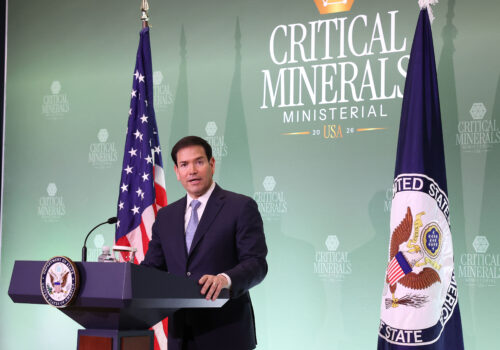


Image: Visitors arrive to attend international mining conference Future Minerals Forum 2026 in Riyadh, Saudi Arabia, January 14, 2026. REUTERS/Hamad I Mohammed