
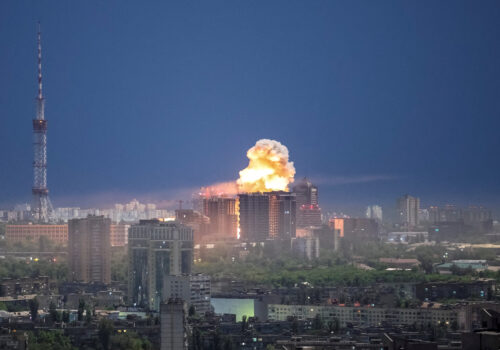
With Russia’s full-scale invasion now well into its fifth year, Ukraine’s drone war has recently entered a new phase that is helping Kyiv regain the initiative. In recent months, Ukraine has dramatically expanded the use of drones to disrupt Russian logistics behind the front lines and shape the battlefield for offensive operations.
This shift is most visible in Russian-occupied southern Ukraine, where key roads connecting Russia to the occupied Crimean peninsula are rapidly becoming some the most dangerous routes of the entire war. Ukraine’s campaign of mid-range drone strikes has focused on systematically targeting Russian military transports along with the air defense systems deployed to protect them. This is undermining Russia’s ability to conduct offensive operations while also potentially setting the stage for Ukrainian gains.
Ukraine’s failed counteroffensive in summer 2023 underlined the cost of attacking well-prepared Russian defenses without first isolating the enemy or achieving local air superiority. Part of the problem was the constant messaging of Ukraine’s intentions prior to the start of the counteroffensive. Ukrainian commanders were also significantly hampered by limited supplies of Western aircraft and missiles. Kyiv is attempting to address this by relying more on domestically produced drones.
Crucially, Ukraine now possesses a selection of far larger drones with heavier warheads, alongside models with much greater range. This is making it possible for Ukrainian forces to strike deep behind the front lines and weaken Russian positions prior to ground attacks. By targeting logistics routes, drone launch sites, air defenses, and command points, Ukraine is attempting to disrupt Russian operations and create temporary pockets of local dominance.
There have recently been some indications that Ukraine may already be testing this model. Ukrainian forces have reportedly advanced south of Zaporzhzhia during May and early June, rolling back months of Russian progress. The amount of territory changing hands remains limited, but these successful operations indicate that small scale drone-enabled advances are possible.
Stay updated
As the world watches the Russian invasion of Ukraine unfold, UkraineAlert delivers the best Atlantic Council expert insight and analysis on Ukraine twice a week directly to your inbox.
Ukraine’s current advantage in the drone war will not go unchallenged, of course. Instead, it is important for Kyiv’s partners to understand that the recent shift in battlefield momentum represents a window of opportunity that will not remain open indefinitely and must be exploited without delay.
There are already signs that Russia is adapting to the new military realities created by Ukraine’s enhanced mid-range drone strike capabilities. Russian forces in southern Ukraine are now using camouflage and decoys, while also deploying mobile fire teams along key logistics routes and erecting netting over highways.
However, given the amount of territory involved, the Russian military will likely struggle to implement defensive measures across the whole of occupied Ukraine. The Kremlin will also face difficult decisions regarding the deployment of limited air defense systems, especially as Ukraine’s strategic bombing campaign inside Russia itself is now gaining momentum.
Eurasia Center events

For Ukraine, the key task in the coming months will be to maintain the country’s current technological edge while adapting tactically to neutralize Russia’s countermeasures. The drones hunting Russian military trucks today may soon be armed with different warheads and targeting systems, for example. Novelties such as the use of balloons to extend the range of strike drones may also become more commonplace.
Russia’s full-scale invasion of Ukraine is the world’s first drone war and has so far been defined by relentless innovation cycles on both sides of the front lines. The developments currently taking place on Ukrainian battlefields are transforming our understanding of how armed conflicts are fought. When the invasion began in 2022, drones occupied a supporting role in a war that was still led by tanks and artillery. Four years on, drones are now the dominant weapons accounting for the vast majority of casualties.
Amid all the recent talk of the tide turning in Ukraine’s favor, there is no room for complacency. Russia is still advancing, albeit on a very limited scale, while Putin’s invading army retains considerable advantages in manpower and conventional firepower that continue to pose serious problems. The Russian military’s own drone capabilities are also evolving at a rapid rate that mirrors the progress taking place on the Ukrainian side.
In the current phase of the drone war, Ukraine does appear to have the upper hand and is using drones to target logistics and weaken Russia’s grip on occupied territory. The next challenge will be to use drones in order to actually retake land. Ukraine’s Ministry of Defense is already deploying drones to implement a “logistics lockdown” throughout occupied southern Ukraine. By the end of the summer campaigning season, it may become clearer whether drones can also play a role in the liberation of areas currently under Kremlin control.
David Kirichenko is an associate research fellow at the Henry Jackson Society.
Further reading


The views expressed in UkraineAlert are solely those of the authors and do not necessarily reflect the views of the Atlantic Council, its staff, or its supporters.


The Eurasia Center’s mission is to enhance transatlantic cooperation in promoting stability, democratic values, and prosperity in Eurasia, from Eastern Europe and Turkey in the West to the Caucasus, Russia, and Central Asia in the East.
Follow us on social media
and support our work
Image: Frédéric Pétry / Hans Lucas via Reuters Connect