
A humanitarian crisis is unfolding in Russian-occupied southern Ukraine, the UN Human Rights Monitoring Mission in Ukraine has warned. In a new report released on June 25, UN officials say thousands of Ukrainian civilians are currently trapped by hostilities in frontline areas of the occupied Kherson region, where they face severe risks to their lives, food shortages, and a lack of medical assistance.
The crisis is centered on the city of Oleshky, which is located close to the left bank of the Dnipro River and directly across the river from regional capital Kherson. Oleshky has been under Russian occupation since the very first day of the full-scale invasion in February 2022, but the humanitarian situation has deteriorated sharply during the past six months. From a pre-war population of 24,000, approximately two thousand mostly elderly residents remain.
With all routes in and out of Oleshky heavily mined and deadly Russian drones operating throughout the area, the city and nearby settlements are effectively cut off from the outside world. Anyone who attempts to evacuate must travel along what locals have dubbed as “the road of death” due to the high risk of encountering drones or landmines.
Satellite footage shows multiple burned out vehicles along the route, highlighting the dangers. Anyone who manages to make it safely through must then embark on a long and arduous journey across occupied Ukrainian territory and via the Russian Federation in order to reach areas under Ukrainian government control.
Stay updated
As the world watches the Russian invasion of Ukraine unfold, UkraineAlert delivers the best Atlantic Council expert insight and analysis on Ukraine twice a week directly to your inbox.
The effective blockade of Oleshky and the surrounding area has made it extremely difficult for any food or medical supplies to be delivered to the local population. Those in need of medical treatment are also unable to receive assistance or move to safer areas.
Meanwhile, a campaign of drone strikes on the civilian population is believed to have killed or wounded dozens of local residents since the start of 2026. Those caught in this trap are forced to live without basic amenities including gas and electricity, while relying on sporadic aid deliveries for food or scavenging among the abandoned ruins of the city.
“Frequent attacks by short-range drones and the presence of landmines are having devastating consequences for thousands of people in these communities,” commented Danielle Bell, who heads the UN Human Rights Monitoring Mission in Ukraine. “People can’t get out, food can’t get in, and sick and injured are not getting the medical assistance they need.”
Eurasia Center events

The situation in Oleshky and surrounding settlements is a reminder of the desperate conditions facing millions of Ukrainians living under Russian occupation. The Kremlin currently controls around 20 percent of Ukraine and has instigated a reign of terror that has seen large numbers of people imprisoned in mass detentions that UN investigators have classified as a crime against humanity. Those who remain in occupied territory are being subjected to a campaign aimed at erasing all traces of Ukrainian statehood, history, language, culture, and national identity.
International awareness of the humanitarian disaster currently taking place in the occupied Kherson region of southern Ukraine is on the rise, with increasing media coverage and expert discussion of the issue. However, activists say much more action is necessary. Speaking on the sidelines of the recent Ukraine Recovery Conference in Poland, Ukrainian Nobel Peace Prize laureate and human rights activist Oleksandra Matviichuk called on the international community to shine a spotlight on the crisis.
The Ukrainian Foreign Ministry has accused Russia of a “gross violation of international humanitarian law” in the occupied Kherson region and has called on the international community to act. While a number of aid organisations have expressed alarm over the deteriorating conditions in and around Oleshky, it is hoped that additional international pressure could help secure a temporary ceasefire in the area.
So far, Russia and Ukraine have been unable to agree terms for a pause in hostilities that would allow aid agencies to conduct a large-scale evacuation of civilians and deliver urgently needed medicines and other basic supplies for the remaining population. “There is a desperate need for a local ceasefire so that people can leave and food and medicines can reach those who decide to stay,” commented Bell.
Oleksandr Tolokonnikov is Deputy Head of the Kherson Regional Military Administration.
Further reading


The views expressed in UkraineAlert are solely those of the authors and do not necessarily reflect the views of the Atlantic Council, its staff, or its supporters.

The Eurasia Center’s mission is to enhance transatlantic cooperation in promoting stability, democratic values, and prosperity in Eurasia, from Eastern Europe and Turkey in the West to the Caucasus, Russia, and Central Asia in the East.
Follow us on social media
and support our work
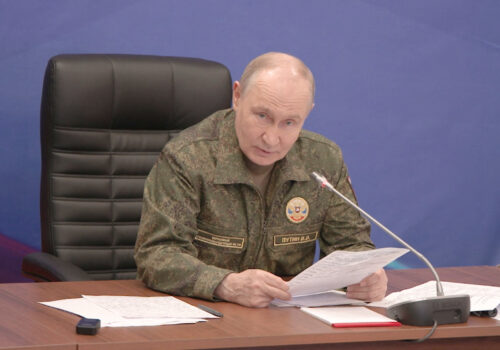
Image: Handout / Latin America News Agency via Reuters Connect