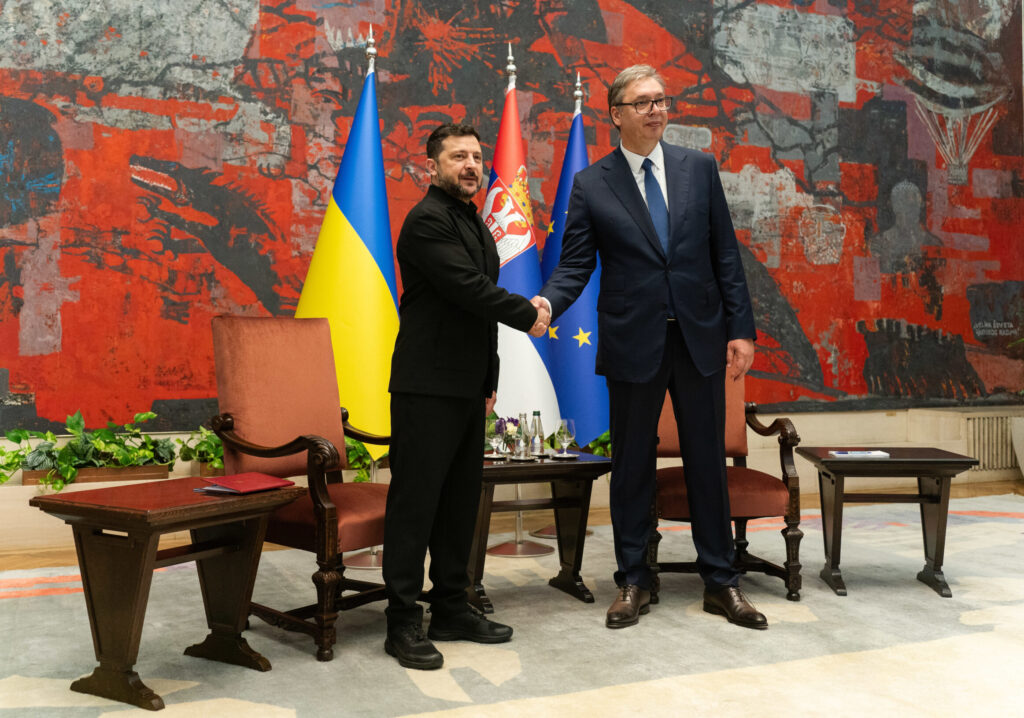
The blue-and-yellow honor guard that greeted Ukrainian President Volodymyr Zelenskyy in Belgrade on August 7 would have been hard to imagine a few years ago, given Serbia’s deep historic ties to Russia. This photo-op certainly made headlines, but the Ukrainian leader’s visit was no mere publicity stunt.
Zelenskyy’s first official trip to Serbia served the interests of Ukraine, Europe, and the United States alike, proving that Kyiv can forge real partnerships amid a grinding war and mounting geopolitical instability. Serbia came to the table with its own complicated history and constraints, including the issue of Kosovo and concerns about territorial integrity. Both sides walked away with results that went beyond symbolism.
None of this squares neatly with Serbia’s decision not to sanction or openly criticize Russia. Indeed, Serbian society remains largely sympathetic to Russia, a position that reflects longstanding cultural, historical, and religious ties. This relationship has been reinforced in recent decades by perceptions of Moscow as a guarantor of Serbian sovereignty, along with widespread Serbian resentment over NATO’s 1999 bombing campaign and the secession of Kosovo.
Despite his country’s strong links to Moscow, Serbian President Aleksandar Vucic appears to understand the difference between Russian mythology and geopolitical reality. For example, he seems well aware that the Kremlin has spent years using its energy foothold in Serbia to fund destabilizing influence operations and corrupt Serbian politics. Nevertheless, support for Russia remains an electoral fact of life that no Serbian government has been willing to openly challenge.
Vucic’s strategy is designed to avoid confrontation. He publicly embraces Moscow to placate domestic audiences, but also quietly enables the flow of ammunition that Ukraine needs to keep fighting. Serbia has never declared itself a weapons supplier to Ukraine, and Vucic still denies it, but Moscow and others know the paper trail. Former US Ambassador to Belgrade Christopher Hill has confirmed that Washington helped Ukraine obtain a significant quantity of Serbian-made ammunition.
Putin’s foreign intelligence service has accused Serbia’s defense industry of “trying to shoot Russia in the back.” In spring 2025, a mysterious explosion rocked a Serbian plant supplying Ukraine, injuring seven workers. Officials in Belgrade did not officially assign blame for the blast, but it mirrored a broader pattern of Russian sabotage elsewhere in Europe.
Stay updated
As the world watches the Russian invasion of Ukraine unfold, UkraineAlert delivers the best Atlantic Council expert insight and analysis on Ukraine twice a week directly to your inbox.
The continued supply of Serbian weapons to Ukraine was not the only issue under discussion in Belgrade. The recent visit of the Ukrainian leader to Serbia had a range of broader geopolitical implications, including the prospect of new opportunities for cooperation with Israel.
Together with Czechia, Serbia has emerged as one of Israel’s closest partners in Europe. Elbit Systems, the Israeli defense giant, is opening a drone manufacturing facility in Serbia this fall. Vucic invited Zelenskyy and other Ukrainian policymakers to attend the opening. In assisting Kyiv, Belgrade is drawing on its credibility with Israel and potentially opening the door for a defense-industrial partnership that Zelenskyy has long sought.
Zelenskyy’s visit also raised the prospect of energy sector cooperation. Serbia sits on the planned Vertical Gas Corridor, the north-south route meant to bring US LNG and Azerbaijani gas into Central and Eastern Europe and cut the Balkan region’s dependence on Russian supply. Serbia’s energy minister met Zelenskyy’s plane in Belgrade, signifying that energy issues would be high on the agenda. Gas sector cooperation, including the prospect of Serbia drawing on Ukraine’s underground storage capacity, was discussed.
This matters because Serbia’s own gas storage is small and entangled with Russian ownership. Ukraine, by contrast, controls the largest underground gas storage facilities in Europe, a fact the United States and a dozen European governments including Serbia acknowledged in a regional energy security partnership earlier this year. Tapping Ukraine’s storage capacity would reduce Serbia’s reliance on Gazprom-linked facilities.
Eurasia Center events

The timing of Zelenskyy’s visit to Serbia was particularly notable. Vucic is expected to call snap parliamentary elections soon, with October or November the most likely dates. Playing host to Ukraine’s leader months before a difficult election was not a move designed to win over voters. Instead, it risked handing Serbia’s pro-Russian nationalist contingent a ready-made grievance to exploit.
While hosting Zelenskyy is unlikely to have strengthened Vucic domestically, the visit was a nod to the West as Serbia seeks to advance its EU accession process and deepen ties with the United States. Vucic may be hoping this timely show of support for Ukraine can help engage Brussels and Washington as he attempts to balance Serbia’s relationships with Moscow and Western capitals.
Ukraine is also looking to develop partnerships beyond the relatively small circle of allies that Kyiv has relied on since 2022. Serbia is certainly not an obvious candidate, but this does not mean that Belgrade cannot make a meaningful contribution to the Ukrainian war effort. Indeed, Serbia may already have provided Kyiv with more practical backing than numerous other European countries who vocally champion their support for Ukraine.
Perhaps the biggest takeaway from Zelenskyy’s Belgrade visit is what it says about wartime Ukraine’s remarkable emergence on the international stage. A nation fighting for survival has found the diplomatic skill and patience to draw a potential partner further into its orbit without demanding public declarations that Belgrade cannot realistically provide. This is the work of a country growing in self-confidence and learning to project influence.
Washington and Brussels have long treated Ukraine primarily as a cause to defend. Zelenskyy’s visit to Serbia shows that Ukraine has also become an international actor in its own right that is able to build relationships in the Balkans, the Caucasus, the Middle East, and beyond. Just as the world now recognizes Ukraine as a major military power, Ukrainian diplomacy is also an increasingly important geopolitical factor that can quietly advance American and European interests in the very regions where Moscow’s influence persists.
Stephen Blank is a senior fellow at the Foreign Policy Research Institute.
Further reading


The views expressed in UkraineAlert are solely those of the authors and do not necessarily reflect the views of the Atlantic Council, its staff, or its supporters.

The Eurasia Center’s mission is to enhance transatlantic cooperation in promoting stability, democratic values, and prosperity in Eurasia, from Eastern Europe and Turkey in the West to the Caucasus, Russia, and Central Asia in the East.
Follow us on social media
and support our work
Image: August 8, 2026, Belgrade, Central Serbia, Serbia: 202688, Belgrade, Serbia - Serbian President VUCIC ALEKSANDAR hosts Ukrainian President VOLODYMYR ZELENSKYY during his official visit to the Republic of Serbia at the Palace of Serbia. The two leaders shook hands before holding a tete-a-tete meeting and bilateral discussions. (Credit Image: © Marko Dimic/ZUMA Press Wire)