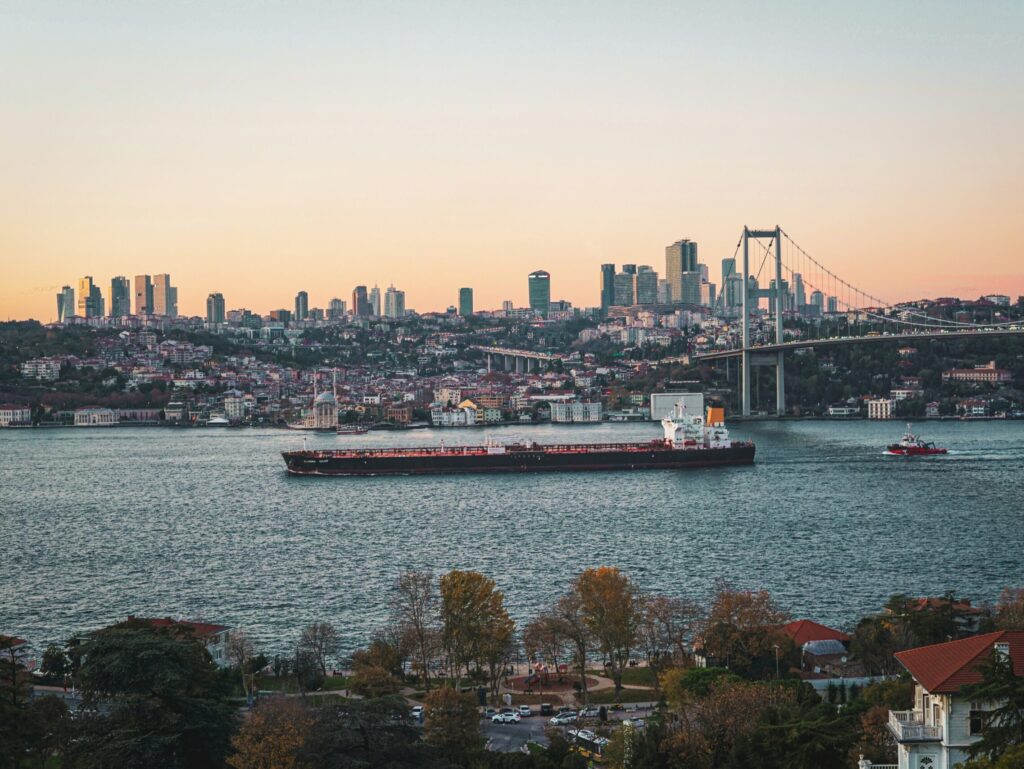
As summer tourists soak in the sun on Odesa’s Black Sea beaches this year, they have an additional attraction they did not ask for: a front-row view of burning vessels.
Smoke rising on the horizon is a dire reminder of Russia’s escalating attacks on commercial ships bound for Greater Odesa, a three-port hub comprising Odesa, Chornomorsk, and Pivdennyi.
In the first half of 2026, Russia carried out more than 180 attacks on the ports of Greater Odesa, almost matching the total for all of 2025. In July alone, Ukraine recorded sixty-seven strikes on port facilities, alongside dozens of attacks on vessels in port and at sea. The attacks continued into August, with commercial ships carrying mostly grain and agricultural products coming under fire daily. The escalation culminated in a major August 9 attack recognized as among the largest on Odesa since 2022.
The stakes are considerable: More than 90 percent of Ukraine’s agricultural exports pass through its Black Sea ports. Estimates put the damage at $1.5 billion since the war began, and 90 percent of shipowners have suspended port calls. Alternative routes can absorb only around half of the cargo previously shipped by sea, according to Ukrainian government estimates.
For Turkey, however, the escalation points to a problem with its Black Sea strategy. Ankara has long championed regional ownership, seeking to limit the role of outside powers and maintain a delicate balance between Russia and Ukraine. But Russia is testing the limits of that model.
Turkey has skin in the game
In addition to the direct impacts on Ukraine, Russia’s campaign is intended to erode confidence among international businesses, insurers, and shipowners in the viability of Ukraine’s maritime route.
Turkey has a stake in whether that strategy succeeds. According to the Black Sea Monitoring Group, about 40 percent of vessels calling at Odesa-region ports are owned or operated by Turkish companies, putting Turkish crews, fleets, and businesses in the line of fire.
Since 2022, Turkish-linked ships have repeatedly been damaged in Russian attacks, including cargo ships Yasa Jupiter, Cenk T, Ant, Victress, and LPG tanker Orinda. In July 2026, the Golden Leo, a Turkish-owned cargo ship carrying corn from Chornomorsk, was struck by Russian fire while traveling through Ukraine’s maritime corridor. Ten were killed, and the vessel later sank off Odesa.
Keeping Ukrainian maritime routes open is therefore a matter of protecting Turkish ships, companies, and regional influence. Allowing one power to turn the Black Sea into an instrument of coercion is at odds with Turkey’s own vision for the region.
False equivalence
A first step for Ankara is to be clear about the main source of escalation in the Black Sea. After an August attack on the Turkish vessels Nadezhda and Yasar near Novorossiysk injured three crew members, Ankara called on both Russia and Ukraine to ensure the safety of navigation. Responsibility for the attack was not established.
Turkey’s concerns about growing risks to civilian shipping are understandable. But such appeals for both sides to show restraint can paint a misleading picture of reciprocal escalation, particularly when Russia’s sustained campaign against Ukrainian seaports, logistics infrastructure, and commercial ships gets less attention in Turkish media.
Ukraine has indeed conducted its own operations at sea, primarily against vessels tied to Russian military logistics, sanctions evasion, and wartime revenues. According to Robert Brovdi, commander of Ukraine’s Unmanned Systems Forces, Ukrainian forces have so far struck 134 Russian vessels in the Sea of Azov and another eighty-four in the Black Sea.
The Black Sea campaign, including recent strikes on oil terminals in Tuapse and Novorossiysk, as well as an August 12 attack on Russia’s naval base in Novorossiysk, reflects Kyiv’s effort to reduce Russian oil revenues and military capabilities. Still, Kyiv appears willing to calibrate those attacks when partners’ interests are at stake. According to the Financial Times, Ukraine halted attacks on tankers using the Caspian Pipeline Consortium terminal after an appeal from US Vice President JD Vance, while continuing to target Russian military and oil infrastructure.
Ankara should stop drawing a false equivalence between Ukraine’s strategy against military-linked targets and Russia’s attacks on legitimate commercial fleets.
Looking beyond Ukraine
The danger is wider than Ukraine. Russian drones have repeatedly entered Moldovan, Romanian, and Turkish airspace, with one crashing in Turkey’s Izmit province near Istanbul. In June, a Ukrainian maritime drone lost control after Russian jamming and later exploded in the Romanian port of Constanța. No one was injured, but the incident showed how Russian electronic interference can send Ukrainian systems off course, creating new risks for NATO territory and civilian infrastructure.
Those risks will grow as Romania’s Neptun Deep offshore gas project approaches production in 2027. Located in Romania’s exclusive economic zone, it is expected to produce around eight billion cubic meters of gas annually at peak output and strengthen Romanian and European energy security—much to Moscow’s displeasure. As new energy infrastructure comes online, Black Sea states will have more to protect.
Regional ownership requires bold action
Turkey has long advocated for the principle of regional ownership in the Black Sea. Its implementation of the Montreux Convention has helped limit naval escalation by restricting the movement of warships through the Turkish Straits. But regional ownership cannot mean only controlling who enters the Black Sea. It must also mean taking responsibility for what happens inside it. This includes deterring hybrid threats and open aggression by Russia, a revisionist power dismantling the regional order.
For decades, Ankara invested in Turkish-led frameworks including the Black Sea Economic Cooperation organization, BLACKSEAFOR, and Operation Black Sea Harmony. Russia’s repeated use of force has either upended or hollowed out these initiatives.
Now, as NATO’s leading naval power in the Black Sea, Turkey has an opportunity to build a more effective regional security framework to defend freedom of navigation, ensure the protection of maritime infrastructure, and counter the shadow fleet that enables Russia to sustain its war.
What would this mean in practice?
Bilaterally, Ankara should use its diplomatic, political, and economic leverage more forcefully to pressure Russia to halt its attacks on commercial vessels and port infrastructure.
Turkish mediation efforts remain important, but they cannot substitute for deterrence. There is also no realistic return to the prewar Black Sea order, the 2023 grain deal, or a neutral maritime space insulated from the wider war. The only way to stop escalation in the Black Sea is to increase the price for Russia.
Trilaterally, Turkey, Romania, and Bulgaria should turn the Mine Countermeasures Black Sea Task Group into a broader regional security platform. At the 2026 NATO Summit in Ankara, the three countries amended a memorandum of understanding to expand the group’s mission to protect critical undersea infrastructure. They should now use that mandate to increase their naval presence and evolve the task group into a broader patrol mission protecting energy infrastructure, maritime trade, and navigation routes from Russian attacks. They should also strengthen defenses against electronic warfare, improve real-time information sharing, and coordinate how they detect and intercept aerial and maritime drones.
At the wider allied level, Turkey should push for stronger defenses around Ukraine’s ports and maritime routes. Air defense, counter-drone systems, electronic warfare, surveillance, and potentially coordinated air and maritime patrols could help protect the full export chain.
Ankara should pursue these efforts both through NATO and the maritime component of the coalition of the willing it is set to lead. US-Turkey-Ukraine cooperation offers another channel, including for diplomatic and military coordination and the potential transfer of US-made weapons from Turkish stocks to Ukraine.
Turkey has long argued that Black Sea security should be owned by the region. Moscow is now testing whether that principle means more than keeping outside navies at bay. If attacks on ships, ports, and infrastructure become normalized as below-threshold activity, Turkey and its regional partners will have already ceded part of that ownership.
Ankara is already positioning itself to lead a future Black Sea security architecture. To do so effectively, it needs to captain a coordinated effort to protect navigation, defend critical infrastructure, and make it harder for Russia to use the Black Sea as an instrument of war and economic coercion.
Yevgeniya Gaber is a nonresident senior fellow at the Atlantic Council Turkey Program. She previously served as a Ukrainian foreign policy adviser and diplomat, including serving in the Ukrainian embassy in Ankara from 2014 to 2018.
The views expressed in TURKEYSource are solely those of the authors and do not necessarily reflect the views of the Atlantic Council, its staff, or its supporters.
Explore the program

Within the Atlantic Council’s longstanding commitment to strengthening the transatlantic relationship, the Atlantic Council Turkey Program conducts research, provides thought leadership, and offers a platform for strategic dialogue between the US, Turkey, and NATO allies to address the region’s toughest challenges and explore opportunities, including in the fields of energy, business & trade, technology, defense, and security.
Related Reading


Image: Photo by adam hilles on Unsplash