
As Ukrainians soak up in the last rays of September sunshine, thoughts are turning to the long cold season ahead. Winter is coming, and in wartime Ukraine that means months of rolling blackouts and subzero uncertainty. With Russian drone and missile attacks already escalating alarmingly and Ukraine’s air defenses struggling to cope, many fear the approaching winter could turn out to be the toughest of the entire war.
Russian airstrikes on Ukraine’s power grid and residential heating infrastructure have intensified during each of the previous four wartime winters. So far, this weaponization of plummeting temperatures has failed to freeze the Ukrainian civilian population into submission. However, there are concerns that the current conditions are uniquely favorable for the Kremlin.
In recent months, Ukrainian stocks of Patriot air defense interceptor missiles have run dangerously low, leaving the country with no credible defense against Russian ballistic missiles. Moscow has sought to capitalize on this shortage, cranking up domestic ballistic production and hammering Ukrainian cities with record numbers of missiles. This helped fuel a surge in civilian casualties during the summer period, according to UN data.
Since August, Russia has also begun deploying large quantities of innovative jet drones in relentless waves of attacks that are designed to terrorize the civilian population and disrupt every aspect of daily life. These recently introduced jet-powered drones are significantly faster than their propeller-driven predecessors, making them far more difficult to counter. Ukrainian defense tech whizzes are now scrambling to develop a new generation of interceptors and scale up production in time for the winter season.
Stay updated
As the world watches the Russian invasion of Ukraine unfold, UkraineAlert delivers the best Atlantic Council expert insight and analysis on Ukraine twice a week directly to your inbox.
Few in Ukraine are currently optimistic about the country’s chances of securing enough ammunition to defend against Russia’s looming ballistic blitz. Patriot interceptor missiles were already in short supply due to limited production, while available stocks have been severely depleted by the US-led campaign against Iran. Likewise, there are fears that with Russia now dramatically increasing the manufacture of jet drones and other categories of cheap cruise missile-style weapons, Ukraine’s limited air defenses will be overwhelmed in the coming months.
As the countdown to winter begins, Ukrainians know what to expect and are preparing accordingly. Key infrastructure targets are being fortified, replacement equipment prepared, and alternative energy sources identified. Meanwhile, the Ukrainian population is bracing for a particularly brutal cold season, with people stockpiling food, repairing generators, and charging up power banks. Some are planning to relocate with their families outside big cities or temporarily move abroad.
Russia is well aware of Ukraine’s vulnerability and is widely thought to view the coming winter season as a potentially decisive stage in their efforts to break Ukrainian resistance. “The Russians are not interested in serious peace talks, at least until the end of winter,” Polish Prime Minister Donald Tusk commented recently. “They are convinced the winter will be tragically critical for Ukraine.”
Eurasia Center events

Kremlin officials appear to be in confident mood ahead of the coming aerial offensive. The Russian Ministry of Defense recently taunted Ukrainians with a social media post featuring an image of strike drones accompanied by the chilling promise of a winter “freeze.” However, it is far from clear whether the Russian population are ready for the possibility of Ukraine launching a winter bombardment of its own.
Ukraine’s September 20 bombing raid on Moscow was the largest of the entire war, highlighting Kyiv’s rapidly expanding airstrike capabilities. Crucially, the attack succeeded in seriously damaging the Russian capital’s main oil refinery, one of the most sensitive targets in the entire city. This was the latest in a series of high-profile incidents that have exposed Russian President Vladimir Putin’s increasing inability to secure his country’s airspace against attack.
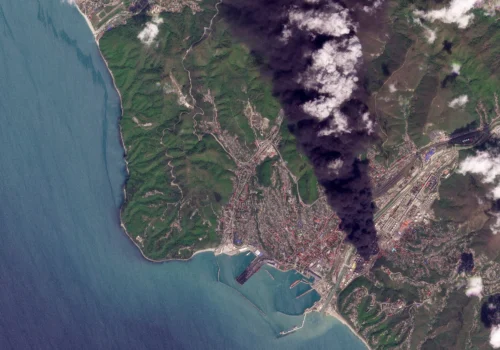
In May 2026, Putin was widely mocked for seeking US President Donald Trump’s intervention to broker a ceasefire ahead of his annual Victory Day parade on Red Square. This embarrassing episode was widely interpreted as tacit acknowledgment of a new security reality in the skies above Moscow. Weeks later, Ukrainian drones disrupted the opening of Putin’s showpiece international economic forum in St. Petersburg, shrouding the Russian dictator’s hometown in plumes of smoke. In recent days, Putin has reportedly moved his flagship annual foreign policy event from Sochi to Moscow amid fears of possible Ukrainian drone strikes.
Putin’s concerns are understandable. Throughout 2026, Ukraine has conducted an expanding and highly effective strategic bombing campaign that has focused on Russian military production sites, logistics hubs, and the country’s extensive energy industry infrastructure. Long-range Ukrainian drone strikes targeting oil refineries have led to gasoline shortages across Russia and sparked the country’s worst fuel crisis since the fall of the Soviet Union.
If Ukraine chooses to strike back in kind this winter and target Russia’s own civilian infrastructure, the potential consequences for the Russian population could be severe. Putin has enormous firepower at his disposal but clearly lacks sufficient air defenses to cover Russia’s vast landmass, creating a multitude of potential targets for Ukraine. Meanwhile, the Russian winter is typically even longer and colder than Ukraine’s, further raising the risk.
Ukrainians have already experienced four bitter winter seasons marked by relentless Russian bombardment, power cuts, and freezing darkness. This will be the first winter when large numbers of Russians face the prospect of similar hardships. Will they prove as resilient? The Ukrainian population is exhausted but they know that if they stop resisting, their country will cease to exist. There is no such argument for Russians. If the coming winter brings unprecedented suffering, many may begin to ask whether they need this war at all.
Peter Dickinson is editor of the Atlantic Council’s UkraineAlert service.
Further reading


The views expressed in UkraineAlert are solely those of the authors and do not necessarily reflect the views of the Atlantic Council, its staff, or its supporters.

The Eurasia Center’s mission is to enhance transatlantic cooperation in promoting stability, democratic values, and prosperity in Eurasia, from Eastern Europe and Turkey in the West to the Caucasus, Russia, and Central Asia in the East.
Follow us on social media
and support our work
Image: Plumes of smoke rise from fires at an oil refinery following what the authorities say is a Ukrainian drone strike in the course of the Russia-Ukraine conflict, in Moscow, Russia, September, 20, 2026. (REUTERS/Stringer)
