
Kyiv has reported further battlefield gains this week as the country’s counteroffensive in eastern Ukraine’s Donetsk region continues. Ukraine’s Operation Vivaldi has been underway for several months and has reportedly resulted in the liberation of sixteen Ukrainian settlements along with more than one hundred square miles of territory. This shift in the front line initiative is helping to highlight the Russian army’s mounting difficulties as Putin’s invasion force struggles to advance while suffering heavy losses.
Operation Vivaldi is particularly significant as it has thwarted Russian efforts to complete the capture of the Donbas region, a task that is widely seen as Putin’s minimal war aim in Ukraine. The Russian military had hoped to seize the fortress belt of cities that make up the remaining Ukrainian-held portion of the Donbas in the coming months via a large-scale encirclement. However, Ukraine’s counteroffensive has now effectively blunted the northern wing of this attempted pincer movement, reversing more than a year of slow but steady Russian gains. “The Kremlin’s plan to seize the Donbas region will not be implemented in the foreseeable future,” commented Andrii Biletskyi, who commands the Ukrainian units spearheading the ongoing offensive in the Donetsk region.
This represents a major setback for Russia. Kremlin officials have sought to pressure Ukraine into handing over the fortress belt without a fight and withdrawing voluntarily from the Donbas as a condition for the start of broader ceasefire negotiations. Meanwhile, Putin has repeatedly expressed confidence that the fall of the region is only a matter of time. The collapse of Russia’s encirclement plan will now force him to downgrade his expectations.
Stay updated
As the world watches the Russian invasion of Ukraine unfold, UkraineAlert delivers the best Atlantic Council expert insight and analysis on Ukraine twice a week directly to your inbox.
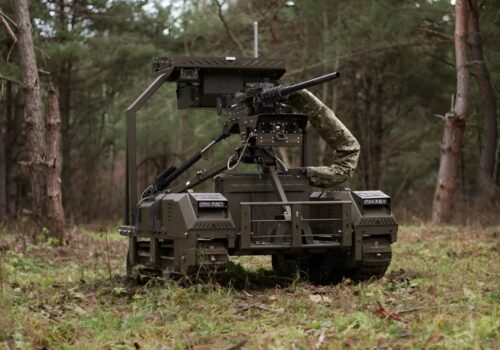
Ukraine’s counteroffensive has showcased the country’s growing mastery of drone warfare and continued ability to defeat Russia on the battlefield despite often being heavily outnumbered and outgunned. During Operation Vivaldi, Ukrainian forces used fleets of bomber drones to transport unmanned ground vehicles armed with machine guns or explosives deep into the Russian rear. These robotic systems were then used to attack unsuspecting Russian positions, causing chaos and setting the stage for Ukrainian advances.
The impact of Operation Vivaldi is also being felt in other sectors of the front, according to recent analysis by the Institute for the Study of War. Ukrainian advances have forced Russia to redeploy troops from sectors further north while also regrouping to the south of the fortress belt as the Kremlin scrambles to prevent Kyiv building on its current momentum. This is hampering Moscow’s offensive operations and widening the gap between battlefield realities and the Kremlin’s bold pronouncements of inevitable Russian victory.
Russia’s recent retreat in the Donbas region has proved personally embarrassing for Vladimir Putin himself. In early September, the Kremlin dictator boasted of sweeping gains in this sector of the front and announced the capture of Sviatohirsk. Days later, Ukrainian officials posted video footage from inside the city demonstrating that it remained far from the combat zone and was firmly in Ukrainian hands.
Putin is not alone. The practice of exaggerating advances and claiming imaginary victories has become increasingly widespread within the Russian army, with commanders routinely lying about the true state of the invasion in order to win favor or avoid censure from their superiors. This refusal to acknowledge unfavorable facts on the ground is now sparking a backlash among Russia’s vocal war blogger community, with many calling out what they see as a pervasive culture of dishonesty.
Eurasia Center events

The success of Operation Vivaldi adds to the growing sense of optimism within the Ukrainian military following the appointment of Mykhailo Drapatyi in summer 2026 as the country’s new commander-in-chief. Since taking up his position, Drapatyi has launched internal reforms to move beyond the Soviet legacy and promote a climate of meritocracy, while embracing a more decentralized command that empowers individual officers and rewards initiative.
Operation Vivaldi closely mirrors Drapatyi’s vision for a technologically advanced and tactically innovative Ukrainian military that is capable of exploiting opportunities while preserving precious manpower. The lessons learned from recent advances in the Donbas will now be shared with other units throughout the Ukrainian armed forces, potentially paving the way for additional local counteroffensives.
Kyiv’s Western partners should now draw their own conclusions from recent developments on the battlefields of eastern Ukraine. Operation Vivaldi was not a decisive victory, but it did demonstrate that the Ukrainian military is able to beat Russia and blunt Putin’s invasion.
This is particularly important at a time when advocates of a negotiated settlement continue to promote the idea of a compromise peace deal, despite the fact that Russia shows no signs of seeking to end the war. On the contrary, the Kremlin’s recent rejection of various ceasefire proposals and insistence on addressing the so-called “root causes” of the war indicate an unwavering commitment to the maximalist goal of erasing Ukrainian statehood.
In order to push Putin toward peace, he must first be convinced that the price of continuing the war is higher than the cost of compromising. This will only be possible if the Ukrainian armed forces are strong enough to stem the tide of the invasion and strike back inside Russia itself. Operation Vivaldi has shown what Ukraine is capable of. If Kyiv’s allies provide sufficient support, the Ukrainian military will finish the job.
David Kirichenko is an associate research fellow at the Henry Jackson Society.
Further reading

The views expressed in UkraineAlert are solely those of the authors and do not necessarily reflect the views of the Atlantic Council, its staff, or its supporters.

The Eurasia Center’s mission is to enhance transatlantic cooperation in promoting stability, democratic values, and prosperity in Eurasia, from Eastern Europe and Turkey in the West to the Caucasus, Russia, and Central Asia in the East.
Follow us on social media
and support our work
Image: President Zelenskyy Visits Ukrainian Troops Near Lyman in Donetsk Region. (IMAGO/APAimages via Reuters Connect)