Watch the event
On Wednesday at the Asia-Pacific Economic Cooperation summit, Russian President Vladimir Putin criticized the EU’s decision to cut off Russian oil and gas, claiming it chipped away at European living standards. But on Thursday, at the Seventh Partnership for Transatlantic Energy Cooperation (P-TEC), Croatian Economy Minister Ante Šušnjar explained that reversing the decision is “not an option” for any country in Europe.
“Cheap energy becomes very expensive when it is used for political blackmail” or when it costs your country its “freedom,” Šušnjar said. “And that is why Europe needs to be sitting at the table” at negotiations about ending the war in Ukraine.
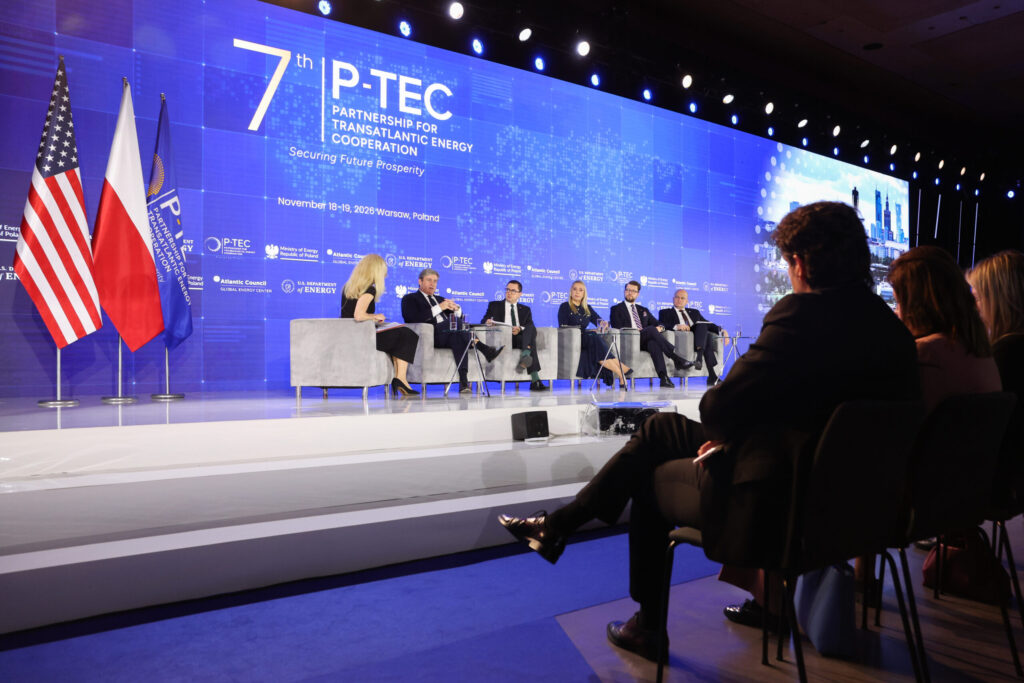
Four other ministers of economy and energy joined Šušnjar onstage at P-TEC, a conference held in Warsaw by the US Department of Energy, the Polish Ministry of Energy, and the Atlantic Council’s Global Energy Center. Going “back to business with Russia,” Polish Energy Minister Miłosz Motyka argued, “is not only a bad message from our region… but it’s very bad news for our partners in America,” as it looks to sell more liquefied natural gas (LNG) across Europe.
The choice has come with costs, noted Slovakian Economy Minister Denisa Saková, as she pointed out that swapping from Russian supplies to the more “volatile” global markets has sent prices upward. But, as Hungarian Energy and Economy Minister István Kapitány explained, “to rely on one source is never good.”
“We need diversity, and we need optionality,” he said. Lithuanian Energy Minister Lukas Savickas argued that pivoting from Russian gas has helped set Europe on the “right path,” in terms of diversifying and becoming more secure. Thus, he contended, it would be a “big strategic mistake” to put the matter back on the table.
Below are more highlights from the conversation, in which the energy and economy ministers talked about their regional approach to energy security and the role of the US.
A unified approach
- To deal with rising energy prices, Šušnjar called on Europe to “jointly purchase” energy from its partners, since reducing the logistics involved would make the pool of energy more affordable. Kapitány agreed, saying that focusing on transportation could help.
- “We are one union,” he said. “Therefore, we need to be transporting gas to Stuttgart, to Warsaw, to Budapest in the same effective way.” He pointed to the Vertical Corridor as an example of the infrastructure that is needed, while acknowledging that the corridor is “just commercially not as viable as it should be.”
- Saková spoke about Slovakia’s challenges, being “at the end of each pipeline” that serves the country, which means “we rely on the mercy of our neighboring countries” for supplies and improvements.
- Šušnjar also called for unity in protecting European infrastructure from Russia’s hybrid attacks. Savickas agreed, sounding the alarm about recently “increased threats” in the form of drones, sabotage, and cyberattacks.
- Reflecting on a December 2025 cyberattack on thirty Polish solar and wind farms, which Polish officials blamed on Russia, Motyka urged Europe not to “forget about cybersecurity,” because Russia’s cyber aggression has moved the “front line of the hybrid war” to every country.
- Energy infrastructure, Savickas said, “has to be resilient by design,” which requires “not only cyber solutions” but also “physical barriers” and efforts to “monitor the skies.” He also called for incorporating resilience and protection standards into EU regulations. “We spend billions” on this infrastructure, he explained, “but if we do not invest the necessary millions into the protection of that infrastructure, then it becomes a clear target.”
Two birds, one stone
- Saková said that the European Union needs to be “more pragmatic” with regard to its sustainability targets. “They are really too ambitious. We now know that we are not able to fulfill them.”
- However, Savickas argued that being pragmatic could include more investments in renewable energy sources. It “could drive our energy independence,” he said, looking back on his country’s investments in solar and wind. “But we still need to prepare for the days and weeks when there is no sun and there is no wind.”
- With the European Green Deal, EU countries, Kapitány noted, can use the bloc’s sustainability funds “to grow an energy mix… which is effective” in preventing overdependence on external energy sources.
- Šušnjar agreed, saying that renewable energy sources and others such as nuclear can help the bloc “be independent on European soil.” Yet, “without baseload energy,” getting those systems running “is not possible,” he added.
Katherine Golden is an associate director of editorial at the Atlantic Council.
Watch the event
Related Reading
Image: Energy and economy ministers from across Central and Eastern Europe speak at the seventh Partnership for Transatlantic Energy Cooperation.