In February 2026, the US Air Force started receiving new F-35s without their next-generation AN/APG-85 radars. This wasn’t a technical failure or a budget cut, but something far more mundane and strategically alarming: a sourcing delay for gallium, a critical mineral under China’s export control since 2023. Beijing is systematically using its near-total control over a range of critical materials to create chokepoints that directly impact the US defense industrial base.
This weaponization of industrial supply chains is the urgent context for Project Vault, launched in February 2026 as a new “strategic critical mineral reserve,” backed by $10 billion in financing from the US Export-Import Bank and an additional $2 billion in private-sector funding. Major firms, including original equipment manufacturers, are joining forces to counter these supply chain threats through market-oriented mechanisms.
It may be tempting to view the Vault as a fresh pile of “stuff” that automatically equals resilience. But stockpiles are no panacea. Like any other government program, they are political instruments vulnerable to bureaucratic turf wars and pork barrel politics. Their strategic value is defined by a series of deliberate governance choices: what form of material to hold, who gets access, when it is released, and at what price. Those choices will determine whether Vault becomes a force multiplier for US defense readiness or a parallel system that competes with the National Defense Stockpile (NDS) by absorbing scarce midstream capacity at the worst possible time.
The baseline: The defense stockpile is real, but limited
It’s worth remembering that China has long had a minerals stockpile that is operated flexibly between military and civilian economic needs. Although there is no public record of China’s stockpiled reserves of grains, minerals, natural gas, and oil, estimates put its stockpiles at 35 percent to 133 percent of the country’s annual demand. Western debates often imagine stockpiles as inert piles of material that act as insurance policies. Beijing treats them as a geopolitical tool: buy when prices are low, tighten when it wants discipline in the market, and wrap the whole thing in administrative opacity.
In contrast, the US system has historically been more rigid. The NDS, formed in 1939 and managed by the Defense Logistics Agency (DLA) since 1988, has served as a “break the glass” mechanism for defense critical minerals. Yet even internal government reports have long underscored the gap between what is held and what a national emergency would demand.
A 2023 assessment noted that the NDS contained about $1.3 billion in total assets, but only $912.3 million in actual stockpiled materials. More alarming, the report concluded that this current inventory would mitigate less than half of the military’s estimated shortfalls and less than 10 percent of essential civilian demand shortfalls in base-case national emergency scenarios, such as a prolonged war with China. This is because a significant portion of the material is held in unprocessed, ore-grade forms that would require extensive refining before they could be used in defense applications.
At the same time, the Pentagon has been moving more aggressively to rebuild depth. In 2025, the DLA pushed for spending $1 billion on critical materials including: $500 million of cobalt, $245 million of antimony, $100 million of tantalum, and $45 million of scandium. All have a direct impact on producing weapon systems across the entire defense enterprise.
The policy question, therefore, is not whether to stockpile, but how. This is where Project Vault enters, with its design being a fundamentally different mission than the NDS. While defense stockpiles are tied to statutory wartime requirements, Vault is being framed as a flexible economic security tool to buffer market shocks before a crisis begins.
If that distinction holds, Vault can be a strength: a shock absorber that keeps industrial throughput alive well before a crisis or war. If the distinction collapses, the Vault risks becoming a second buyer, chasing the same bottlenecked materials that the defense stockpile is trying to secure. One way to think of this two-reserve world is that the NDS prepares for a crisis, while Vault prevents one, absorbing the economic shocks and coercive trade pressures that adversaries use to weaken the US defense industrial base. This division of labor makes the NDS the reserve for war, and Vault the reserve for the “war before the war.”
Warehouses of rock don’t win wars
Most commentaries treat critical minerals as a single bucket of sixty different goods. Defense production does not. The journey from mine to missile reveals a series of industrial truths: ore is not a magnet, oxide is not a metal, and even a purified, qualified alloy is still a world away from a flight-critical part. The true chokepoints of defense production happen midstream: the highly specialized stages of separation, refining, conversion, and powder production.
China’s strategic dominance extends beyond just mines. Beijing controls most of the processing, refining, and machining downstream. These processes require immense expertise, much of which has been lost in the United States over decades, leaving only a handful of irreplaceable, capital-intensive facilities. A stockpile of raw ore is strategically inert if the nation lacks the capacity to transform it into a usable form.
This presents Project Vault with a decisive choice. If it warehouses mostly upstream raw materials, it can help stabilize commodity prices but will fail to solve the most pressing operational constraint for the defense industrial base. If, however, Vault is designed to hold a reserve of the processed, high-purity materials needed to keep production lines running, it could preserve the industrial capacity that the Pentagon cannot otherwise surge on command. This choice will determine whether Vault is a tool for economic symbolism or a genuine instrument of national security.
Governance is strategy: Five principles for integration
Every reserve is a set of rules masquerading as a warehouse. While the NDS operates on statutory logic for wartime mobilization, Project Vault’s commercial architecture suggests a more flexible “draw-and-replenish” approach. This begs the central governance question: In a crisis, do Vault’s rules ensure that materials flow where they’re most needed for the industrial base, or do they inadvertently crowd out defense priorities? The risk of creating bidding wars for scarce processed materials or facing allocation ambiguity in a gray zone conflict is real. Aligning Vault’s rules with national security needs is key to making it a strategic asset.
Success depends on five core integration principles. First, form-factor tiering must separate bulk market stabilizers from the processed, defense-usable forms of materials that translate into industrial surge readiness. Second, anti-crowding guardrails must be established to coordinate procurement via the DLA, preventing self-defeating bidding wars. Third, a “trigger ladder” must define release protocols for gray zone coercion scenarios. Fourth, this trigger ladder must include defense priority clauses for a small set of critical nodes, preventing the problem of an existing but inaccessible inventory. Finally, the entire two-reserve architecture must be validated through rigorous stress testing. Joint force and interagency exercises, alongside effective “red teaming,” would help identify where rules break before a real crisis breaks the industrial base.
Vault is a welcome signal that Washington is finally treating mineral supply chains as strategic terrain. If Vault is carefully integrated with the NDS through proper governance, it can harden the entire transatlantic industrial base against gray zone pressures Beijing wields—or any other crisis that disrupts mineral markets.
The choice is now simple. Craft a reserve built to withstand adversarial economic coercion or settle for the expensive illusion of security.
Morgan D. Bazilian is the director of the Payne Institute for Public Policy and professor at the Colorado School of Mines. Previously, he was lead energy specialist at the World Bank and has over two decades of experience in energy security, natural resources, national security, energy poverty, and international affairs.
Lt. Col. Jahara “FRANKY” Matisek is a US Air Force command pilot, nonresident research fellow at the US Naval War College and the Payne Institute for Public Policy, and a visiting scholar at Northwestern University. He has published over one hundred articles on strategy and warfare.
Stay connected
Sign up for PowerPlay, the Atlantic Council’s bimonthly newsletter keeping you up to date on all facets of the energy transition
related content
our work

The Global Energy Center develops and promotes pragmatic and nonpartisan policy solutions designed to advance global energy security, enhance economic opportunity, and accelerate pathways to net-zero emissions.
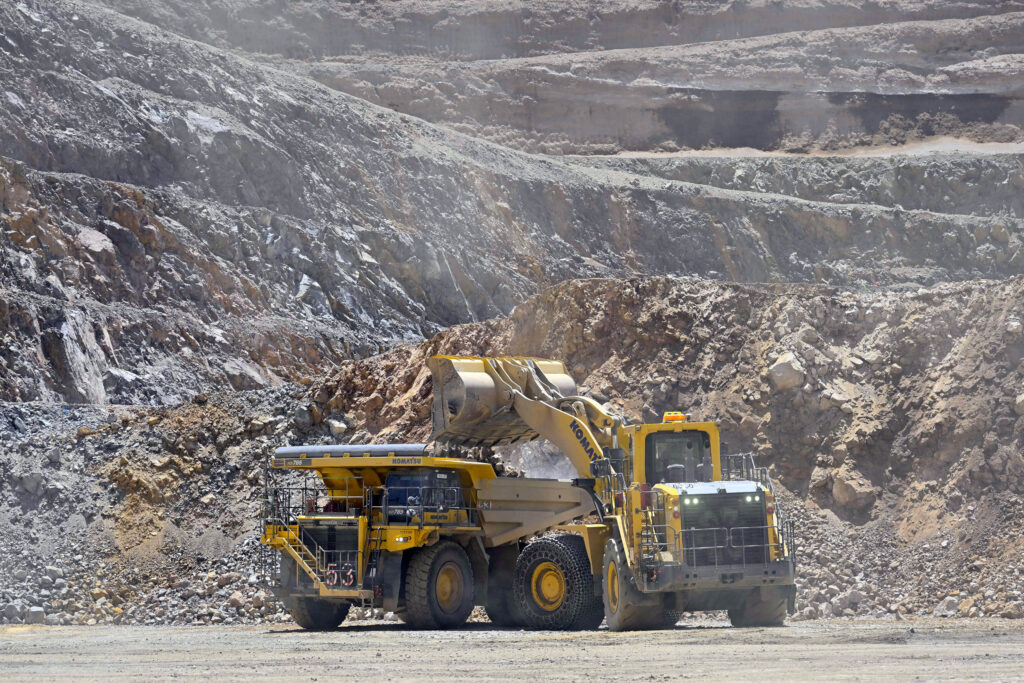
Image: May 9, 2023 - Mountain Pass, California, U.S. - Heavy equipment work to load and deliver raw ore for processing inside the MP Materials mine on May 9, 2023 in Mountain Pass, California. The mine is the only rare-earth mining and processing facility in the United States. The specialized minerals have a diverse applications in electrical and electronic components, lasers, glass, magnetic materials, and industrial processes. (Credit Image: © David Becker/ZUMA Press Wire)