In Iraq, stability and progress rely on leadership changes rather than leaders holding onto power.
On December 29, Iraq’s newly elected parliament met for the first time since the top court confirmed the November 11 election results. The session started the process of forming a new government in a parliament where no single party has a majority. Prime Minister Mohammed Shia Sudani, who wants a second term, won the most seats with forty-six out of 329. However, in Iraq’s political system, winning the most seats does not guarantee the top job. Instead, the next prime minister is chosen through coalition deals among the main Shia factions. Whether Sudani gets another term is still uncertain, but these coalition talks will shape not only the next cabinet but also Iraq’s direction during future challenges.
In Washington, many believe that Sudani is different from Nouri al-Maliki, leader of the State of Law Coalition and the only prime minister who has previously served two terms in post-Saddam Hussein Iraq. This assumption is both comforting and misleading. Sudani is often seen as more focused on technical issues and less divisive, leading a country that seems more stable than before. This could suggest that the status quo is the safest choice, as Sudani will likely continue efforts to work with Washington on critical issues of reform and militia disarmament in the next four years.
But this perspective conflates personal leadership qualities with deeper structural problems that have haunted Iraq historically. Iraq’s political system has weak checks and balances, and the state is seen as a source of rewards by the political elite. In this kind of political landscape, one leader staying in power too long can turn temporary authority into lasting control. Even capable leaders can weaken institutions if they stay for a second term.
The main issue for the country’s stability is not whether Sudani is like al-Maliki, but whether Iraq’s political system allows real competition. For true contestability, losing groups must believe they can return to power through talks and elections, and rivals should keep competing within the system instead of looking for power elsewhere. In Iraq, this kind of competition is important for security, not just for democracy.
SIGN UP FOR THIS WEEK IN THE MIDEAST NEWSLETTER
The structural risks of a second term
Since the overthrow of the former Iraqi regime in 2003, Iraq’s politics have been competitive but lack strong limits. The political elite have utilized ministries and agencies not just for policy but also to manage coalitions by handing out jobs, contracts, and security roles to keep alliances together. All former prime ministers have been guilty of turning the state into a system of political favors, but they have differed in how far they pushed it. Prime ministers such as Haider al-Abadi, Adel Abdulmahdi, and Mustafa al-Kadhimi were not aggressive enough and lost power. Still, they left the state more stable than their predecessors.
In comparison, leaders who treated the state as spoils of war and built strong patronage networks, such as al-Maliki, served longer.
Iraqi prime ministers are often perceived as practical in their first terms, because they take office through a quota-sharing bargain that parcels out ministries and senior posts across blocs. This limits a premier’s control over a bureaucracy shaped by party patronage. This is visible at the point of government formation. For example, former Prime Minister Adel Abdul Mahdi was sworn in in October 2018 with only a partial cabinet after parties deadlocked over key portfolios, and Mustafa al-Kadhimi began in May 2020 with several ministries still vacant as blocs continued to bargain over nominees.
Under those constraints, first-term premiers tend to lower immediate friction among rival power centers and prioritize deals, including Baghdad-Erbil arrangements such as budget-oil agreements. They also try to contain armed factions through a mix of formal incorporation and selective pressure. For example, the 2016 law that placed the Popular Mobilization Forces on a state footing to Kadhimi’s June 2020 raid on a Kata’ib Hezbollah site was followed days later by the release of most detainees after militia pushback.
In contrast, a second term changes the incentives by making it more rewarding to hold onto power. Leaders expecting to stay longer often put loyal people in top jobs, use government contracts to protect themselves, weaken oversight bodies, and use audits or investigations more against their opponents than their allies. Sudani’s government began moving in this direction toward the end of its first term, including by directing a federal oversight committee to scrutinize the Kurdistan Regional Government’s revenues and spending. In 2025, similar audit claims were often cited to justify delaying or withholding the Kurdistan region’s federal budget transfers.
This is the second-term trap in Iraq: It does not always lead straight to authoritarianism but slowly turns appointments, contracts, and enforcement tools into a system that limits political change and weakens institutions. This process often happens quietly and is often explained as being efficient or stable by outsiders who may not see how serious it is.
How state capture unfolds
In Iraq, administrative capture usually happens gradually through legal, political, and economic steps, rather than through open announcements.
This process often begins with key appointments in areas such as the interior and intelligence agencies, which control force; as well as finance and planning ministries, which manage spending; and justice positions, which oversee investigations. It continues with hard-to-audit procurement practices, such as emergency approvals, unclear contracts, secret spending, and the use of state-linked groups to move money. Over time, oversight bodies and courts may start enforcing rules selectively, targeting opponents more while letting allies off the hook, especially when these institutions are open to political pressure.
The main effect of administrative capture is on how the state functions, not just its reputation. It weakens the state’s ability to handle crises by distorting information and valuing loyalty over skill. Intelligence becomes less open, leadership roles become more political, and contracts are awarded for favors rather than for readiness. This creates a false sense of strength at the top level but breeds public distrust by hiding real problems. As people lose trust, the state’s legitimacy and its ability to respond effectively during crises like insurgencies, militia violence, or protests are greatly reduced.
Iraq has gone through this before, though it is often forgotten during quieter times. In 2014, military units that looked strong on paper fell apart when faced with the Islamic State of Iraq and al-Sham. Reports blamed this on corruption, poor leadership, political appointments, and sectarian splits—problems that happen when security forces serve politics instead of acting as professional institutions. What seems stable can quickly fall apart in a crisis.
This is the main lesson from al-Maliki’s second term in office, which can be defined as the slipping slope toward the end of Iraq as one unified country. The problem was not just one leader’s style but the failure of institutions to stop power from becoming too personalized once someone stayed in office too long.
Supporters of Sudani point out his focus on service, his governance style, and the alleged deliveries to the Iraqis. Even his critics often admit he handles competing pressures with discipline.
However, in Iraq, a leader’s personal style cannot overcome deeper systemic pressures for long, especially when seeking a second term. Sudani’s support comes from the Shiite Coordination Framework, which brings together many groups with different interests, including some close to Iran. This coalition is more about bargaining than unity, so individual goals often take a back seat to group dynamics.
If Sudani wins a second term, he is likely to use the state to advance his personal power in the absence of real checks and balances, a concern reflected by the Shia Coordination Framework’s veto of his staying in power. Even if he secures a second term, his coalition partners could also impose strict demands and conditions on him, expecting that Sudani would use his power to make appointments that strengthen their networks, financial benefits, and use enforcement to help his allies and further limit rivals. The same practical skills that help manage coalitions, such as avoiding conflict and keeping support, can also make administrative capture worse by slowly tying state institutions to political groups.
Contestability as a stabilizing force
Since 2014, Iraq has faced instability, with mass protests, political deadlock, and repeated crises of legitimacy. Still, things have experienced somewhat incremental improvements since then because prime ministers have not been able to see their power as permanent. Even during messy transitions, the belief that no leader stays forever has kept politics open and allowed for change.
This openness changes how political groups act. When they think losing an election means they can still bargain later, they are more likely to take part in elections, talks, and building coalitions, and less likely to use force. But if it looks as though leaders cannot be replaced, rivals try to block decisions, build armed groups outside the system, and see politics as a fight for survival. In a country where armed groups exist alongside the government, this can slowly, then suddenly, destroy stability.
From this point of view, the real question for US policymakers is not about the personal qualities of Iraq’s next prime minister but whether the political system is open enough to stop the state from becoming a tool for narrow group interests.
What should the United States do?
The United States has limited influence in Iraqi politics, and being too direct can backfire by increasing nationalism, helping spoilers, or making it look as though the United States is picking leaders. So, any good US strategy should be careful and focused, aiming to support strong institutions and political change without backing any one leader.
Although it’s understandable that Washington seeks stability in Iraq after years of upheaval, its strategy should prioritize institutional processes over individual leaders to achieve that end. Iraq’s history demonstrates that apparent calm can coincide with institutional erosion, and the consequences of such hollowing become evident during subsequent crises.
The key question is not whether Sudani is like al-Maliki, but whether a second term would reduce competition and weaken institutions. Keeping the same leader can help stability only if there is real oversight and a chance for political change. Without these, stability is a credit borrowed on time until the next crisis happens.
Yerevan Saeed is a nonresident senior fellow with the Iraq Initiative in the Atlantic Council’s Middle East programs. Saeed is the Barzani scholar-in-residence in the Department of Politics, Governance & Economics at American University’s School of International Service, where he also serves as director of the Global Kurdish Initiative for Peace.
Further reading

Fri, Nov 14, 2025
Experts react: How will Iraq’s parliamentary election shape the country’s politics?
New Atlanticist By
Our experts examine what the results of Tuesday’s elections mean for the future of Iraqi politics and Baghdad’s regional role.
Mon, Nov 10, 2025
Dispatch from Baghdad: Don’t confuse the calm around Iraq’s election with stability
Dispatches By Yerevan Saeed
Iraqi society faces several slow-burning stressors, from water and climate problems to over-centralization and narcotics trafficking.
Fri, Oct 31, 2025
Inside the divides of Iraq’s Coordination Framework—and why they matter ahead of landmark elections
MENASource By Rend Al-Rahim
The November election will not necessarily determine who the next prime minister will be, but it will provide an opportunity to shift power dynamics within the fractious Shia bloc.
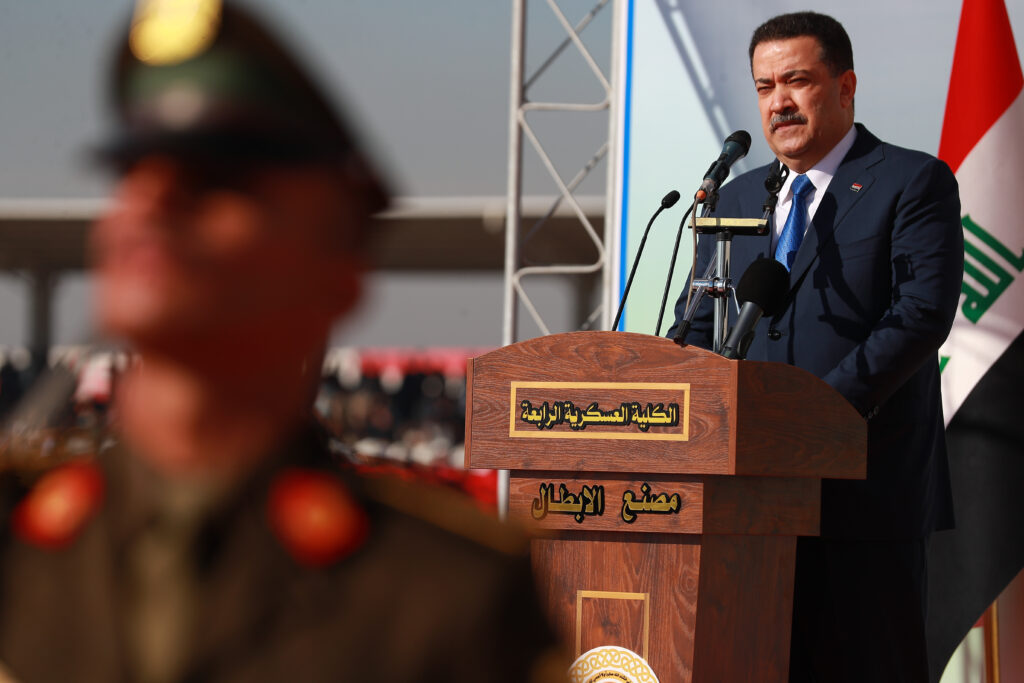
Image: Iraqi Prime Minister Mohammed Shia al-Sudani delivers his speech during the 105th Iraqi Army Day parade in Baghdad.