Russia’s most important Middle East base is not where you think
When Bashar al-Assad’s regime collapsed in December 2024, many analysts predicted that Russia was on the verge of losing the military infrastructure it had built up over the past decade. Moscow’s access to the strategically important Khmeimim Air Base and the Tartus naval facility appeared uncertain as new Syrian authorities reassessed foreign relations. Media reports told of Russia facing new restrictions and renegotiations with the new Syrian authorities that limited its freedom of movement.
This raised concerns among Western policymakers that Russia might shift its regional posture to Libya if its foothold in Syria unraveled, given Russia’s existing relationship with the Libyan National Army (LNA). Moscow has cultivated ties with LNA Commander Khalifa Haftar for nearly a decade to secure access to eastern Libyan territory and military infrastructure, turning Libya into a logistical hub for Russia to project power deep into Africa.
One year later, Russia’s situation in Syria appears better than many expected in the early post-Assad days. Russia has preserved a reduced but durable presence in Syria. High-level engagements between Russian President Vladimir Putin and Syrian President Ahmed al-Sharaa reaffirmed Moscow’s role in the country, and al-Sharaa publicly committed to honoring preexisting military agreements. The result is a more constrained footprint, but not one that represents a strategic loss.
While its plan B in Libya proved unnecessary, Russia nevertheless has spent the past year building up its logistical network in eastern and southern Libya. Serving as a transit hub, Libyan airbases give Russia the ability to reach deep into the African continent, where it seeds for instability with arms shipments and members of its Africa Corps—a Russian defense ministry-controlled paramilitary group and successor to the Wagner Group.
Why southern Libya became Russia’s new strategic platform
By late 2024, before its future in post-Assad Syria was determined, Russia was actively searching for alternatives for strategic relationships in the Middle East and North Africa. Flights from Syria to eastern Libya, movements of personnel and equipment, and diplomatic visits by Russian officials to eastern Libya were being reported, as concerns about Russia establishing a naval port in eastern Libya grew among Western leaders. A year later, Russia still has not secured a port in the southern Mediterranean, likely because Libya’s eastern authorities are unwilling to jeopardize improving ties with the United States, Turkey, and European partners by granting Moscow a major coastal facility.
Instead, Russia expanded inland in Libya. The Maaten al-Sarra airbase provides a key example. This strategically located airbase near the borders with Chad and Sudan is a staging point for Russia’s destabilizing operations across the Sahel. It predates the Assad regime’s collapse and is reportedly financed by the United Arab Emirates. But beginning in December 2024, Russian equipment, personnel, and Syrian fighters tied to the Assad regime began arriving at the desert airbase
Although Maaten al-Sarra is a key location in Russia’s southern Libya presence, Moscow uses multiple airfields as part of its transit corridor to the Sahel. These include the al-Khadim base in eastern Libya, the al-Jufra base in central Libya, the Brak al-Shati base near Sabha, and the al-Qardabiya base south of Sirte. Together, these dispersed locations form a resilient transit network connecting Russia’s foothold in Syria to its growing activities in the Sahel, increasing Russia’s ability to sustain Africa Corps deployments and arms supplies to its African partners. The inland network faces less international scrutiny, requires fewer political concessions from Libyan authorities, and gives Moscow access to remote corridors that support long-range logistical movements.
Countering Russia’s gains in Libya
Russia’s increased presence in Libya over the past year hasn’t gone entirely unchecked. The United States and its key international partners have sought to counter Russian activities and influence. This has primarily been through a strategy to accelerate military unification between eastern and western Libya, with promises of security cooperation and training. LNA Deputy Commander Saddam Haftar has been the main focus of these efforts to untangle the LNA from Russia’s hold.
In February, the United States sent two B-52H Stratofortress aircraft into Libyan airspace as part of a joint training with Libyan military tactical air controllers. In April, the US Navy conducted its first port call to Libya in over fifty years with stops in Tripoli and Benghazi. That same month, Ankara hosted a visit by LNA’s Saddam Hafter, and in August, the Turkish Navy conducted port calls to both Tripoli and Benghazi as well.
SIGN UP FOR THIS WEEK IN THE MIDEAST NEWSLETTER
On the sidelines of the UN General Assembly this September, the United States hosted a senior officials meeting on Libya. Participants included representatives from Egypt, France, Germany, Italy, Qatar, Saudi Arabia, Turkey, the United Arab Emirates, and the United Kingdom. The importance of Libyan east-west security integration was highlighted, as was the importance of modifying the UN arms embargo in January 2025, which enables joint training and technical assistance in support of east-west integration.
In October, United States Africa Command (AFRICOM) Deputy Commander Lt. Gen. John Brennan announced that Libya will participate and co-host part of the US military’s annual Flintlock exercise in the spring of 2026. Brennan commented that “this exercise isn’t just about military training; it’s about overcoming divisions, building capacity, and supporting Libya’s sovereign right to determine its own future.”
During the first week of December, AFRICOM Commander Gen. Dagvin Anderson met in Tripoli with Deputy Minister of Defense Abdulsalam Zubi and Chief of Staff Gen. Mohamed al-Haddad, as well as with Haftar and his son Deputy Commander Saddam Haftar in Benghazi. These discussions focused on maintaining regional stability, supporting Libyan efforts to unify military institutions, and US-Libya security cooperation, including Flintlock 26.
While these efforts by the United States and its partners have likely nudged along east-west military integration in Libya, it remains unclear if the strategy has done much to counter Russian activities or separate Russia and LNA leadership. Incentives, such as legitimacy and security cooperation, may be insufficient when used alone to try to pull the LNA away from Russia’s orbit. Economic sticks, such as targeted sanctions, may be required too.
Eliminating or greatly diminishing Russia’s use of Libya as a transit hub for its arms shipments and for personnel to flow into the Sahel would be a significant step toward promoting stability and ending conflicts on the continent. This would advance US President Donald Trump’s peacebuilding priorities, pushed forward over the past year by Senior Advisor Massad Boulos.
One year after the fall of Assad, Russia’s most important bases in the region may not be Khmeimim Air Base or the Tartus naval facility in Syria, but instead a handful of small air bases scattered across Libya. This represents a key front in Washington and its partners’ efforts to counter Russia.
Frank Talbot is a nonresident senior fellow with the North Africa Initiative at the Atlantic Council’s Rafid Hariri Center & Middle East programs. Previously, he served in the Department of State supporting stabilization initiatives in the Middle East and North Africa.
Further reading
Fri, Oct 3, 2025
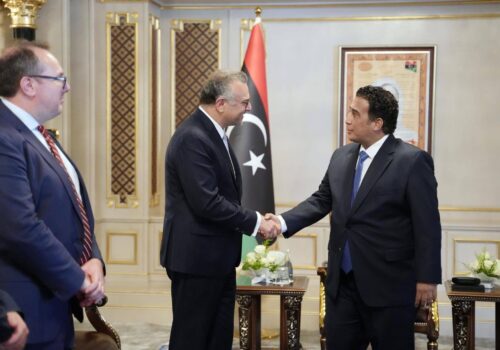
US, Italy, and Turkey alignment could push the needle in Libya
MENASource By
The US, Italy and Turkey can—through balanced diplomacy—reinforce the economic opportunities presented by institutional unification in Libya.
Wed, Apr 2, 2025
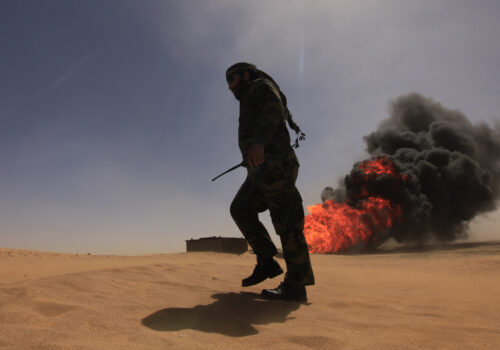
Libya’s political deadlock endures. There is a case for Trump and Meloni to challenge the status quo.
MENASource By
The political crisis in Libya is one that the US and Italy may be uniquely postured, and incentivized, to quell.

Tue, Nov 18, 2025
The Trump-MBS meeting comes at a pivotal moment for Vision 2030
MENASource By Frank Talbot
Saudi Arabia is looking to attract more international investors, keep supply chains running, and maintain a consistent stream of visitors.
Image: Russian President Vladimir Putin and Libyan military commander Khalifa Haftar attend a meeting in Moscow, Russia May 10, 2025. Sputnik/Gavriil Grigorov/Pool via REUTERS ATTENTION EDITORS - THIS IMAGE WAS PROVIDED BY A THIRD PARTY.