The United States remains militarily engaged in Syria, but in a narrow and increasingly fragile posture. A small contingent of US forces operates alongside local partners, focused primarily on counterterrorism operations against the Islamic State of Iraq and al-Sham (ISIS) and on preventing the group’s reemergence. The mission is deliberately limited: it is framed around counterterrorism rather than a broader Syria strategy, lacks a clearly articulated political end state beyond ISIS’s “enduring defeat,” and has persisted amid recurring debate in Washington—across administrations and in Congress—over its duration, legal basis, and strategic value.
Last week, the United States withdrew from al-Tanf Base, strategically located near the Syria-Iraq-Jordan border, and handed control to Syria. The move is a signal of the Trump administration’s inclination to disengage following the killing of two American soldiers in Syria in December.
But wars rarely end simply because we grow tired of them. For a US public deeply weary of overseas deployments, withdrawal may prove popular. Yet the danger is not simply that the United States may leave Syria; it is that it may leave at the wrong moment—mistaking exhaustion for strategy—and in doing so set the stage for a Libya-style unravelling.
Syria today is not Libya. The two conflicts emerged from different political systems, unfolded along different timelines, and produced different outcomes. But comparisons persist—not because the cases are identical, but because they share a set of structural risks that Libya exposed with brutal clarity.
There are reasons for cautious hope. Violence has declined from its peak, regional diplomacy has cautiously resumed, and parts of the country are experiencing a degree of stability unimaginable a decade ago. Some refugees are returning. Gulf states are exploring reconstruction and reintegration. Even global observers have begun, carefully, to note signs of improvement; The Economist, for example, pointed to Syria’s relative progress compared with recent years.
But Libya did not collapse overnight either. It drifted—slowly and predictably—into fragmentation when external pressure eased before internal cohesion took hold. Syria now sits at a similar inflection point.
Why Syria is not Libya—yet
Unlike Libya in 2011, Syria is not emerging from a complete institutional vacuum. When Muammar al-Qaddafi fell, Libya’s state effectively collapsed with him. Power had been highly personalized, formal institutions had been deliberately hollowed out, and there was no unified national army, bureaucracy, or political framework capable of absorbing the shock of regime change. What remained were militias, local power centers, and competing claims to legitimacy, with little institutional memory to anchor reconstruction.
Syria, by contrast, retains a battered but functioning state apparatus—administrative structures, defined borders, and a population long accustomed to centralized authority. That difference does not guarantee stability, but it does provide something Libya lacked: an institutional core around which consolidation is at least possible.
This distinction matters. Syria still has something to stabilize around—but it is not a permanent advantage. State institutions that are hollowed out or bypassed by armed actors do not gradually strengthen on their own; they erode in specific and predictable ways. Parallel chains of command emerge. Local militias assume policing, taxation, and dispute resolution functions. Civil servants answer to whoever controls territory rather than to a central authority. Over time, loyalty shifts from institutions to armed patrons, and the state’s claim to a monopoly on force becomes increasingly nominal.
This is why the difference between Syria and Libya is not one of destiny, but timing. Syria’s administrative core buys time, not immunity. If fragmentation hardens before authority is consolidated—if security integration stalls, if militias become permanent stakeholders, and if external actors continue to operate through proxies rather than institutions—Syria’s current advantages will narrow. Once parallel systems of power become entrenched, they rarely unwind peacefully. What remains then is not stability, but managed disorder—the condition that ultimately consumed Libya.
ISIS is weakened, not gone
The territorial defeat of ISIS in March 2019, when Baghouz—the group’s last territorial enclave—fell to the Syrian Democratic Forces with US support, was a real achievement. But dismantling a caliphate is not the same as dismantling a movement.
ISIS today is decentralized and opportunistic, operating through small, mobile cells that exploit gaps between competing authorities. It relies on assassinations, bombings, prison breaks, and extortion in Syria’s ungoverned spaces rather than holding territory outright. The group thrives not on controlling cities, but on the absence of sustained authority.
Libya offers a clear lesson: extremist groups do not require a vacuum everywhere—only somewhere. After the collapse of central authority in 2011, jihadist groups never needed to control the Libyan state as a whole to remain dangerous. Instead, they embedded themselves in neglected spaces—most notably in cities such as Derna and Sirte, in desert transit corridors, and around poorly governed oil and smuggling routes. Even after ISIS lost Sirte in 2016, its fighters dispersed into Libya’s south and into ungoverned border regions, sustaining insurgent activity through assassinations, extortion, and cross-border movement. Fragmentation, not total collapse, proved sufficient to keep extremist networks alive.
Syria’s patchwork of control—particularly in the east and south—presents precisely that risk. ISIS does not need to reconquer Raqqa to be dangerous. It needs only space, time, and unresolved security seams. Those conditions persist.
The risk of fragmentation
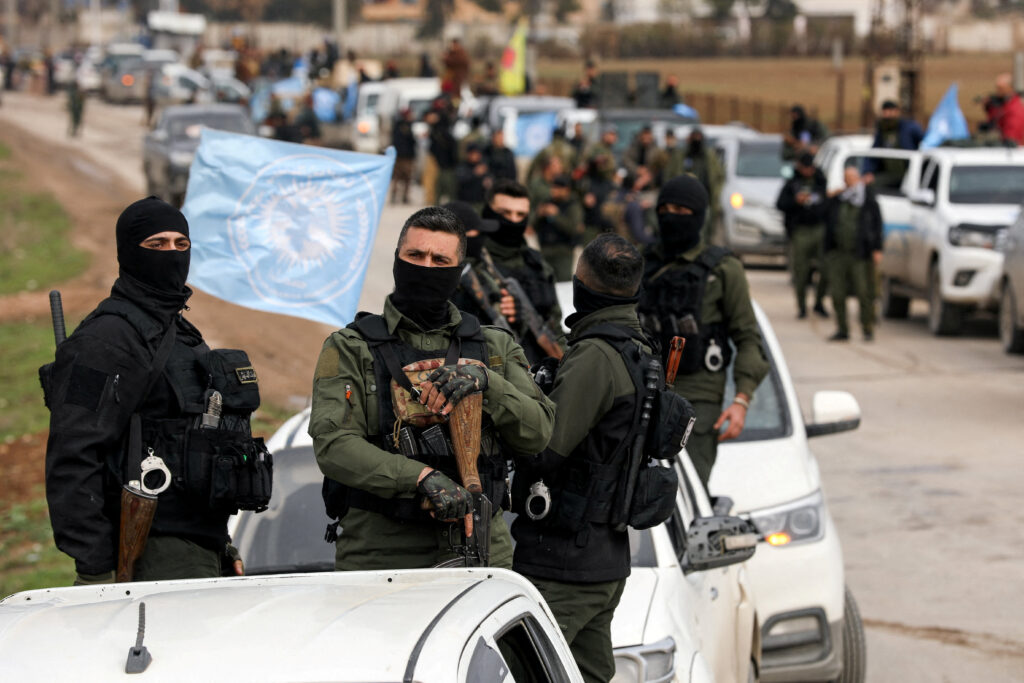
Libya’s defining failure was not regime change itself, but what followed: competing armed factions, weak national institutions, and no agreed monopoly on force. Syria remains vulnerable to the same dynamic. Multiple armed actors operate with overlapping jurisdictions, divergent external patrons, and incompatible political visions. Efforts to integrate forces—particularly in the northeast—remain fragile and incomplete.
In Libya, militias did not merely fill a security vacuum; they became political stakeholders with incentives to preserve disorder. Control over territory, checkpoints, and revenue streams translated into leverage, not responsibility. Syria risks a similar outcome if armed groups are tolerated indefinitely as semi-autonomous actors rather than integrated—or demobilized—under a unified national authority.
Whether Syria’s leadership can meaningfully incorporate Druze and Kurdish forces—especially after the degradation of much of the country’s strategic military hardware—will shape whether stability endures or erodes. Progress exists, but it is reversible. Without a credible, unified security framework, stability remains contingent rather than durable.
US patience—and “America First”—has a short fuse
In Washington, a limited troop presence is often described as sustainable. For the US public, it is anything but clear. An Ipsos poll conducted shortly after the fall of Bashar al-Assad in December 2024 found that only 41 percent of Americans supported keeping US troops in Syria to fight ISIS, while 50 percent expressed the view that Syria’s problems were “none of our business.” The desire to avoid “forever wars” now spans presidential administrations and political ideologies. This restraint reflects hard-earned lessons—but it also creates a dilemma.
Syria does not exist in a vacuum. It competes for attention in an already crowded strategic environment: Ukraine, China, inflation, and border security. That makes Syria vulnerable not because it matters less, but because it lacks a durable domestic constituency capable of sustaining long-term engagement. History suggests that exits driven by political fatigue rather than conditions on the ground tend to be rushed and poorly sequenced. Libya’s descent accelerated when international engagement faded faster than institutions could form. Syria risks repeating that pattern if political will collapses before the groundwork is laid.
Regional states are engaged, but cautious
Middle Eastern powers are not indifferent to Syria’s fate. Gulf states see stabilization as preferable to perpetual conflict. Turkey, Israel, and Arab governments all have clear stakes. But none are prepared to deploy large-scale ground forces to underwrite Syria’s security. Their involvement remains selective, interest-driven, and often conflicting.
Libya demonstrated what happens when regional competition substitutes for national cohesion. After 2011, external actors repeatedly backed rival factions rather than a unified national framework: Egypt, the United Arab Emirates, and Russia supported forces in eastern Libya, while Turkey and Qatar backed western-based authorities. These competing interventions hardened political and military divisions, undermined United Nations–backed reconciliation efforts, and transformed militias into proxies with external lifelines rather than incentives to integrate into a national state. Instead of converging toward a single authority, Libya developed parallel governments, rival security institutions, and a persistent contest over territory and resources. Regional competition did not stabilize Libya; it locked fragmentation in place.
Europe is focused elsewhere
In 2011, Europe played a visible role in Libya’s intervention but struggled to sustain influence once the fighting stopped. Since Russia’s invasion of Ukraine, European military resources, intelligence capacity, and political attention have been overwhelmingly concentrated on deterrence and support for Kyiv. There is limited appetite for sustained engagement in secondary theaters.
At the same time, Europe’s Libya experience exposed structural limits. European Union member states pursued divergent policies—France and Italy backed competing Libyan actors, while others prioritized migration containment over state-building—undermining the emergence of a coherent European strategy. The result was episodic diplomacy without the sustained security and institutional investment required to stabilize the country. Syria presents a similar risk.
What sequencing actually means
Avoiding a Libya-style outcome does not require “endless wars.” But it does require sequencing—and sequencing is not a slogan. In Libya, withdrawal and disengagement preceded the consolidation of authority, producing a fragmented state defined by parallel governments, rival security forces, and militias that outlived the transition and came to dominate political and economic life. Counterterrorism responsibility became diffuse, borders became porous, and external actors increasingly backed proxies rather than institutions.
A Libya-style outcome, then, is not total collapse but chronic fragmentation: a country with formal political processes but no effective monopoly on force, episodic violence punctuated by cease-fires, and a security environment in which extremist groups exploit gaps between competing authorities. Avoiding that path in Syria requires ensuring that security integration precedes withdrawal, that responsibility for counterterrorism is clearly owned by legitimate institutions, and that regional actors are aligned around containment rather than competition.
Libya’s lesson is not that the West stayed too long. It is that it left before responsibility had truly shifted. This approach does not reduce risk; it transfers it, often to less capable actors and eventually back to the United States itself.
None of this means Syria is doomed. The past year has shown that incremental progress is possible. Diplomacy, reconstruction discussions, and reduced violence matter. But Libya teaches that fragile gains can evaporate quickly when fragmentation hardens and external pressure lifts too soon.
Syria is not a lost cause. It is a conditional one. The warning signs are visible. The question is whether the United States chooses to learn from recent history—or repeat it under a different name.
Kurt Davis Jr. is a nonresident senior fellow with the Atlantic Council’s Scowcroft Middle East Security Initiative.
Image: Members of the Kurdish internal security forces stand at the back of a pick-up truck, as they head towards the front lines at the outskirts of the town of Tel Hamis, following the agreement between the Syrian Democratic Forces (SDF), and the Damascus government, which stipulates the withdrawal of the Syrian army and the SDF from the front lines, in Qamishli, Syria, February 13, 2026. REUTERS/Orhan Qereman