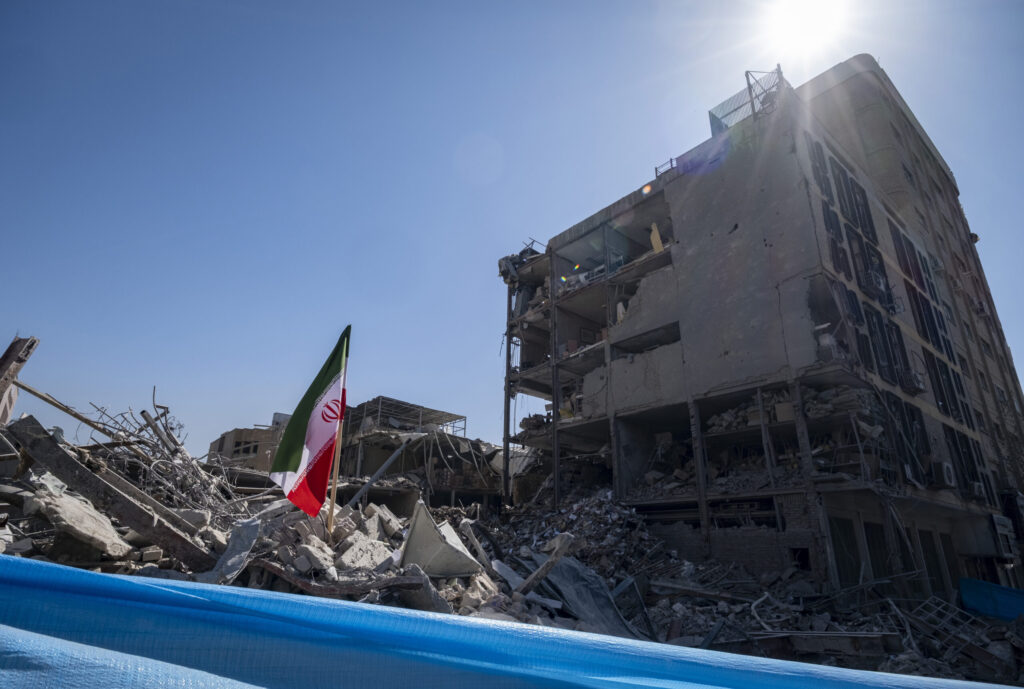
As US and Israeli warplanes and missiles began attacking Iran’s military and security infrastructure and senior leaders, both US President Donald Trump and Israeli Prime Minister Benjamin Netanyahu called for the Iranian people to seize the opportunity to rise up and overthrow the regime. Can a mass uprising bring the Islamic Republic down, especially after the death of Supreme Leader Ali Khamenei and other senior officials, and after days or weeks of sustained attacks destroy much of the regime’s security and intelligence apparatus?
On the surface, there would appear reason for optimism. Opposition to the clerical regime in Tehran has been growing for almost a decade. Massive protests erupted in 2017 and 2019 over poor economic conditions but quickly turned into calls by many protesters for the downfall of the government. And the Woman, Life, Freedom Movement, which roiled the country for months in 2022 and 2023 over the security forces’ killing of a young Kurdish woman for not wearing the hijab, featured demands to replace the Islamic Republic with a democratic government committed to protecting basic freedoms.
Many observers felt these protests had crossed the Rubicon in challenging the cleric-led regime’s legitimacy and calling its survival into question. But regime security forces eventually regained control by killing some 550 people, arresting tens of thousands, and maintaining heightened surveillance and the repression of suspected protest leaders and their families.
So, the massive protests that engulfed Iran in January were only the latest wave in growing opposition to the regime during the past decade. The despair of a population over a collapsing economy and a ruthlessly repressive and corrupt regime deaf to calls for change helps to explain why many Iranians are reportedly cheering the US and Israeli assault. But once the bombs stop falling, can the people rise up to oust what remains of the regime?
No one knows exactly what will follow once the US-Israeli strikes end, but a few considerations create grounds for questioning whether an uprising can succeed.
Any effort by the Iranian people to overthrow what is left of the current regime will have to deal with those who have the guns.
First of all, in none of the earlier protests has a clear leadership emerged that was able to inspire and organize followers and articulate a compelling vision of what could come after the mullahs are overthrown. Most of those with the courage to speak out against the regime are currently in prison or in exile, and the regime has been vigilant in preventing any coherent opposition organizations from developing.
Iranian leaders who previously mounted efforts to reform the Islamic Republic rather than overthrow it—such as former President Mohammad Khatami and former Prime Minister Mir-Hossein Mousavi, who led the Green Movement after the disputed 2009 election—have been suppressed or sidelined by the regime. They have been largely discredited in the eyes of younger Iranians, who are convinced that for real change to take place, the regime must go.
Outside of Iran, Reza Pahlavi, whose father, the shah, was ousted in the 1979 revolution, has emerged as a potential leader in a post-Islamic Republic government. He has been preaching a message of unity among those who oppose the regime and portraying himself as a potential leader if there were to be a transition to a government chosen freely by the Iranian people. During the recent protests, some demonstrators expressed support for Pahlavi’s return as leader once the current regime is gone. But Pahlavi’s supporters in the diaspora have a history of sowing division and seeking to intimidate other voices in the opposition, and it isn’t clear how much support he actually has inside the country. On Tuesday, Trump told Reuters that he had doubts about Pahlavi’s ability to lead Iran.
Several potential developments could complicate the picture of Iranians rising up to, as Trump put it, “take back their country.” Perhaps, as the regime and its security apparatus grow weaker, Iran’s ethnic minorities will seize the moment to press for greater independence. Kurds in Iran’s northwest, Baloch in the southeast, and Iranian Arabs in Ahvaz province in southwestern Iran have long sought greater autonomy and have at various times taken up arms to challenge the regime’s control.
Regime elites have remained unified in the face of past protests, including the latest uprising in January, and so far appear to be holding firm under the current onslaught from the United States and Israel. But there may soon be splits within the regime itself as security and political leaders scramble for survival and the reins of power. Such splits or defections could take the form of suing for peace to hold onto a remnant of power or trying to consolidate a hardline core of political, military, and religious leaders committed to riding out the current storm.
One thing seems clear. Any effort by the Iranian people to overthrow what is left of the current regime will have to deal with those who have the guns. No matter how devastating the effect of the US and Israeli attacks on Iran’s military and security structures and leadership, many Islamic Revolutionary Guard Corps (IRGC) leaders and rank and file are likely to survive and have a say over how things develop in Iran. The IRGC is deeply embedded in the current regime economically, politically, and militarily. Its remaining leaders, or a portion of them, will need to support any opposition leader or movement if it is to succeed. And for that to happen, remaining IRGC leaders will need to be convinced that the old order can no longer survive and the new regime being envisioned will serve their interests.
So can the Iranian people rise up and overthrow the current regime? Their success in doing so is likely to depend on the emergence of a unifying leader, an effective organization, and the ability of the opposition to gain the support of what remains of the IRGC.
Alan Pino is a nonresident senior fellow with the Scowcroft Middle East Security Initiative at the Atlantic Council’s Middle East programs. He previously served for thirty-seven years at the Central Intelligence Agency covering the Middle East and counterterrorism.
Further reading

Tue, Mar 3, 2026
Experts react: How the world is responding to the US-Israeli war with Iran
Dispatches By
We turned to our global network to explain how leaders in Europe, Asia, and Latin America are viewing the ongoing US-Israeli war against Iran.
Mon, Mar 2, 2026
The Gulf that emerges from the Iran war will be very different
Dispatches By Allison Minor
Iran’s decision to target the UAE, Qatar, Oman, Saudi Arabia, and other countries in the Gulf will have far-reaching consequences.
Sun, Mar 1, 2026
Experts react: How the US war with Iran is playing out around the Middle East
Dispatches By
What happens in Iran doesn’t stay in Iran. The consequences of the US-Israeli military campaign launched on Saturday will radiate across the region and the world.
Image: A national flag is photographed on the ruins of a police station that is struck during U.S.-Israeli attacks in Tehran, Iran, on March 3, 2026. (Photo by Morteza Nikoubazl/NurPhoto)